

AsianFin -- On the afternoon of last Saturday, Tencent's Yuanbao became the second most popular free app on the Apple App Store, following DeepSeek in first place and followed by ByteDance's Doubao.
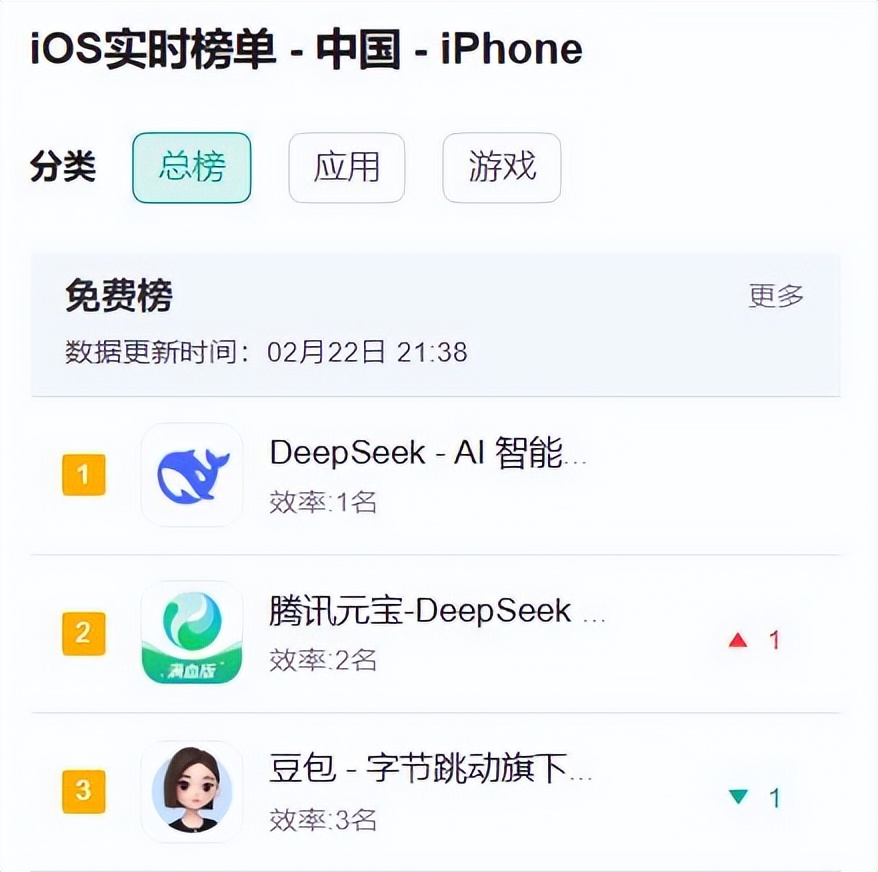
The main reason Tencent Yuanbao managed to stand out at this point is also reflected in the app's suffix—“DeepSeek R1…”
Initially, the integration of DeepSeek into WeChat search sparked significant discussion among users. When WeChat users opened the search box, they might not only see the R1 model but also a link recommending the download of Yuanbao.
Yuanbao might have increased its advertising efforts during this period, making “WeChat + DeepSeek” akin to the “red envelope” phenomenon for WeChat over a decade ago, becoming a powerful tool for Yuanbao to gain recognition among consumers.
In fact, in 2024, Tencent Yuanbao was almost unheard of among consumers. According to Qimai data, Tencent Yuanbao did not appear in the top 30 AI product rankings for 2024. The Tencent apps that made the list were Sogou Input Method and WeChat Input Method. Yuanbao's absence from the top 30 in annual cumulative downloads means that, across major app store platforms tracked by Qimai, ByteDance's Doubao had at least 20 times the cumulative downloads of Tencent Yuanbao in 2024.
In 2024, a year marked by the implementation of AI applications, Tencent and ByteDance, both giants in social media traffic, exhibited completely opposite states in their AI-to-consumer strategies. This was not only reflected in the download gap between Doubao and Yuanbao but also in their consumer product matrix: In the AI era, Tencent had no other notable consumer-facing new applications besides Yuanbao, whereas ByteDance was creating a comprehensive range of new AI-to-consumer applications.
This might be related to their product DNA—one excels at creating products, while the other excels at leveraging its business ecosystem to seize opportunities. Clearly, Tencent's Yuanbao has now encountered the opportunity presented by DeepSeek.
Following this shift, both ByteDance and Tencent have adjusted parts of their organizational structures related to AI business. Combined with the previously analyzed Alibaba AI to C structure by New Stance, the focus areas for AI to C over the next year for ByteDance, Tencent, and Alibaba have gradually become clear.
ByteDance and Tencent's Apps: Top Two in China in 2024 Before DeepSeek's Rise
As the parent companies of the largest social media platforms in China, ByteDance and Tencent have contrasting attitudes towards creating new consumer applications, akin to "ice and fire."
In the era of large models, ByteDance remains enthusiastic about creating new applications, while Tencent has consistently exercised restraint in creating new application ecosystems.
Looking at the current application matrix related to AI to C, ByteDance primarily has Doubao, Jianying, Feishu, Jimeng, Maoxiang, and Xinghui. Among these, only Jianying and Feishu existed before the era of large models.
Last year, there were various metrics for AI application traffic, but focusing solely on mobile platforms, ByteDance's AI applications dominated the largest traffic entry points.
According to Qimai's annual download rankings for AI applications, aside from "Jimeng," which was released in the latter half of the year, all the aforementioned ByteDance applications made it into Qimai's top 30 annual download list, with two even ranking in the top three. Although Jimeng did not make the list, it was once considered a competitor to OpenAI's Sora, securing a position in the AI video generation field.
ByteDance's products are making strides across the entire AIGC field. In contrast, last year, Tencent only had Sogou Input Method and WeChat Input Method, both released before the era of large models and in the same track. In recent years, most of Tencent's new consumer products can be seen as extensions of WeChat, such as public accounts, mini-programs, WeChat Work, video channels, WeChat Shops, and Yuanbao.
The Chatbots that made it to last year's mobile download rankings included Doubao, Kimi, Wen Xiaoyan, Tongyi, Zhipu Qingyan, iFlytek Spark, and Tiangong. Other major companies and a few unicorns had their Chatbots listed, but Yuanbao did not make it to the AI rankings and was not notable in the chatbot segment last year.
In between ByteDance and Tencent, there are companies like Baidu and Alibaba, which are in a relatively "middle ground" state.
In terms of AI to C, Baidu's Wen Xiaoyan last year was as "diligent" as ByteDance's Doubao. Both ByteDance and Baidu, dominated by their advertising businesses, were striving to launch the next killer app. Meanwhile, Baidu's Wenku and Baidu Input Method continued to make small-scale innovations within their existing product ecosystems, much like Tencent.
Starting this year, New Stance has conducted several reviews of Alibaba's AI to C business, revealing that its various AI applications are at different stages of development. Alibaba has pre-existing applications like Quark and DingTalk that have already captured the market before the era of large models, actively competing with ByteDance's Doubao and Feishu, and achieving notable success last year. However, the development of the Tongyi app last year was hesitant, similar to Tencent's Yuanbao. This hesitation might be due to the fact that both Tencent and Alibaba have strong positions in the AI industry chain beyond AI to C.
Specifically, Alibaba's hesitation with Tongyi is due to its organizational structure being "marginalized," while Tencent has an additional advantage with WeChat, a massive C-end traffic portal. Yuanbao might have been waiting for an opportunity to leverage a hot topic combined with WeChat to drive traffic to Yuanbao.
However, ByteDance's biggest advantage, C-end traffic, cannot be reused like Tencent's WeChat.
Douyin operates in the public domain, while WeChat operates in the private domain. Products focusing on public domain traffic primarily iterate through recommendation algorithms, and once the product components are finalized, any addition or removal of a component is considered a significant change to the user ecosystem. In contrast, products focusing on private domain traffic can freely combine internal components without affecting the overall user ecosystem. This explains why Tencent can continue to rely on WeChat's success, while ByteDance cannot solely depend on Douyin.
Just as WeChat can easily integrate DeepSeek and allow it to access UGC data within the platform, would Douyin integrate DeepSeek and allow access to its UGC data? This seems highly unlikely. In this regard, ByteDance seems to have suffered a silent setback from Tencent.
Moreover, ByteDance lacks advantages in both cloud business and model levels, while Tencent has sufficient advantages in almost every aspect, making it the closest to a hexagonal warrior in the AI era.
The inertia brought by WeChat might be the main reason why Tencent dares to wait for opportunities in the AI to C sector.
Two Giants' Adjustments to DeepSeek's Popularity
Based on the analysis of the advantages of each role, both ByteDance and Tencent have recently made corresponding adjustments to their organizational structures.
ByteDance, not particularly advantaged in AI technology, is increasing its internal influence on technology: According to a report from LatePost in January, ByteDance officially launched a research project codenamed "Seed Edge." The core goal of this project is to conduct long-term, foundational AGI frontier research beyond pre-training and large model iterations. Seed Edge has outlined five major research directions.
On February 21, self-media outlet Shen Xiaofei reported that former Google DeepMind Vice President Wu Yonghui joined ByteDance as the head of foundational research for the Seed large model team. Following his appointment, the team underwent a structural adjustment, with several algorithm and technology leaders who previously reported to Zhu Wenjia now reporting to Wu Yonghui.
Additionally, a report by Zheshang Securities at the end of 2024 indicated that after ByteDance's AI investment of 80 billion yuan in 2024, nearly matching the combined total of BAT (100 billion yuan), ByteDance's capital expenditure budget for 2025 will increase to nearly 160 billion yuan, primarily for AI computing power procurement and IDC infrastructure.
Perhaps seeing how DeepSeek and WeChat popularized Yuanbao, Tencent quickly made adjustments to integrate AI-to-C products: According to an exclusive report by "Intelligent Emergence," Tencent recently transferred more products and applications, including QQ Browser, Sogou Input Method, and ima, into CSIG (Cloud and Smart Industries Group).
This follows the transfer of Tencent Yuanbao from TEG (Technology and Engineering Group) to CSIG in January.
However, since ByteDance and Tencent represent two "extremes" in AI-to-C, their exploration of related organizational structures is not as in-depth as Alibaba's "middle ground" approach.
Regarding the relationship between technology, models, and C-end products, "New Stance" previously analyzed that Alibaba has reached a stage where it needs to consider "balancing the discourse power of technology, models, and application ecosystems."
After a year of being "sidelined" in 2024, the Tongyi large model led by Alibaba Cloud in internal To C business has, according to Huxiu, been clearly encouraged (or required) to engage in deep communication with Alibaba Cloud's Tongyi large model team. Each business unit within Alibaba's Taobao system is expected to quickly propose "requirements" to the Tongyi team to achieve AI transformation through collaborative models.
In terms of the relationship between C-end products, Alibaba has also made integrations ahead of Tencent.
In January and February, Alibaba undertook a structural reorganization, merging the Quark Tongyi C-end and Tmall Genie under the unified management of Wu Jia. They also brought in artificial intelligence experts to oversee the development of foundational models/solutions for applications, enhancing the end-to-end integration of models with applications.
These efforts are extending across major AI companies, and when engaging in AI to C, a key challenge is understanding the relationship between new and old applications, as well as the interplay between technology, models, and applications.
By 2025, will Tencent and ByteDance be able to identify where internal friction previously occurred and where efforts should now be concentrated, as Alibaba has? Given the established ecological advantages of these roles, exploring organizational structures might become a crucial factor in determining the progress of AI to C applications at major companies this year.
Of course, a brief moment in the spotlight does not equate to a decisive victory. While the release of Grok3 might temporarily allow Grok to surpass ChatGPT in rankings, we cannot definitively say that Grok has truly surpassed OpenAI in the minds of users.
Currently, netizens have summarized their perceptions of major AI applications: "Using AI feels like being a boss, with a foolish but diligent Doubao, a capable but inactive DeepSeek, a mediocre Kimi that offers no emotional value, and a ChatGPT that's too expensive to hire."
Whether these summaries are negative or positive, the fact that they have prompted widespread discussion among netizens can be considered a form of "victory."
Now, we can clearly see Baidu and Tencent Yuanbao vying for the user perception of a "fully powered DeepSeek." Who will ultimately win this battle, or how Tencent Yuanbao and other AI applications will further develop their general user perception in the coming year, is indeed worth anticipating.
Explore more exclusive insights at nextfin.ai.


