

AsianFin -- U.S. President Donald Trump on Wednesday threatened more hefty tariffs on Spain after the member state of the North Atlantic Treaty Organization (NATO) refused to raise defense spending as other members.
Credit:Xinhua News Agency
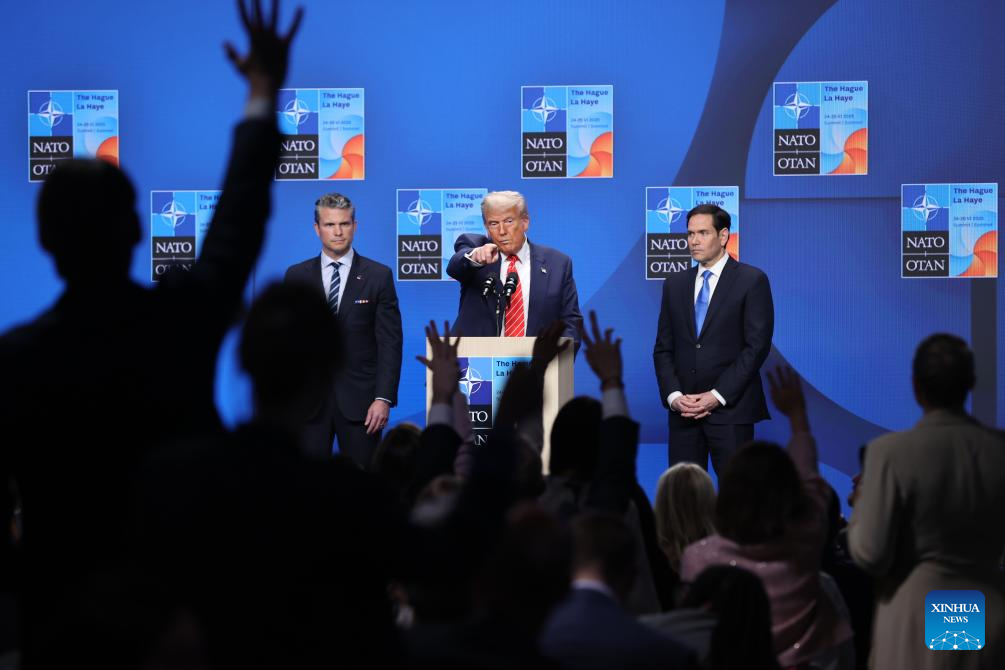
Trump at the NATO summit in The Hague vowed to slap “twice as much as” tariffs on Spanish imports. “You’re the only country that is not paying. I don’t know what the problem is,” he responded to a question about Spain balking at the latest NATO target of defense spending.
“You know what we’re going to do? We’re negotiating with Spain on a trade deal and we’re going to make them pay twice as much — and I’m actually serious about that. I like Spain … it’s a great place and they are great people, but Spain is the only country out of all of the countries that refuses to pay,” Trump said. “So, they want a little bit of a free ride, but they will have to pay it back to us on trade because I am not going to let that happen. It’s unfair,” he continued.
Trump made the remarks on the heels of a joint declaration issued on Wednesday following the high-level NATO summit. NATO members have agreed to raise their defense spending to 5% of gross domestic product (GDP) annually by 2035, according to the declaration.
NATO said in the declaration that it was “united in the face of profound security threats and challenges,” in particular the long-term threat posed by Russia to Euro-Atlantic security and the “persistent threat” of terrorism.
The five-paragraph declaration outlined that the new spending target will be split between two key categories: 3.5% for core defense and 1.5% for related areas, including critical infrastructure, networks, and defense industrial capabilities. The plan will undergo a review in 2029, taking into account the strategic environment and revised capability targets, the document added.
Trump hailed the agreement at a press conference after the summit, asserting that Washington had long carried more than its fair share of the alliance's defense burden. He publicly assaulted Spain for it was “terrible” that the southern European country would not commit to meet the new NATO spending target.
Madrid downplays Trump’s comments and emphasizes its commitment to NATO, a spokesperson for the government said. Spanish Economy and Trade Minister Carlos Cuerpo on Wednesday dismissed Trump’s tariff threat, according to Spanish news agency EFE. “The European Commission is in charge of negotiations on behalf of all EU countries, not just Spain,” Cuerpo said. “This negotiation is being made in the EU-U.S. framework.”
A Bloomberg report earlier Wednesday suggested the EU is readying retaliation if its trade negotiations fail to remove the baseline reciprocal tariffs imposed by the Trump administration.
The EU reportedly plans to hit U.S. imports including Boeing Co. aircraft with retaliatory tariffs if U.S. President Donald Trump sticks to a 10% baseline levy on the bloc’s goods. “We will need to retaliate and rebalance in some key sectors if the US insists on an asymmetrical deal,” the EU’s industry chief, Stephane Sejourne, told the news media outlet, including if the “outcome of the negotiations is that a 10% tariff remains.”
Spain has agreed with NATO to limit its military spending to 2.1% of GDP, Spanish Prime Minister Pedro Sanchez announced on Sunday, ahead of the NATO summit. In his Sunday statement, Sanchez called the 5% target "disproportionate and unnecessary" for Spain, emphasized that Spain is "one of the five NATO countries with the most troops deployed worldwide."
The prime minister warned that "rushing toward 5%" would lead to rising prices and public spending, and reduce investment in key sectors such as education and digital development.
Explore more exclusive insights at nextfin.ai.


