

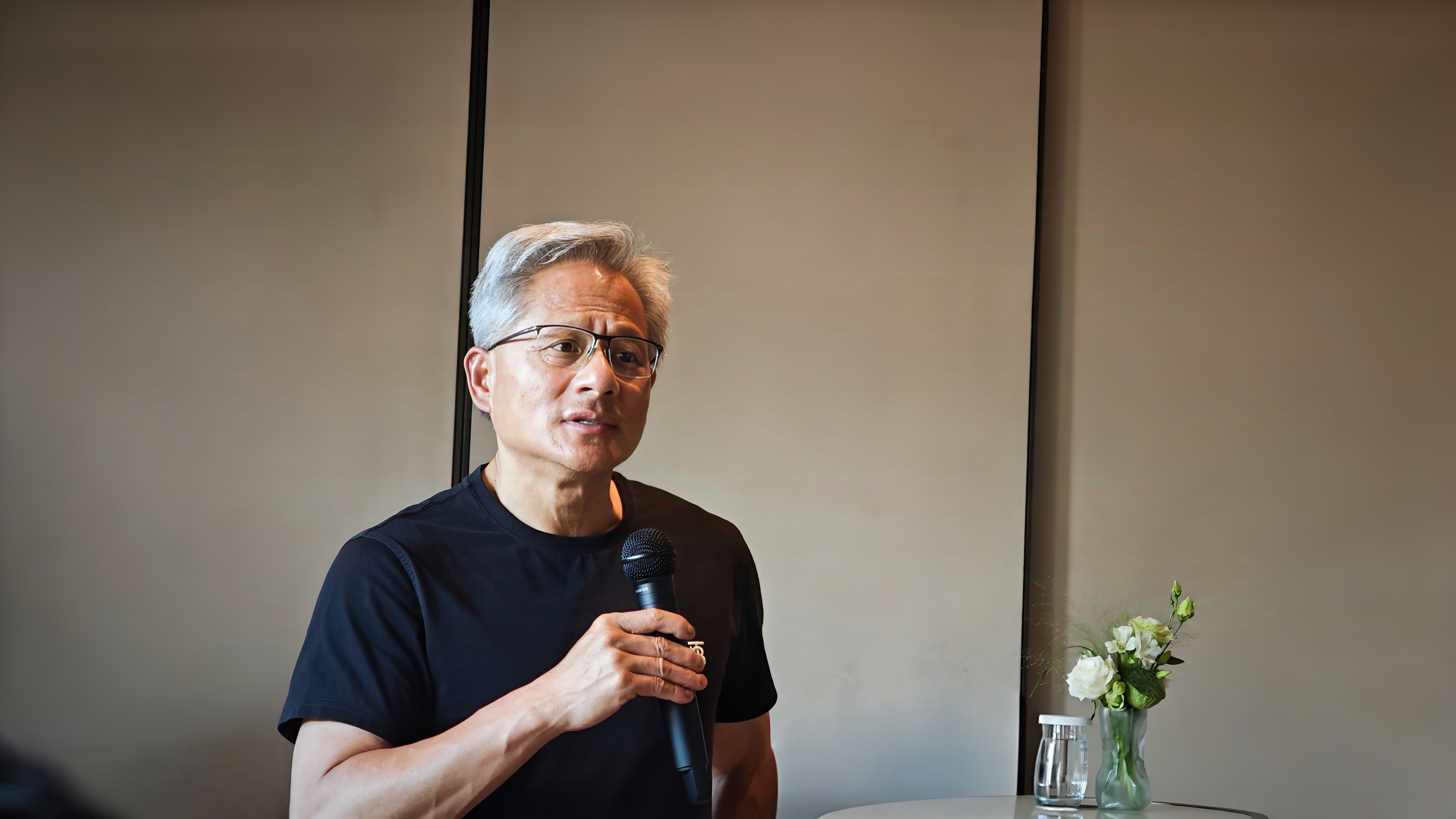
AsianFin -- Nvidia Corp. Chief Executive Officer Jensen Huang made a public appearance in Beijing this week, underscoring the strategic importance of the Chinese market to the world’s most valuable semiconductor company.
The visit—Huang’s third to China this year—coincided with a series of significant developments: regulatory approval for Nvidia’s H20 AI chip, an upcoming launch of the RTX Pro GPU, and a record-breaking market capitalization that pushed Nvidia past $4.1 trillion, surpassing Japan’s 2024 GDP.
For the first time, Huang set aside his signature leather jacket for a traditional Tang suit and addressed the audience partly in Chinese at the opening of the 3rd China International Supply Chain Expo. Later that day, he held a closed-door roundtable with more than 30 media outlets, where he laid out his vision for AI development in China, emphasizing the country’s rapid progress in large models, computing infrastructure, and real-world deployment.
Huang stressed China’s growing prominence in the AI sector, particularly in the development of foundational models and applied systems. He singled out DeepSeek for launching the world’s first open-source inference model—a breakthrough in the evolution of scalable and adaptable AI systems. The DeepSeek-R1, he noted, introduces a novel framework for reasoning and is emblematic of China's acceleration in model innovation.
China's strength, according to Huang, lies in its combination of talent density and a robust educational foundation. The country trains roughly half of the world’s AI researchers, and with its deep roots in mathematics and computer science, is now well-positioned to lead in applied AI. Companies like Alibaba, Kimi, and DeepSeek are advancing quickly in both model development and product integration, creating a rich ecosystem of innovation driven by intense market competition.
Navigating Regulatory Complexities and Supply Challenges
The green light for Nvidia’s H20 chip—developed specifically to comply with U.S. export controls—comes at a time of heightened scrutiny over AI hardware destined for China. While Huang characterized the H20 as well-suited for large model training, he acknowledged persistent supply chain uncertainties following previous order cancellations. Restarting production and meeting new demand remain open challenges.
On the RTX Pro GPU, Huang noted its design focus on digital twin simulations and robotics—key growth areas for Nvidia as it pushes deeper into enterprise and industrial AI use cases.
He also struck a pragmatic tone on platform openness, indicating that Nvidia does not oppose the development of CUDA-compatible alternatives, as long as they coexist with its own technologies. This stance reflects Nvidia’s strategy of defending its software moat while adapting to evolving developer ecosystems in global markets.
Deep Ties With China’s Tech Giants
Huang reflected on Nvidia’s three-decade history in China, tracing partnerships with Tencent, NetEase, and Xiaomi back to their earliest days. He expressed admiration for Xiaomi’s new electric vehicle and lamented that it is not available in the U.S. market. The company's close ties with Chinese tech firms continue to serve as a cornerstone of its strategy, particularly as AI becomes increasingly integrated into consumer applications.
Nvidia’s platform now supports more than 1.5 million developers in China, and leading firms such as Alibaba, Moonshot AI, and MiniMax are building open-source systems on top of its architecture. The resulting AI models are not just technically impressive—they offer commercial viability, allowing enterprises to build products and business models directly atop these technologies.
China’s AI Strengths in Robotics and Mechatronics
Looking ahead, Huang identified robotics as the next major AI frontier. He pointed to China’s unique position at the intersection of AI software, mechanical engineering, and large-scale manufacturing as a decisive advantage. These factors make China an ideal environment for deploying autonomous machines across industrial, consumer, and service scenarios.
The combination of advanced mechatronics, strong AI capabilities, and a deep manufacturing base could allow China to take a leadership role in the global robotics economy. As automation becomes a necessary response to global labor shortages, countries that can scale intelligent robotics will see disproportionate gains in productivity.
Addressing the broader geopolitical backdrop, Huang emphasized Nvidia’s role as a global technology provider. With AI in high demand across markets, governments are increasingly engaging Nvidia to better understand how its technologies can be deployed to serve national priorities. This dynamic creates both regulatory risks and policy influence opportunities for the company.
Huang downplayed the importance of which country or company has the "smartest" model, arguing instead that utility, efficiency, and adaptability will drive long-term value. He compared model performance to employee value—not about theoretical intelligence, but about practical effectiveness.
Personal Reflections on a Global Journey
Huang’s return to China was not without personal touches. He noted that Beijing would be his only stop on this trip—citing a desire to return home and reunite with his dog. The moment was symbolic of a broader theme: even as Nvidia transforms global industries, its leadership remains attuned to personal roots and cultural nuance.
Founded in 1993, Nvidia has spent three decades evolving from a gaming chip designer into a linchpin of global AI infrastructure. With technologies like CUDA and the DGX supercomputer, it has driven computing performance gains far exceeding Moore’s Law. Huang’s early delivery of a DGX system to OpenAI in 2016 presaged the generative AI boom now reshaping every sector from healthcare to transportation.
As Nvidia's AI ambitions scale, China remains an indispensable part of its global equation—both as a market and as a wellspring of innovation. And with Huang now stepping further into the spotlight in China, that equation appears more tightly bound than ever.
Explore more exclusive insights at nextfin.ai.


