

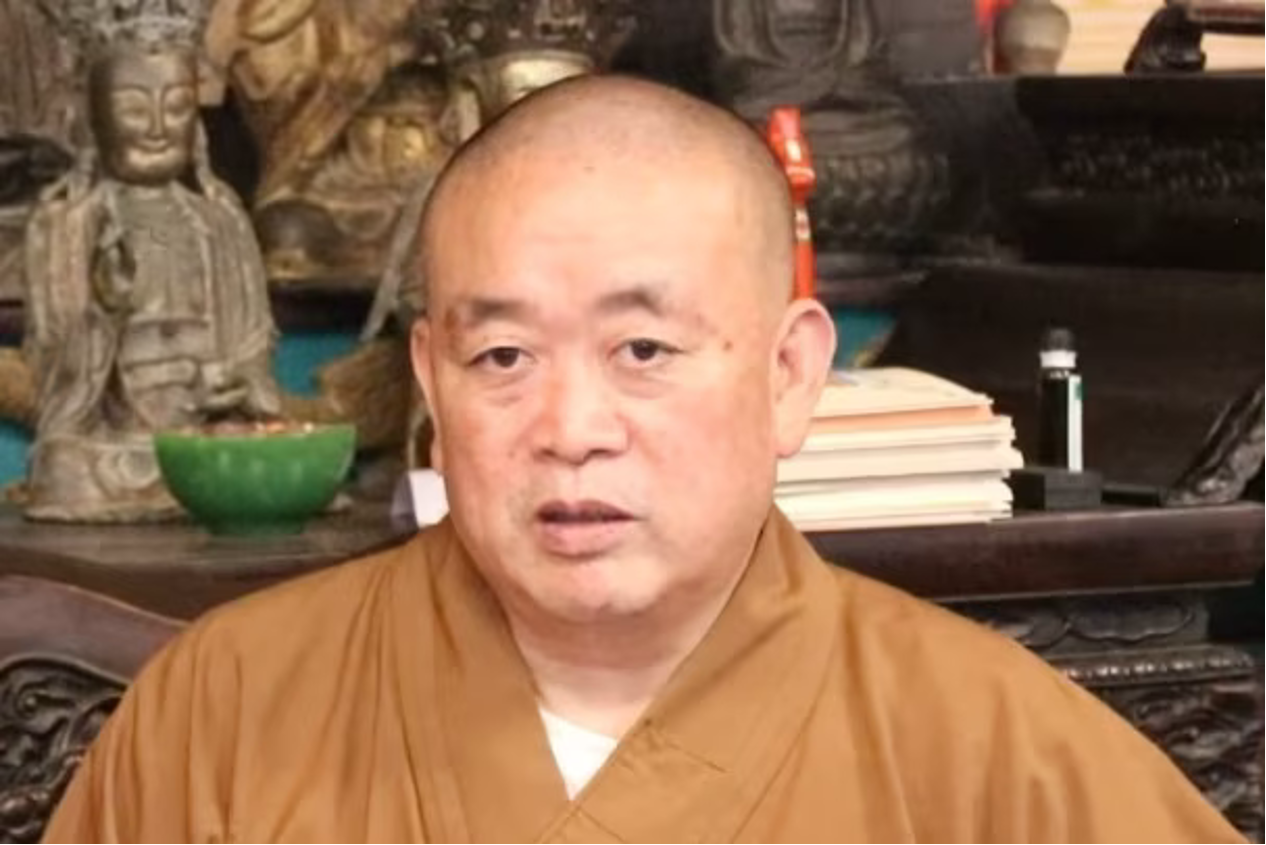
Shi Yongxi is being investigated by Chinese authorities
AsianFin-- China's renowned Shaolin Temple said Sunday that its abbot is under investigation on suspicion of embezzling temple assets and having sexual relationships with a few women, in about 10 years after the accusations were first posted.
Shi Yongxin, a controversial Buddhist monk for almost a decade in China, allegedly committed criminal offences and violated Buddhist precepts by maintaining relationships with women over a long period and fathering at least one child, according to a notice from the temple on its WeChat account.
Shi Yongxin, 59, was the deputy head of China’s Buddhist Association, the head of the provincial Buddhist Association and a deputy to the National People’s Congress, China's national legislature, from 1998 to 2018. In addition to being actively involved in politics, he was also known as a “monk CEO,” running business activities associated with the trademark and brand of “Shaolin” across China and overseas.
The notice said findings from the investigation would be announced in due course.
An online notice by Kaifeng Police claiming that Shi was intercepted on the border when he was attempting to flee to the U.S. with several mistresses and 21 children was dismissed as fake by the police.
The news immediately went viral online given that the accusations were in the shark contrast with a monk’s image and they were nothing new. Shi Yongxin had been accused of such offenses and misconduct since 2011. However, he had survived the scandals again and again, remaining unscathed.
In 2011, news about Shi Yongxin being arrested for prostitution was spread online. The management commission of the temple asked Dengfeng police to investigate the negative publicity.
In October 2011, online rumors claimed that Shi Yongxin had at least 3 billion dollars in overseas bank accounts and had villas in the U.S. and Germany. He had an affair with a female graduate of Peking University and had a kid with the graduate and they both lived in Germany. Shaolin Temple issued a statement, saying that the allegations were baseless libel.
In July 2015, a person who claimed to be Shi Zhengyi, a monk of Shaolin Temple, posted an article online titled “Who is to Supervise Shaolin Temple Abbot Shi Yongxin, the Corrupt 'Tiger'?” Shi Zhengyi said Shi Yongxin had relationships with a number of women and he had two national ID cards, which was against the law. The temple responded by saying the charges were vicious fabrication and insults. In November, provincial authorities released the findings, saying that Shi Yongxin had no kid.
Shi Yongxin, whose original name is Liu Yingcheng before he joined the Shaoxin Temple in Henan province in 1981 at the age of 16, came from a poor rural region in neighboring Anhui province. In 1982, Shaolin Temple, a movie featuring martial arts superstar Jet Li, was released, captivating hundreds of millions of young people across China and making the temple a mecca for them. In 1984, Shi Yongxin became the assistant to the abbot. In 1999, he became the abbot of the temple. Shi Yongxin oversaw the transformation from being a temple with over a dozen of monks farming to feed themselves to a temple with massive cash flows from Kong Fu shows, Kong Fu schools, and admissions tickets. Criticisms came with the temple’s huge commercial success and Shi Yongxin was ridiculed online by many for allegedly being indecent and corrupt.
Reputation of the Temple Hangs in Balance
Beyond being a religious institution and the birthplace of Shaolin kung fu, the temple is also a cash cow for the local government. The temple received 4.2 million visits in 2017, generating revenues of 500 million yuan (about 69.4 million dollars) from selling admission tickets. Other business activities, including martial arts training and shows, mementos, books, food related to the temple, generated 700 million yuan (about 90 million dollars). The revenues from the admissions were spit between the temple and the local government, with 30% going to the temple and 70% to the government. Shi Yongxin received a $130,000 car from the local government for his contribution to the tourism business in the region. The temple charged as high as over 100 dollars per hour for “experience camp” while burning incense for Buddha could be as costly as 100,000 yuan (about 13,888 dollars) per time.
As of 2022, the temple had 706 trademarks approved by the authorities, covering instant food, lamps, accommodation, feeders, jewels and drinks. In addition to authorizing the use of the trade mark to movies, games and food, the temple also entered the health and wellbeing sector. In 2003, Shi Yongxin set up a Shaolin pharmaceuticals department, developing drugs based on traditional recipes. By 2019, the revenues from the sale of drugs exceeded 80 million yuan (about 11 million dollars).
In April 2022, a commercial land lot in Zhengzhou, the capital of the province, was for auction. Later, the lot was acquired by a subsidiary of a company controlled by Shi Yongxin. The lot will be used for the development of a five-star hotel and high-end condos, which triggered controversy of a religious institution being involved in commercial property development.
The authorities explained that the use of the lot was for the purpose of cultural exchange. However, the public believe the temple has gone too far, saying that “a business plan was hidden in the abbot’s outfit.“ In 2022, the temple was accelerating its global expansion. Shi Yongxin has met with a host of world leaders, including Russian President Vladimir Putin and the late Queen Elizabeth II.
The temple has also embraced the internet and e-commerce. In 1997, Shi Yongxin had introduced China’s first website of a temple, far earlier than the creation of Sina, Sohu, Netease and Tencent. In 2008, the temple set up a store on Taobao, an outlet of Alibaba, selling materials for practicing religion. By 2015, the annual sales hit 23 million yuan. In 2021, the temple created an account on Douyin, the sister app of TikTok, gained over 10 million followers within six months and sold over 50 million yuan in the debut liveselling show.
The temple’s martial arts group offered 200 performances annually across the globe since their first show in Buckingham Palace in Britain. One show can generate up to 500,000 dollars now from 100,000 dollars in early years. It also set up cultural centers in over 40 countries and regions, forming an extensive network.
In over four decades, the temple has gone from barely feeding its monks under a leaky temple roof to a corporation under the supervision of Shi Yongxin. Now with the probe by Chinese authorities into the abbot, the reputation of the temple is in jeopardy.
(Author: Ma Jinnan; editor: Chelsea Sun)
Explore more exclusive insights at nextfin.ai.


