

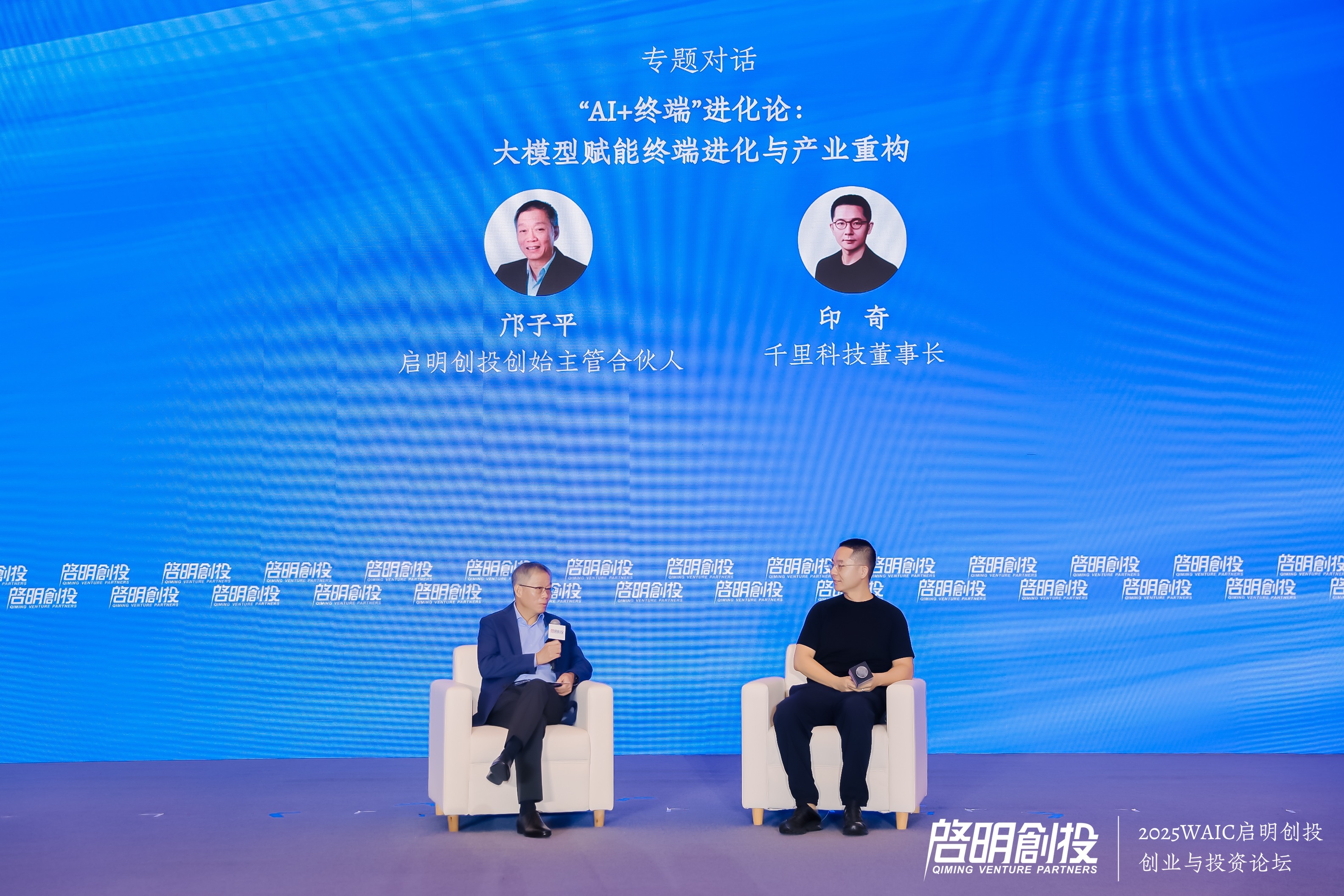
Duane Kuang, Founding Managing Partner of Qiming Venture and Yin Qi, Chairman of Qianli Technology
AsianFin -- If core elements such as technology, product, or commercialization are not sound, companies risk moving quickly in the wrong direction, said Yin Qi, Chairman of Qianli Technology and co-founder of facial recognition giant Megvii. He emphasized that without a business model that forms a closed loop, sustaining technological progress is unlikely.
Yin, who rose to prominence as a “CV Four Dragon” pioneer, made the remarks at the 2025 World Artificial Intelligence Conference in Shanghai, in a fireside dialogue with Duane Kuang, Founding Managing Partner of Qiming Venture Partners.
He challenged a long-cherished Silicon Valley mantra: “Entrepreneurship is like jumping off a cliff and assembling a plane on the way down.” That mindset, he argued, no longer holds in today’s capital- and compute-intensive AI landscape.
Yin, now steering Qianli Technology, said he’s laser-focused on embedding AI in consumer hardware—especially smartphones and vehicles. He forecast two major trends: AI operating systems will undergo a paradigm shift within 12 months, and the line between hardware and AI services will blur as terminals evolve into full-stack intelligent agents.
“We’ll move from human-controlled devices to human-machine collaboration,” said Yin. “That means the form factor of hardware will become secondary. What matters is the AI agent service it enables.”
In his view, AI terminals will diversify before reconsolidating around dominant formats—offering opportunities for both Big Tech incumbents and startups in sectors ranging from auto interiors to smart homes.
Kuang echoed Yin’s structural view, calling 2025 the start of a “cycle of resonance” where rapid model development is now matched by practical deployment and cost-efficient scaling.
“In 2025, we’re seeing technology and application finally sync,” Kuang said. “The roots are in place, and the tree is starting to grow.”
According to Qiming’s 2025 AI Outlook, the next 12 to 24 months will see surging token consumption across multimodal models and AI agents, with token-cost optimization emerging as a key infrastructure battleground.
Yin acknowledged that while the U.S.–China model development gap has shrunk to roughly six months, the real divergence lies in resource input.
“The U.S. is investing far more compute into original breakthroughs,” he said. “China is more pragmatic, more trend-following.”
Still, he expects China to play a more critical role in the global open-source ecosystem—even if U.S. firms continue dominating proprietary innovation.
Yin described the evolution of AI across two axes: horizontally, through learning paradigms—from imitation to reinforcement to autonomous learning; and vertically, from language models to multimodal and embodied world models. He predicted the reinforcement learning phase would last through at least mid-2026.
Reflecting on his journey from Megvii to Qianli, Yin stressed the importance of business viability in foundational model companies. He challenged founders to justify annual compute investments of 2 to 3 billion yuan with realistic five- to ten-year ROI scenarios.
“Bold assumptions are okay, but you must return to common sense,” he said. “The flywheel has to turn.”
He categorized two types of “flywheels”: one close to consumers with immediate feedback loops, and another, slower-moving but with massive potential—like foundational models.
Yin voiced skepticism about pure AI software startups breaking through in China’s hyper-competitive landscape dominated by Tencent and ByteDance.
“Everyone’s watching this space,” he said. “It’s hard to sneak in unnoticed—unlike the early days of the mobile internet.”
Instead, he sees more upside in integrated AI hardware. As an example, he pointed to Xiaomi’s successful bundling of foldable phones with photo printers, forming what he called a "closed-loop AI service."
Looking ahead, Yin said operating systems—especially Android—will become key distribution platforms for AI agents. If products like Google’s Gemini roll out widely across Android phones, their daily active users could reach 300 million globally.
He anticipates a coming convergence between AI operating systems, services, and hardware—arguing that hardware will serve primarily as commoditized “carriers” for differentiated AI agents.
Yin proposed a framework for evaluating hardware opportunities: person (smartphones, wearables), car (intelligent driving, cockpits), and home (embodied AI scenarios).
He expects massive shipments—exceeding 50 million units annually—in this “person-car-home” ecosystem. Meanwhile, Qiming is betting on hardware subcategories with 1–5 million units shipped annually.
Despite the hype, Yin urged AI founders to balance vision with structure.
“Without a strategy that connects tech, product, and revenue, you’re just building in the dark,” he said.
This article first appeared on TMTPost App. Adapted and edited for Bloomberg-style reporting.
Explore more exclusive insights at nextfin.ai.


