

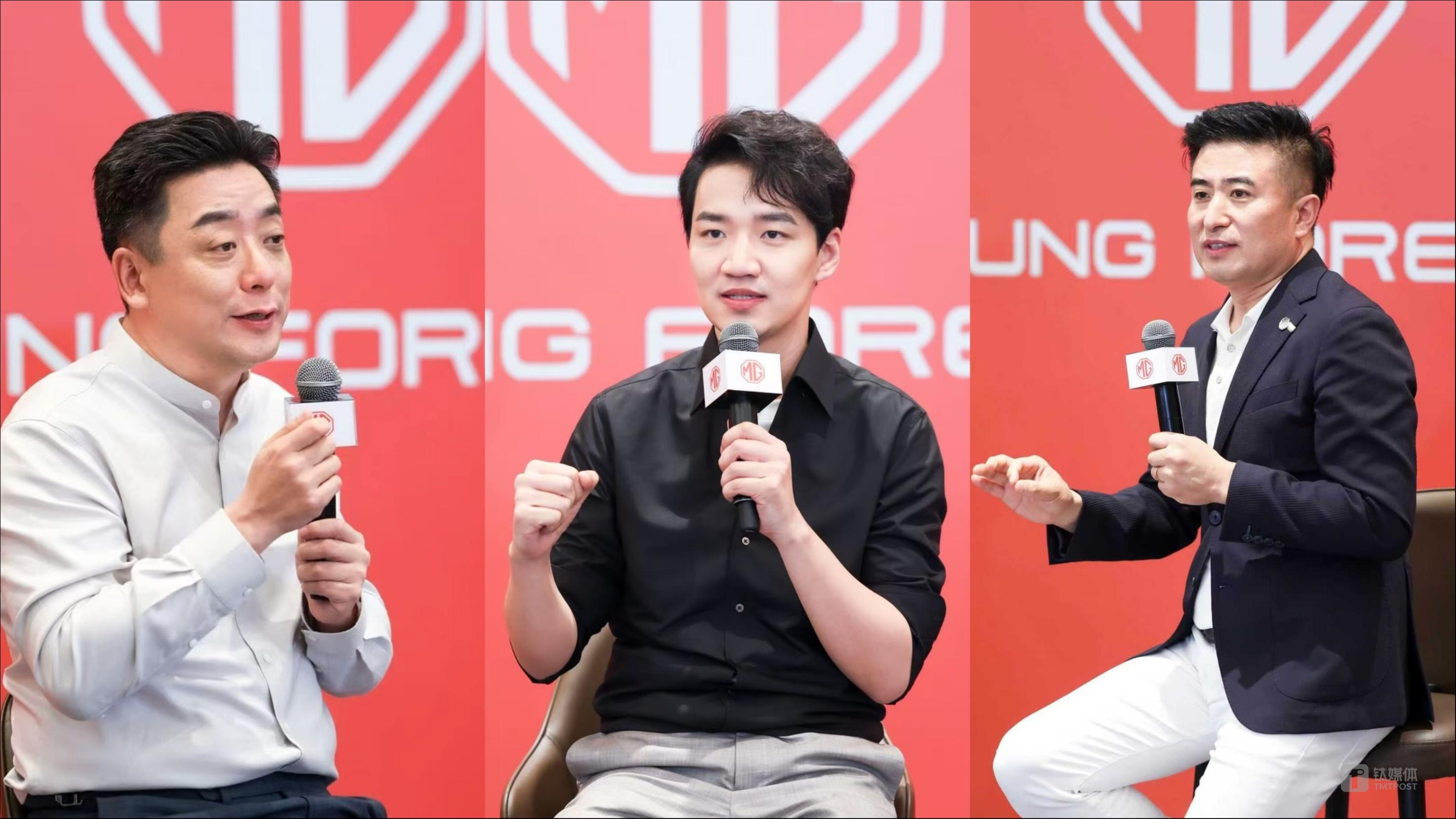
Left: Yu Jingmin, Executive Deputy General Manager of SAIC Motor Passenger Vehicle Company; Center: Chen Cui, General Manager of MG Brand Division, SAIC Motor Passenger Vehicle; Right: Shao Jingfeng, Chief Designer of SAIC Motor Innovation and R&D Headquarters and General Manager of SAIC Motor UK Technical Center
AsianFin -- In China’s increasingly competitive new energy vehicle (NEV) space, the pure electric hatchback market in the 100,000-yuan segment has long been dominated by a few key players, with BYD’s Dolphin holding the crown thanks to consistent monthly sales of over 20,000 units. Now, SAIC-owned MG is looking to shake up that landscape.
On August 5, MG officially kicked off pre-sales for its all-new MG4, a strategic model carrying a starting price of 73,800 yuan, a maximum CLTC range of 530 kilometers, and what the company calls the world’s first mass-produced semi-solid-state battery. The model is designed to spearhead MG’s “All in New Energy” push—its most ambitious effort yet to grow market share at home and abroad.
The MG4’s role is twofold: first, to bring cutting-edge intelligent technologies into a mainstream price bracket, and second, to serve as a truly global product capable of winning over customers in both domestic and overseas markets. For SAIC Motor, China’s largest automaker, it’s also a litmus test of whether MG can bridge its stark performance gap between international and domestic markets.
Globally, MG has been a success story. The brand now operates in over 100 countries and regions and has posted solid growth despite trade headwinds. In 2024, even under the weight of EU tariffs and global supply chain disruptions, MG shipped more than 243,000 vehicles overseas. The momentum has carried into 2025, with overseas sales hitting 153,100 units in the first half—a year-on-year jump of 18.6%. By contrast, Tesla’s overseas deliveries in the same period fell 33.2%.
But at home, the picture is less rosy. In the first five months of 2025, MG sold just 42,800 units in China, less than a quarter of its full-year target of 180,000. For Wang Xiaoqiu, SAIC Motor’s chairman, this domestic underperformance undermines MG’s global narrative. “If MG underperforms in the domestic market, then even if it leads in global sales, it can hardly be called a ‘global brand led by the Chinese,’” he has said.
To close that gap, MG is entering an aggressive product rollout phase. Between 2025 and 2026, it plans to launch four new or refreshed models each year. Two flagship models—a coupe and a top-end sedan—are slated for 2026, with the goal of breaking the symbolic “10,000 units per month” barrier. By 2027, MG expects to have a seven-model core lineup in place.
The MG4 is the first strike in that offensive, targeting what may be the toughest battleground: the A-segment pure electric hatchback market. Here, entrenched rivals include the BYD Dolphin, Geely Xingyuan, Aion UT, and Volkswagen ID.3. In this crowded space, MG is not aiming to simply match specs and slash prices. “We benchmark ourselves against outstanding products in the market, striving not just to match them, but to surpass them,” said Chen Cuizhan, MG’s general manager.
MG believes it can stand out by focusing on three user priorities: space, range, and safety. The MG4 leverages proprietary technologies such as integrated thermal management, CTB (Cell-to-Body) construction, and semi-solid-state batteries. The thermal management system ensures battery stability in extreme temperatures, addressing winter range anxiety. The CTB design enhances body rigidity while freeing up cabin space, tackling one of the key complaints about the previous MG4. The semi-solid-state battery, due for delivery later this year, is expected to set new benchmarks for safety and low-temperature performance.
“These are advantages our competitors don’t have,” Chen said. “They form the core barriers that differentiate our product and represent the MG4’s competitive strengths.”
MG is pairing these features with an aggressive pre-sale price. Chen is confident that 73,800 yuan offers compelling value, signaling MG’s determination to gain market share quickly without compromising quality. “We need to show customers our strength and determination,” he added.
The timing is critical. The 100,000-yuan EV segment is shifting from feature-stacking to a focus on deeper technology integration. The Dolphin appeals as a mass-market commuter. The Geely Xingyuan has bet on feature leapfrogging. MG’s differentiated path centers on solving core pain points with proprietary technology and targeted investment.
However, executing that strategy will not be easy. The first challenge is translating technical terms like “semi-solid-state battery” into benefits that consumers can understand and value. The second is reshaping MG’s domestic brand image so Chinese buyers view it as more than a cost-effective global export brand. Third, the company must respond to China’s fast-changing, fragmented consumer tastes as it rolls out its new lineup. And finally, MG’s sales and service network must deliver a customer experience that matches its technology-forward positioning.
For SAIC, the MG4’s domestic performance will be more than just a test of a single model—it will be a barometer for whether MG’s international momentum can be replicated at home. In the world’s most competitive EV market, winning over local buyers could prove even harder than conquering overseas markets. But if the MG4 can break through, it might just pave the way for MG’s long-awaited resurgence in China.
Explore more exclusive insights at nextfin.ai.


