


AsianFin -- The rise of humanoid robots and solid-state batteries has captured investors’ attention in 2025, even as technological refinement and large-scale commercialization remain works in progress.
According to data from Choice, since June, the A-share solid-state battery sector has surged 45.7%, far outpacing the Shanghai Composite Index’s 16.3% gain and the Shenzhen Component Index’s 29.9% rise. Humanoid robots, meanwhile, climbed 34.4% during the same period, signaling a growing enthusiasm for these cutting-edge concepts.
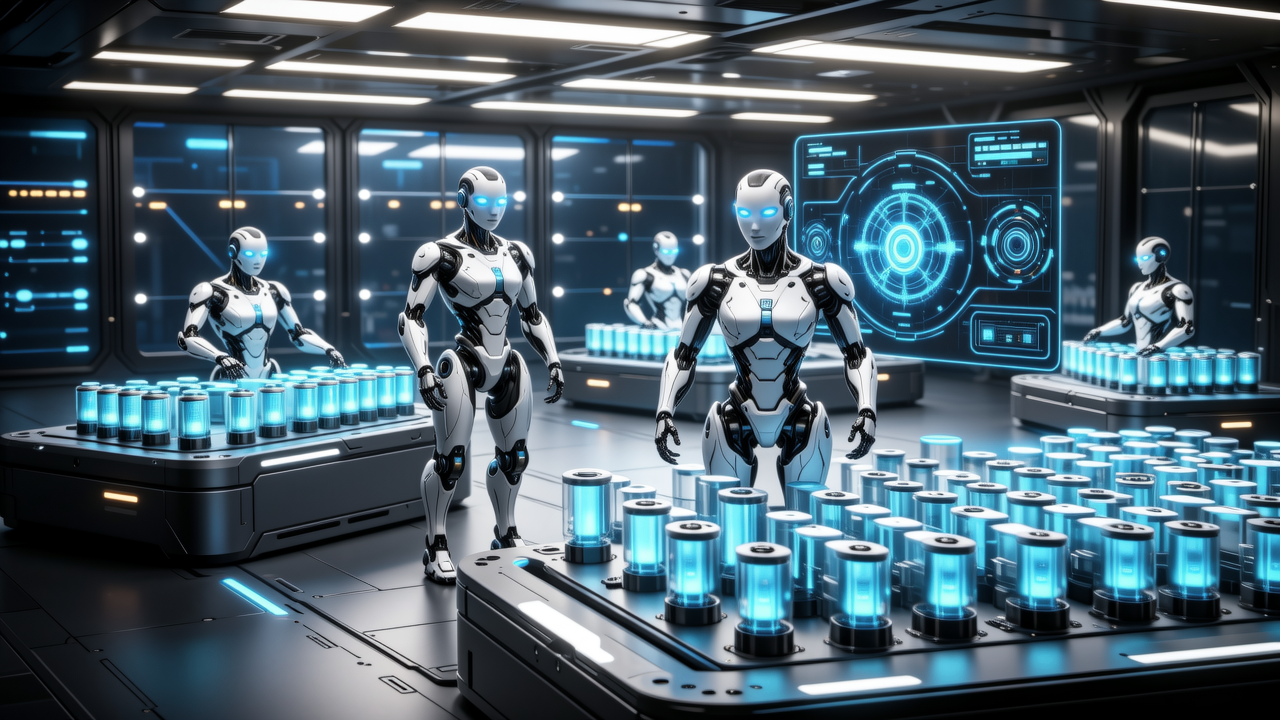
AI-generated image
Market sentiment around these sectors has been fueled in part by bold forecasts labeling 2025 as the “first year of humanoid robot commercialization” and the “first year of mass production for solid-state batteries.” While such predictions are often aspirational, they reflect the growing confidence of institutional investors and the frequency of corporate announcements in these areas. Analysts caution, however, that expectations may be getting ahead of reality, as both sectors still face significant technical challenges.
Currently, much of the industry’s attention is focused on the timeline for vehicle integration of solid-state batteries. But a report from GF Securities in August suggested that China’s solid-state battery market may see explosive demand first in emerging applications such as low-altitude aircraft and humanoid robots. Similarly, Guotai Haitong Securities highlighted that solid-state batteries, with their high energy density and superior safety, are rapidly progressing from experimental prototypes toward industrialization. In cost-insensitive sectors such as robotics and low-altitude flight, adoption may precede vehicle integration, creating new growth opportunities.
Leading lithium battery manufacturer EVE Energy has capitalized on the solid-state battery trend, with its stock soaring nearly 83% since August. In early September, the company inaugurated its Solid-State Battery Research Institute’s Chengdu mass production base. The first phase is scheduled for completion by December 2025, with an ambitious goal of delivering 100 MWh of annual production capacity for its 10Ah all-solid-state battery, “Longquan No.2,” by December 2026. The product is primarily aimed at high-end applications including humanoid robots, low-altitude aircraft, and AI devices.
Industry insiders noted that EVE Energy has invested heavily in both research and production of solid-state batteries, ranking among the top traditional lithium battery companies in this field. Historically, the company’s focus had been on hybrid vehicle applications, with plans to launch pilot lines in 2025, release a 1.0 product in 2026, and introduce a higher-performance 2.0 version in 2028. The recent pivot toward humanoid robots and low-altitude aircraft aligns closely with market enthusiasm and investor sentiment, suggesting that EVE Energy is responding to immediate opportunities in emerging technology sectors.
In terms of technical specifications, EVE Energy had previously set an energy density R&D standard of 400 Wh/kg for hybrid vehicle applications. Its June 2025 announcement at the 2nd Lithium Battery Conference indicated a planned 2026 1.0 battery with 350 Wh/kg energy density and volumetric energy density of 800 Wh/L. The newly announced Longquan No.2 battery offers 300 Wh/kg and 700 Wh/L, reflecting a shift in focus from vehicle performance benchmarks to robotics and low-altitude flight requirements.
The trend is not unique to EVE Energy. Companies spanning both consumer and power battery sectors have demonstrated greater agility in adapting solid-state batteries for emerging markets such as humanoid robots and low-altitude aircraft. Farasis Energy, for example, recently reported that its first-generation sulfide all-solid-state battery achieves 400 Wh/kg, enabling continuous operation of humanoid robots for 8–12 hours—well above the industry average of less than two hours. Samples have already been sent to leading humanoid robot enterprises, highlighting the growing commercial readiness of these batteries.
Market research supports the optimism surrounding robotics applications. A Frost & Sullivan study projects that consumer batteries for robotics will grow at a compound annual growth rate (CAGR) of 39.1% from 2025 to 2029, comparable to automotive electronics (39.6%), higher than data centers (35.7%), but below low-altitude aviation (75.5%). The combination of humanoid robots and solid-state batteries could introduce new dynamics to the competitive landscape, with the potential to reshape both technological trajectories and market positioning.
However, industry observers caution that repurposing solid-state batteries originally designed for vehicles for use in robotics and low-altitude aircraft, while technically feasible, carries practical uncertainties. A management executive from a hydrogen fuel cell company told Barron’s China that while weight adaptation for smaller, high-mobility platforms is straightforward, predicting stable demand remains challenging. Low-altitude aircraft manufacturers and robotics companies often test new energy solutions, but fragmented demand complicates scaling production lines for mass manufacturing.
Despite the uncertainties, enthusiasm for solid-state batteries and humanoid robots is unlikely to wane. Corporate investment, institutional research, and media coverage continue to generate momentum, suggesting that these emerging sectors may redefine expectations for energy storage and robotics performance. Analysts emphasize that while breakthroughs in energy density, cost, and industrial-scale production are still needed, the alignment of investor sentiment with technological innovation is creating unprecedented opportunities for companies that can execute effectively.
In conclusion, 2025 may prove to be a pivotal year for the commercialization of humanoid robots and solid-state batteries, with market interest running ahead of technical realities. Companies such as EVE Energy and Farasis Energy are at the forefront, seeking to translate research and prototypes into practical applications across high-end equipment, robotics, and low-altitude flight. While risks remain—including technical bottlenecks, demand instability, and production scaling challenges—the sector’s rapid development underscores the potential for solid-state batteries to catalyze new growth in robotics and beyond.
As the global race for next-generation energy storage intensifies, the combination of high-energy-density solid-state batteries and advanced robotics may redefine industrial and consumer applications, offering a glimpse into a high-tech future where humanoid robots and emerging aerial platforms operate seamlessly, powered by safe, efficient, and reliable energy solutions.
Explore more exclusive insights at nextfin.ai.


