

AsianFin – U.S. President Donald Trump said on Friday that he appreciated the progress in the approval process of TikTok’s sale to U.S. buyers in a post on his self-founded Truth Social.
“The call was a very good one, we will be speaking again by phone, appreciate the TikTok approval, and both look forward to meeting at APEC!” Trump wrote in a post after his phone conversation with Chinese President Xi Jinping. 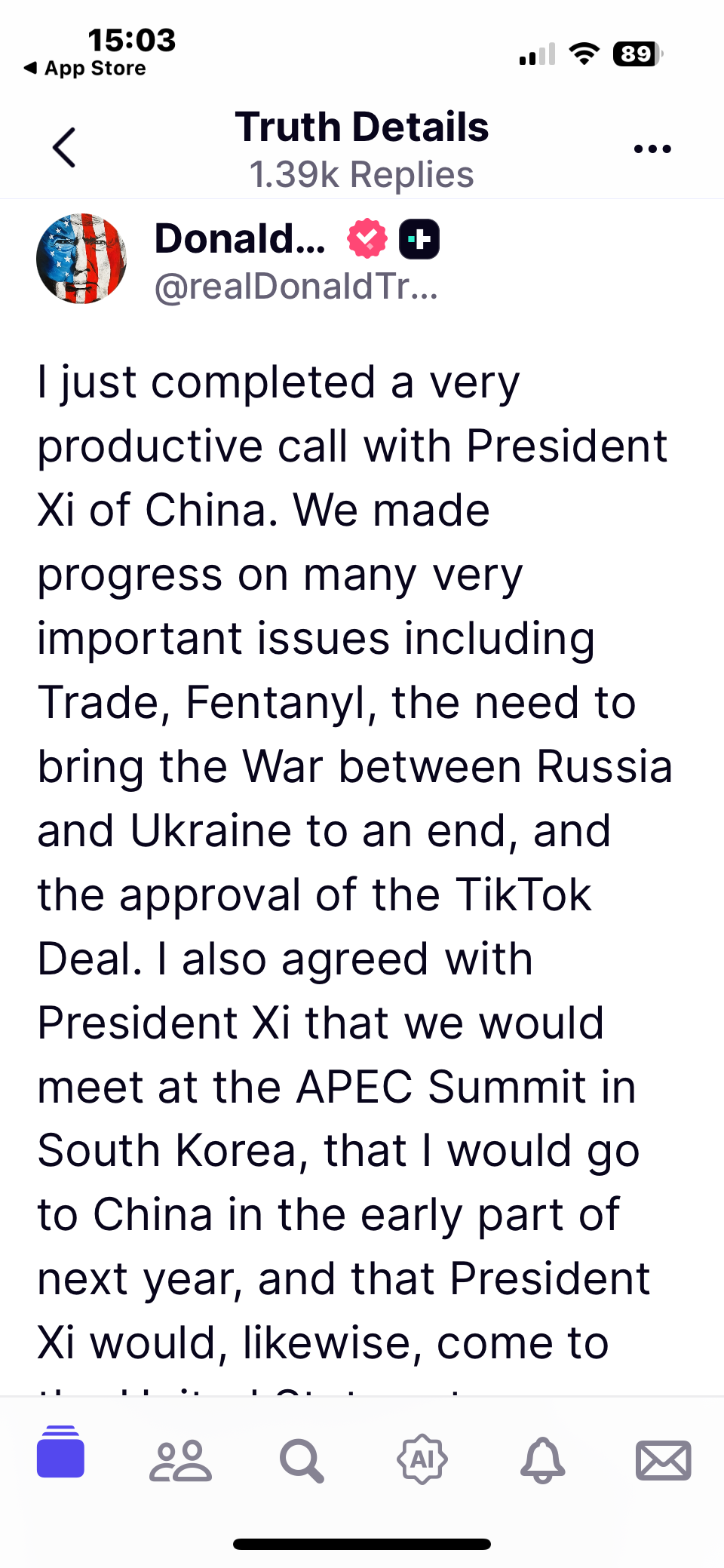
In a social media post, U.S. President Donald Trump wrote on his phone conversation with Chinese President Xi Jinping
Xi and Trump had a phone call on Friday that started at 8 am Friday and ended after less than one hour.
The Chinese president emphasized during the phone conversation that China’s position on the TikTok issue is clear: the Chinese government respects the will of enterprises and is glad to see the enterprises conduct sound business negotiations based on market rules, ultimately reaching solutions that comply with Chinese laws and regulations and balance various interests.
He also expressed hope that the U.S. would provide a fair, open, and non-discriminatory business environment for Chinese companies investing in the U.S.
Trump said that the U.S. hopes to promote bilateral economic and trade cooperation and supports continuing bilateral discussions to properly resolve the TikTok matter.
In the post after the phone call, Trump also said progress was made on issues including approval of the TikTok deal. “We made progress on many very important issues including trade, Fentanyl, the need to bring the War between Russia and Ukraine to an end, and the approval of the TikTok Deal. I also agreed with President Xi that we would meet at the APEC summit in South Korea, that I would go to China in the early part of next year, and that President Xi would, likewise, come to the United States at an appropriate time,” he wrote.
Following the call, ByteDance issued a statement, saying that “We thank President Xi and President Trump for their attention to TikTok. ByteDance will proceed with related matters in accordance with Chinese laws to ensure that TikTok U.S. continues to serve its large American user base.”
Wang Jingtao, Deputy Director of China’s Cyberspace Administration, told reporters on Monday in Madrid, the capital of Spain, that on the basis of fully respecting business autonomy and market principles, both parties reached a basic consensus on resolving the TikTok issue through third-party entrusted operation of U.S. user data and content safety and licensing of algorithms and other intellectual property rights.
“The Chinese government will, in accordance with the law, review matters involving TikTok’s technology export and IP licensing,” Wang said.
On September 14, China’s Vice Premier He Lifeng led a delegation to Spain for talks with the U.S., marking the fourth round of China-U.S. trade negotiations since Trump started a tariff war in April. Both sides reached a consensus on resolving the TikTok issue, reducing investment barriers, and promoting related economic and trade cooperation.
The TikTok issue is mainly about TikTok U.S.’s equity, licensing of its core algorithms, and data security arrangements. However, no deal details have been officially released.
Earlier this spring, ByteDance and its shareholders had drafted a deal proposal, but this was not finalized.
The crisis started with a bill named the PAFACA — Protecting Americans from Foreign Adversary Controlled Applications Act, which passed the U.S. House of Representatives with overwhelming support on March 13, 2024. The act required TikTok to divest from its Chinese parent company ByteDance within 270 days, or up to 360 days if extended by the U.S. President, or cease operations in the U.S.
During the nearly six months before the ban took effect, TikTok exhausted legal avenues, suing the U.S. Department of Justice all the way to the Supreme Court, but failed. On January 19, 2025, the 270-day deadline expired, and TikTok was forced to shut down operations in the U.S. Trump then signed four executive orders extending the deadline, allowing TikTok to return to app stores and continue operating.
The PAFACA law defines any app as being “controlled by a foreign adversary” if foreign individuals or entities directly or indirectly own 20% or more of the company. The law effectively prohibits ByteDance, a Chinese tech giant, from having more than 20% stake in TikTok.
ByteDance is currently owned by its founder Zhang Yiming (about 20%), employees (about 20%) and global institutional investors (about 60%), such as Blackrock, General Atlantic and Susquehanna International Group. However, in terms of voting rights, Zhang Yiming and ByteDance’s management retain control.
Given that TikTok’s business model relies heavily on algorithmic recommendations, any sale of its assets or control would require approval from China’s Ministry of Commerce.
Explore more exclusive insights at nextfin.ai.


