

AsianFin -- Chinese Premier Li Qiang on Thursday highlighted importance of partnership between the world’s top two economies as one of key White House advisors touted progress on U.S.-China trade talks.
Credit:Xinhua News Agency
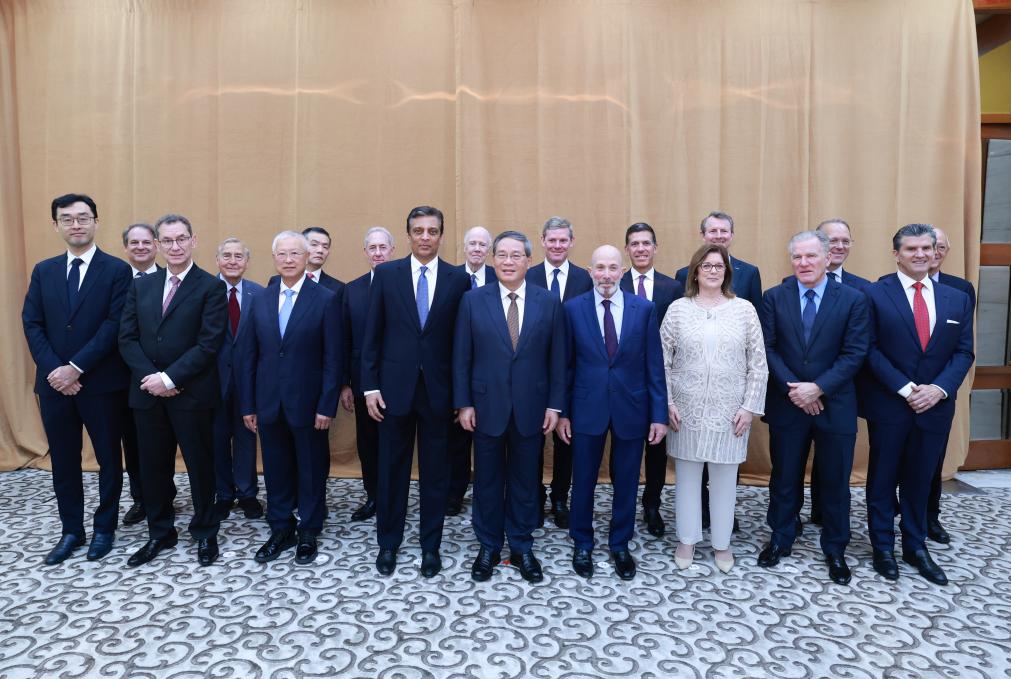
China-U.S. relations are the most important bilateral relations in the world, and the two countries can and should be partners and friends, Li said when meeting with friendly organizations in the United States on the sidelines of the general debate of the 80th session of the United Nations General Assembly, the state news agency Xinhua reported.
Looking back at history, friendly exchanges between China and the United States have been the mainstream and the general trend,Li said, while looking forward, the two contries need to find the right way to get along in the new era.
As Chinese President Xi Jinping has pointed out, the broad Pacific Ocean is vast enough to embrace both China and the United States, as well as other countries, Li said, noting that economic and trade relations are an important component of bilateral ties. As the world's two major countries, China and the United States should respect each other, coexist in peace, pursue win-win cooperation, and achieve common prosperity through mutual success, he said.
Li vowed to maintain stable and healthy economic development, and create more opportunities for worldwide businesses, including U.S. companies. No matter how the external environment changes, China will do its utmost to provide greater certainty for the development of foreign businesses, Li added.
Li reiterated China’s commitments to unswervingly expanding opening up, continuously relaxing market access, and expanding imports. China will actively respond to foreign businesses' concerns and offer help to resolve practical difficulties, so as to ensure that foreign businesses feel at ease when operating and developing in China, according to Li.
The organizations that Li met in New York include representatives from the U.S.-China Business Council, the National Committee on U.S.-China Relations, the U.S. Chamber of Commerce and the Council on Foreign Relations, as well as scholars and business leaders, according to Xinhua.
Thomas Donilon, chairman of the BlackRock Investment Institute, Peng Zhao, chief executive of Citadel Securities, Albert Bourla, Pfizer Inc. CEO and Las Vegas Sands Corp. chairman Robert Goldstein were attending the gathering with Li, Bloomberg reported. Visa Inc. chief executive Ryan McInerney, FedEx Corp. CEO Rajesh Subramaniam, Amphenol Corp.’s President Richard Adam Norwitt and Estée Lauder Cos. chief Stephane de La Faverie were also reportedly present at the meeting.
During his meeting with a U.S. congressional delegation led by Representative Adam Smith in Beijing, Chinese Foreign Minister Wang Yi on Tuesday also sent a positive signal. Wang highlighted that China and the United States are partners, rather than rivals -- and certainly not enemies, Xinhua reported.
Wang in the meeting called on China and U.S. to strengthen communication and dialogue, avoid misunderstandings and misjudgments, prevent confrontations and opposition, promote mutually beneficial cooperation, and jointly shoulder the responsibilities of major powers. He stressed that understanding is the foundation on which trust can be built, the starting point from which cooperation can be explored, and the driving force that can shape the future.
Wang noted that China's door is always open, and more members of the U.S. Congress are welcomed to visit China and undertake exchanges.
U.S. President Donald Trump’s top economic advisor, National Economic Council Director Kevin Hassett on Thursday said the U.S. has made “enormous progress” on trade talks with China in the last few months but considerable work remains.
"I feel like compared to a few months ago, we've made an enormous amount of progress," Hassett said in a Fox New interview when talking about the work of U.S. Trade Representative Jamieson Greer and Treasury Secretary Scott Bessent, who were said to be talking to Chinese counterparts practically every day.
While there are many items on the table in trade talks, Hassett suggested U.S. negotiators are working on resuming China’s imports of argicultural goods. “"we care very much about the fact that China has stopped buying our agricultural products," he said. He expected the “productive negotiation” will lead to a lot of progress from now on to Thanksgiving.
Explore more exclusive insights at nextfin.ai.


