

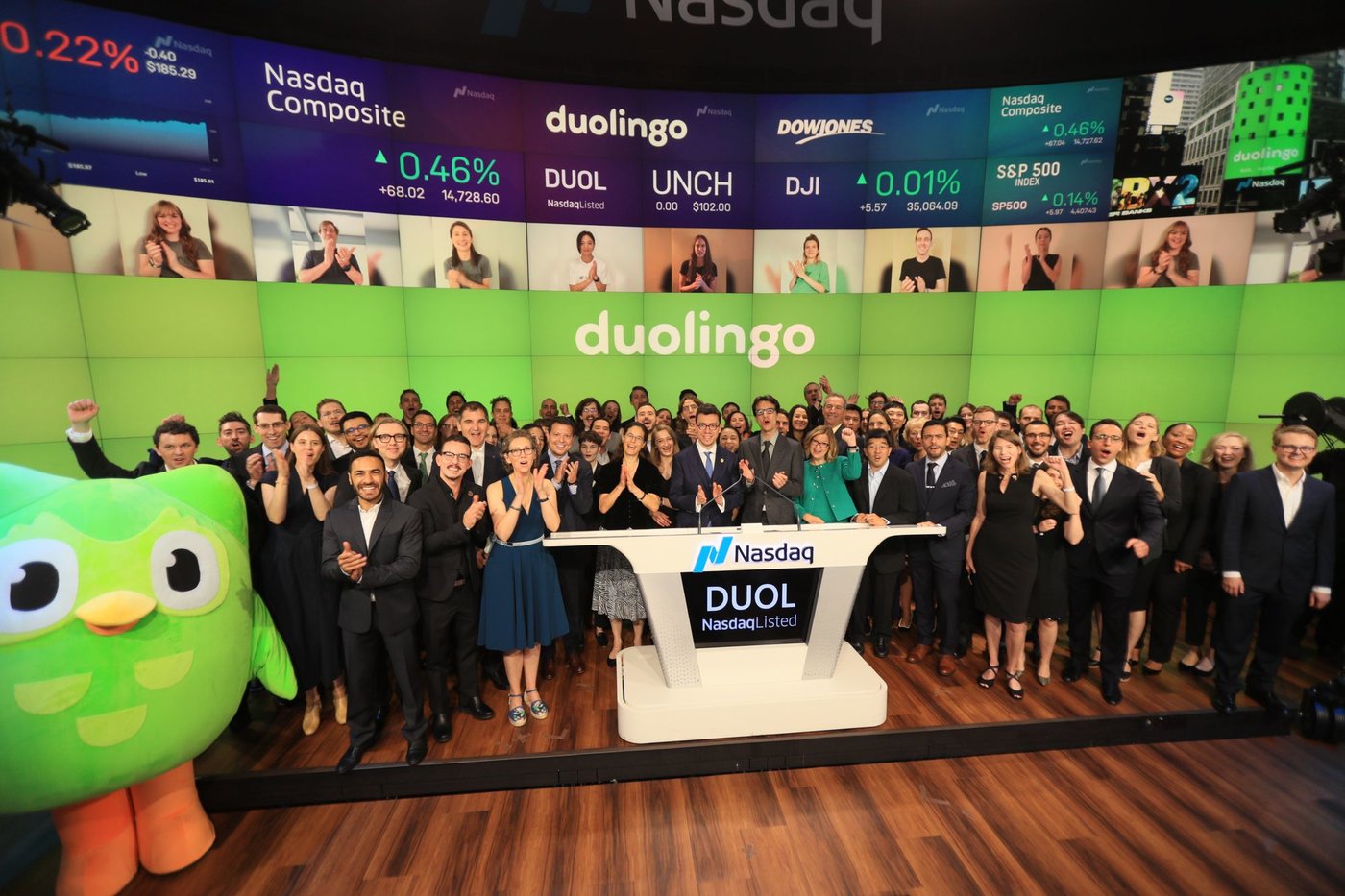
Image from Duolingo’s official website
AsianFin -- Duolingo, the world’s most valuable AI-powered edtech company, has launched a suite of new products and features in China, signaling its ambition to tap the country’s booming language-learning market. The moves aim to drive both app engagement and adoption of the Duolingo English Test (DET), positioning the company for its next phase of growth.
Among the updates, Duolingo has introduced the Duolingo Score for the first time in China. This new feature allows users to track progress across multiple languages, providing a reference for language proficiency and a way to share learning achievements. The Duolingo English Test, meanwhile, has been upgraded with an enhanced dual-camera mode. Test-takers now use their phone cameras to scan and verify their environment before the exam, setting up a secondary camera for monitoring during the test. DET has also added interactive speaking questions and upgraded listening exercises to deliver a more immersive, two-way experience that evaluates candidates’ skills in realistic scenarios.
Rogelio Alvarez, Vice President of Business and Global General Manager of DET, emphasized the company’s vision at the launch event, saying, “Our goal is clear: to make DET the global standard for English proficiency assessment and to lead the future of language testing. The Chinese market is at the heart of realizing this vision.”
Post-event discussions highlighted China’s significance for Duolingo. The country has the world’s second-largest population of English learners—behind India—but the largest group of English test-takers globally. Despite a contraction in the study-abroad market, Duolingo continues to grow its presence, with increasing institutional recognition and expanding user adoption across its language-learning app.
Yuan Yue, Head of Commercial Growth for DET in China, noted that the test is actively supporting the internationalization strategies of Chinese educational institutions. Currently, over 150 international high schools and domestic universities use DET for admissions, periodic assessments, and placement tests. DET’s Global Partner Network also counts more than 1,600 official partners worldwide, strengthening its institutional footprint.
Founded in 2012 by Carnegie Mellon professor Luis von Ahn, Duolingo leverages gamification to teach languages, combining translation exercises, interactive quizzes, and story-based lessons. AI algorithms power courses in over 40 languages and dialects, including English, French, and Spanish. The company aims to make free education accessible globally. Duolingo went public on NASDAQ in June 2021 and has since expanded its reach to more than 1 billion registered users, with 130 million monthly active users. DET has served over 3 million test-takers and is recognized by more than 6,000 higher education programs worldwide.
Financially, Duolingo has shown strong growth. In the first half of 2025, revenue reached $483 million, up 40% year-on-year, with gross profit at $347 million, a 37% increase. Operating profit rose 62% to $56.96 million, and net profit climbed 56% to $79.92 million. Paid subscriptions also grew 46% in Q2. In August, Duolingo raised its annual revenue forecast to $1.02 billion for 2025, up from an earlier estimate of $996.6 million. J.P. Morgan analysts maintain a “buy” rating with a target price of $515.
The broader study-abroad market is also evolving. According to the “2025 China Study Abroad Family Survey Report,” while the U.S. remains the top destination, student interest is shifting toward China, Europe, and other regions. About 30% of surveyed parents hope their children will return to China after studying abroad, double the rate from 2024. Families are increasingly focused on cost-effectiveness during preparation and study periods.
Wang Chen, Head of DET for China, said the country is the fastest-growing market for the Duolingo app globally and one of the largest sources of DET test-takers. The test has reached hundreds of thousands of candidates in more than 1,300 cities and counties, with an average age of 21.1 years, reflecting a younger demographic and increasing competition among test-takers.
Looking ahead, Duolingo is doubling down on AI technology to scale content creation and improve productivity. Luis von Ahn noted that the company has not laid off a single full-time employee since its founding and has been expanding its workforce while using AI to enhance output. “With the same number of people, we can now create four or five times as much content in the same amount of time,” he said. AI automation is helping engineers rapidly develop courses in language, math, music, and chess, allowing the company to achieve more with the same resources.
As Duolingo continues to expand its AI-powered offerings in China, the company aims to cement its leadership in both language learning and English proficiency testing. With robust revenue growth, a global user base, and a focus on innovative AI applications, Duolingo is well-positioned to capture the next wave of growth in the world’s largest English-learning market.
As of press time, Duolingo’s market capitalization stands at $14.365 billion.
Explore more exclusive insights at nextfin.ai.


