

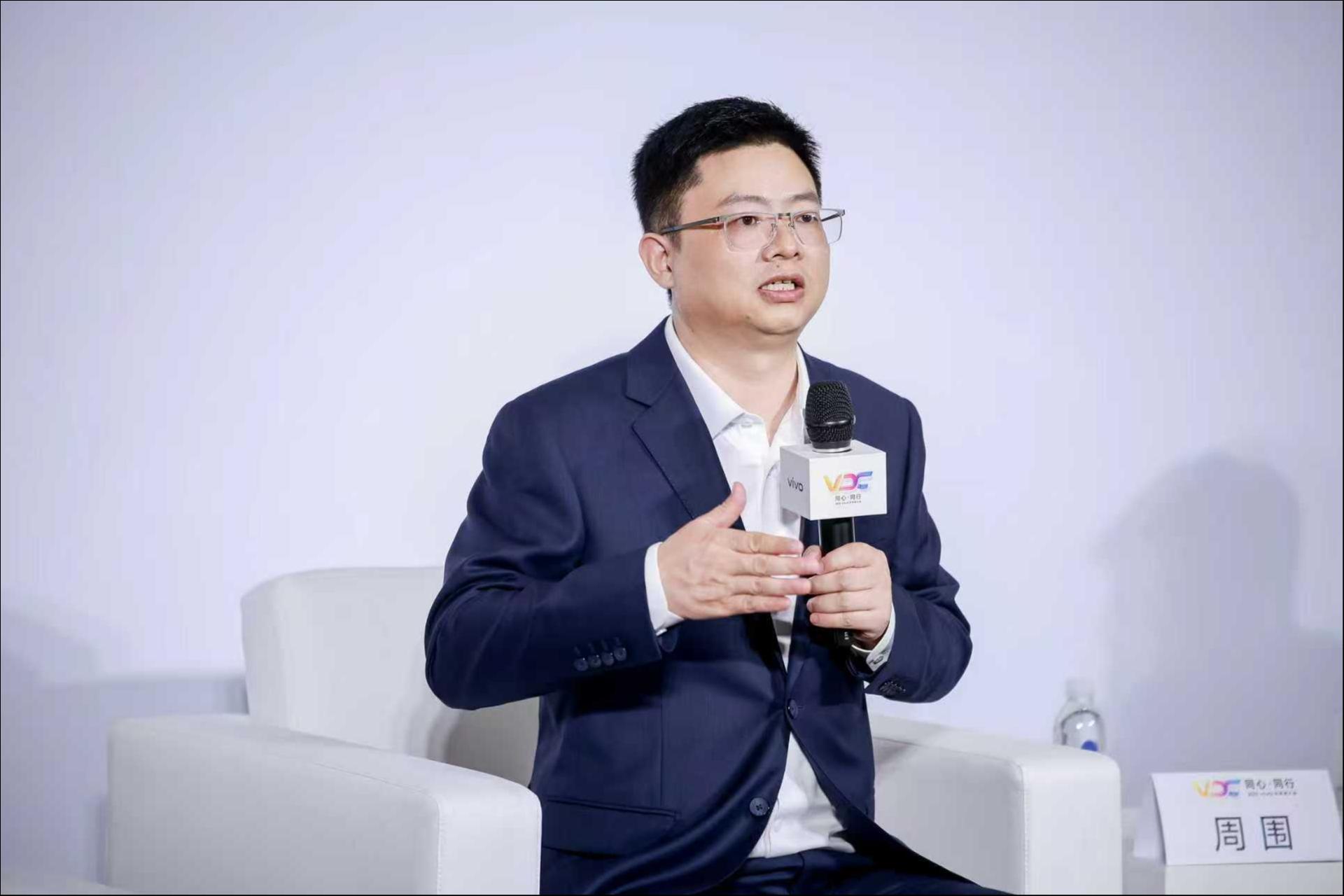
Zhou Wei, Vice President of vivo, Vice President of OS Products, and Director of vivo AI Global Research Institute
While implementing cloud-based large AI models is relatively straightforward, the true challenge lies in advancing on-device AI capabilities for smartphones, said Zhou Wei, Vice President of vivo, Vice President of OS Products, and Director of vivo AI Global Research Institute, during the 2025 vivo Developer Conference.
The conference highlighted vivo’s latest achievements under its Blue Heart Intelligence strategy, including OriginOS 6 and BlueOS 3, with on-device large models emerging as a central focus. One of the key showcases was the Blue Heart large model matrix. Its lightweight 3B on-device multimodal inference model offers enhanced language understanding and logical reasoning, delivering a user experience comparable to the larger 10B parameter model while occupying far less memory.
Vivo’s Blue Heart Personal Intelligence Framework enables devices to understand user intent through multimodal data integration and continuously improve personalization. In 2025, the Intent Framework 2.0 will fully support the MCP protocol and launch the A2A protocol for intelligent agent adaptation, allowing developers to share intent, skills, and contextual capabilities seamlessly.
At the conference, Zhou stressed that smartphone manufacturers are moving away from pursuing foundational large models with hundreds of billions of parameters. “Developing a 400-billion-parameter large model could cost 5 billion yuan in computing power alone, with electricity costs around 1.5 billion yuan annually,” he said. “Such investments are unsustainable, especially for smaller players.”
The emergence of open-source models like DeepSeek has leveled the playing field, allowing third-party platforms to deploy powerful large models. However, Zhou noted that cloud functions, while relatively easy to implement, are only part of the solution. The real innovation lies in enabling sophisticated AI capabilities directly on the device.
OriginOS 6 has streamlined user operations, integrating real-world communication habits into the interface to improve efficiency. Vivo’s phone assistant automatically recognizes on-screen content, categorizes and organizes information, and links data such as schedules and addresses. Currently, Blue Heart Xiao V supports over a thousand app skills, with applications extending to smartphones, in-car systems, and smart home devices.
Blue River OS 3 further enhances intelligent application development with generative UI capabilities. Developers using Blue River Studio can input text or reference samples, and the Coding Agent automatically generates code, supporting multi-turn conversations and project-level understanding.
Zhou acknowledged ongoing limitations: on-device AI agents still operate mainly within manufacturer-developed apps. Cross-app functionality requires negotiations between developers’ security standards and device capabilities. To overcome this, vivo is promoting industry standards and expects AI technology to mature over several years.
The 2025 Developer Conference underscores vivo’s strategic shift: prioritizing efficient, personalized, and on-device AI intelligence over pursuing massive cloud-based models. “As smartphone manufacturers’ capabilities improve, collaboration with the internet industry will enable seamless user experiences,” Zhou concluded.
Explore more exclusive insights at nextfin.ai.


