

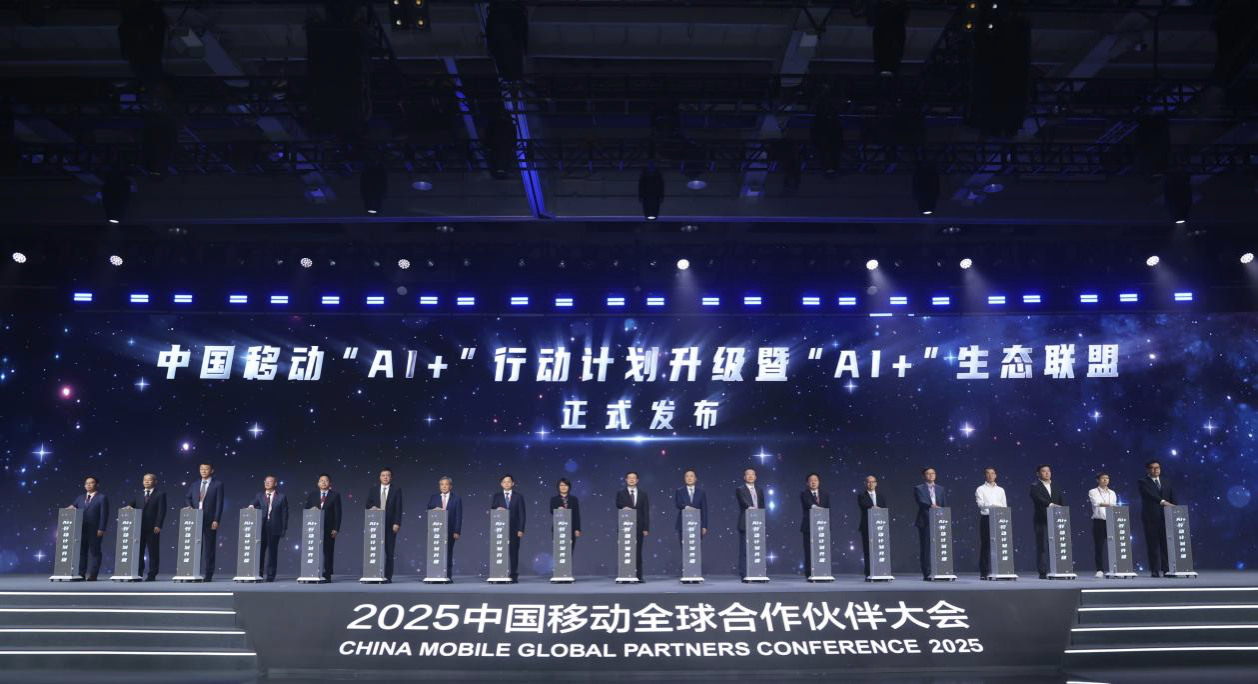
China Mobile is betting big on AI+ as it unveils plans to double investment and build the nation’s largest intelligent computing infrastructure by 2028. The telecom giant aims to drive industrial adoption of AI by fostering collaboration across computing power, models, and data, moving beyond the traditional focus on model size or computing speed.
“AI+ has entered a new stage of large-scale application and comprehensive economic empowerment,” said Yang Jie, Chairman of China Mobile. He detailed plans to expand the company’s digital-intelligent infrastructure, integrate 5G-A and 6G technologies, and upgrade cloud computing to cloud-intelligent computing. China Mobile will also iteratively enhance its Jiutian general-purpose multimodal large model, bolster security and trustworthiness, and develop refined industry-specific AI models.
The initiative targets the deployment of intelligent agents, smart devices, and sector-focused AI solutions while expanding AI+ information consumption. Notable projects include the Lingxi intelligent service gateway, aimed at emerging sectors such as autonomous vehicles, smart terminals, and service robots, alongside AI applications in healthcare, education, eldercare, and public governance. The goal is to enhance social services, improve government efficiency, and accelerate intelligent industrial development.
China’s roadmap for AI adoption is ambitious. The State Council’s “Opinions on Deepening the Implementation of the AI+ Initiative” sets phased targets: over 70% adoption of next-generation smart devices and intelligent agents by 2027, surpassing 90% by 2030, and full integration into China’s social and economic systems by 2035. The plan emphasizes the leading role of government and state-owned enterprises in open deployment scenarios, strengthening the innovation ecosystem, and providing robust support for computing power, algorithms, and data.
China Mobile is translating this vision into concrete infrastructure. By 2028, the company plans to double its AI investment, construct the country’s largest and most technologically advanced intelligent computing system, and deploy a 100,000-card computing cluster to surpass 100 EFLOPS in domestic intelligent computing capacity.
The Jiutian model is set to reach world-class international standards, offering inclusive “Model-as-a-Service” capabilities. China Mobile also plans to supply high-quality datasets across 15 industries and cultivate a pipeline of top AI talent. Over 100 strategic high-value scenarios are slated for rollout, spanning research, design, network operations, marketing, and business management. Its autonomous network is projected to advance from L3 to L4, while the Lingxi intelligent agent platform is expected to serve over 200 million users, establishing a fully integrated AI service gateway.
More than 3,000 AI+DICT projects are expected to drive AI adoption across industries including new industrialization, government services, and agriculture, while also promoting the export of China’s AI capabilities.
In an era where large models alone no longer define competitive advantage, ecosystem integration and industrial deployment have become decisive. China Mobile is positioning itself at the forefront, building a comprehensive AI ecosystem that spans devices, infrastructure, services, and applications.
“From individual AI models to holistic ecosystem implementation, the focus is now on practical impact,” Yang Jie said. “China Mobile is committed to ensuring that AI+ technology delivers tangible benefits across industries and society.”
Explore more exclusive insights at nextfin.ai.


