

Huobi (HTX) founder and Avenir Capital Chairman Li Lin is creating a $1 billion Ethereum asset management company as a leading investor, according to a source familiar with the matter
Li is contributing $200 million to the Ethereum asset management company, according to an insider who revealed the information on the condition of anonymity. Shen Bo, co-founder of Distributed Capital; Xiao Feng, CEO of HashKey Group; and Cai Wensheng, founder of Meitu, are each investing $100 million into the company. In addition, Sequoia Capital, along with several Hong Kong-based institutions, are each investing tens of millions of dollars.
Market sources indicate that this asset management company aims to provide regulated investment channels for Ethereum and related digital assets for institutional investors. An official launch announcement is expected within two to three weeks.
The investor group is currently in talks to acquire a NASDAQ-listed shell company to build the necessary trading structure. According to insiders, negotiations are still ongoing and the final structure may change.
Seizing the Ethereum ETF Policy Window
This move comes at a pivotal time in global digital asset regulation—the U.S. Securities Exchange Commission (SEC) has officially approved spot Ethereum ETFs like ETHA from asset management giant BlackRock. Although these products are not yet available on the market, the policy window for global institutional Ethereum allocation is now open.
In mid-July 2025, Ethereum asset management company Ether Machine Inc. announced its intention to go public via SPAC, in a deal valued at over $1.5 billion, with investors including Kraken, 10T, and Pantera Capital. If Li’s asset management firm successfully launches, it will mark a new phase of East-West institutional competition in Ethereum investment.
This initiative aligns with the global trend of institutional investors allocating Ethereum as part of their portfolios.
According to public data, 70 companies currently hold 5.9 million ETH (roughly $22.296 billion) on their balance sheets—nearly 5% of Ethereum's total supply. Notable holders include Tom Lee’s BitMine and Joseph Lubin’s SharpLink Gaming, both of which consider Ethereum a primary reserve asset.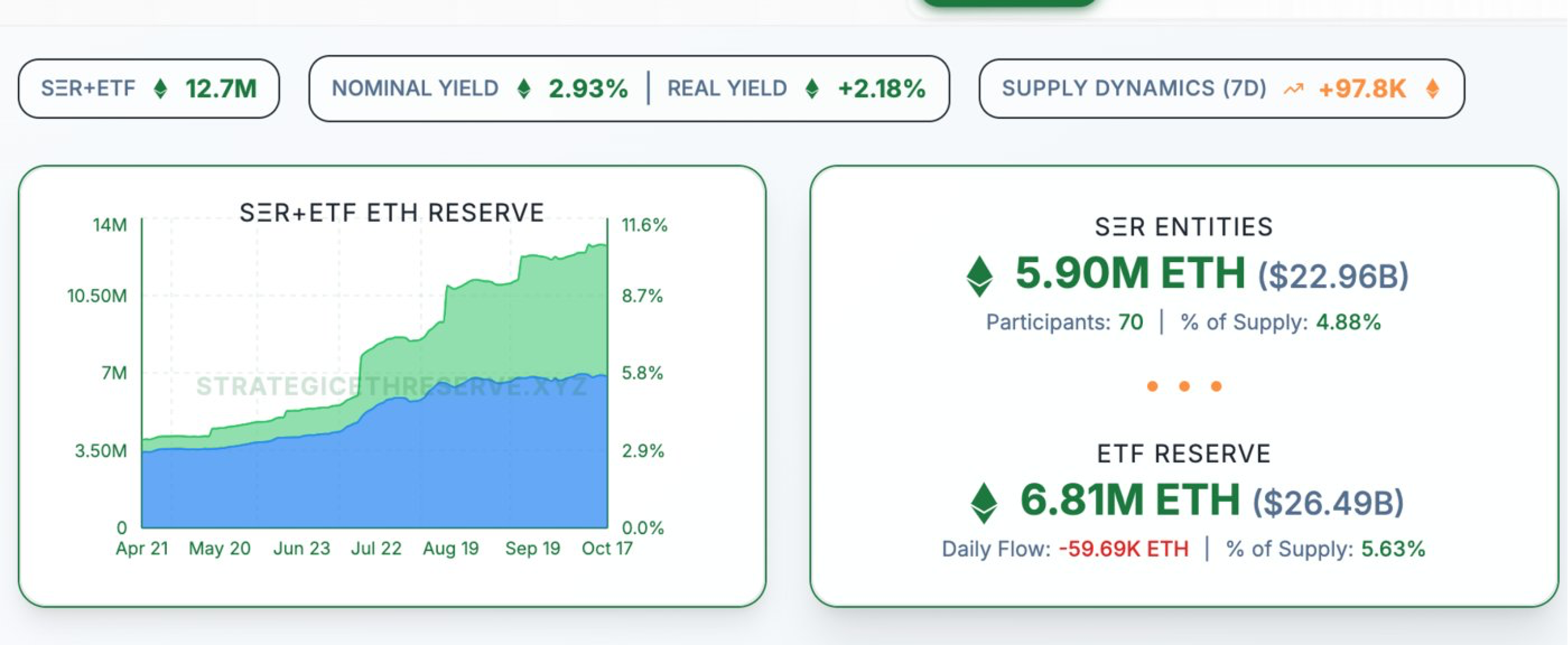
Source: Strategic ETH Reserve
If Li’s firm reaches its $1 billion AUM target, it would become one of the largest institutional Ethereum asset platforms, competing with BitMine, SharpLink Gaming, and Grayscale Ethereum Trust.
Notably, the price of Ethereum has recently fallen below $3,900, but investors like Tom Lee view this as a buying opportunity. Market observations show that BitMine has been actively accumulating Ethereum, while SharpLink Gaming has even sold equity at a premium to raise funds for more ETH purchases.
With new Ethereum-focused trust funds emerging, a new wave of institutional buying is expected to accelerate.
China's Crypto Pioneers Stage a Comeback
This collaboration can be described as a “supergroup” of China’s earliest crypto pioneers.
· Li founded Huobi in 2013 and sold the platform to Justin Sun in 2021. He then established Avenir Capital in Hong Kong, which has since become one of Asia’s largest holders of Bitcoin ETFs, with over $1 billion in AUM.
· Shen, Xiao, and Cai are also part of China’s first wave of crypto entrepreneurs and began laying the groundwork as early as 2015, when Ethereum first launched. Shen’s Distributed Capital was among the earliest institutional investors in the Ethereum ecosystem, funding blockchain infrastructure projects in the mid-2010s. Xiao’s HashKey Group was one of the first to receive a virtual asset license in Hong Kong, giving it regulatory credibility often lacking among Chinese mainland-based crypto firms. Cai had made numerous high-profile crypto investments through his personal fund and successfully took the Meitu XiuXiu photo-editing app public.
Hong Kong as the Launchpad for “Compliant Second Acts”
With Chinese mainland continuing to ban crypto trading, Hong Kong’s clear regulatory framework is becoming the primary launchpad for crypto elites’ “compliant second ventures.”
This new venture led by Li and others is not just a capital operation, but also signifies a strategic shift as Chinese crypto capital moves toward a more regulated and institutionalized phase.
If successful, the project will provide traditional Asian investors with a regulated, mainstream entry point into Ethereum, strengthening Ethereum’s role in institutional finance and supporting the maturation of the digital asset market.
Explore more exclusive insights at nextfin.ai.


