

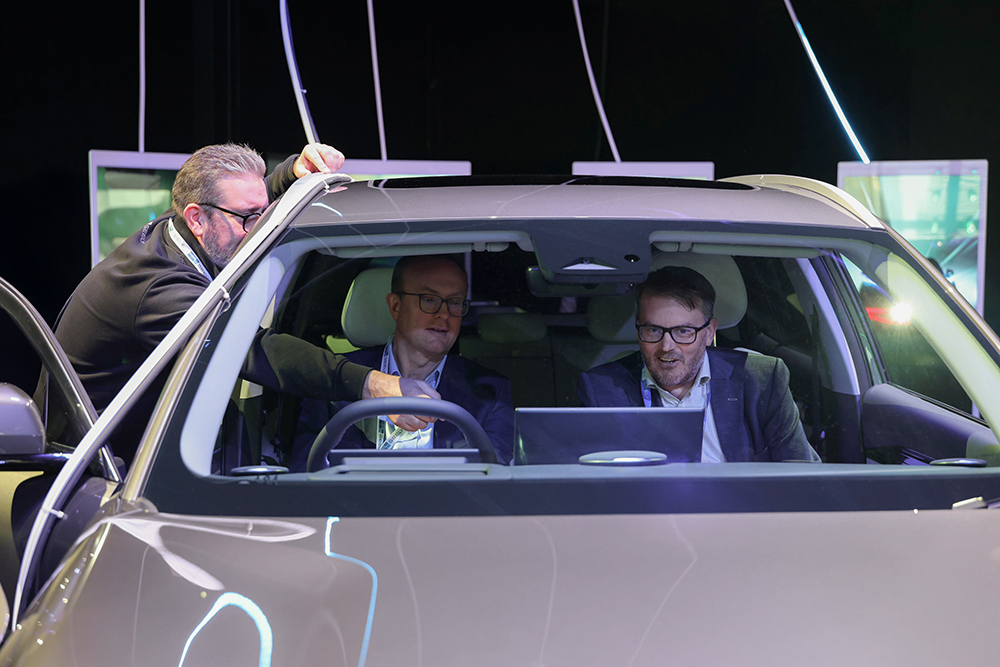
Geely EX5 UK Launch Event
At the historic heart of global timekeeping, Geely Holding Group marked a new hour in China’s auto globalization push.
The Zhejiang-based automaker unveiled its first global new energy vehicle, the Geely International EX5, in Greenwich, signaling its official entry into the UK market and, symbolically, into Europe’s high-stakes electric vehicle race.
Choosing Greenwich was a nod to a country now setting the pace for Europe’s clean-energy transition. In the first half of the year, the UK’s pure electric vehicle market expanded 34.6% from a year earlier, making it the fastest-growing new energy market on the continent.
For Geely, one of China’s largest private carmakers, the launch marks a strategic inflection point. It’s no longer about exporting cars—it’s about embedding itself in the heart of Europe’s industrial and technological supply chain. Yet, as the company pushes deeper into developed markets, the challenge ahead is steep.
The globalization of Chinese automakers has reached a new phase—one that requires moving beyond low-cost exports toward comprehensive global operations integrating design, R&D, software, and data ecosystems. For Geely, success will hinge less on price competitiveness and more on the ability to localize deeply.
“Starting in the UK gives us the highest entry barrier and, therefore, the highest benchmark,” said Gan Jiayue, CEO of Geely Auto Group, during an investor meeting in London. The UK’s stringent regulations, demanding consumers, and advanced industrial standards make it a proving ground for the company’s international ambitions.
The UK will serve as Geely’s European hub, extending its reach to Germany, France, Italy, and Spain. Over the next five years, Geely plans to roll out 15 new models in Europe and establish a sales and service network of more than 1,000 locations.
But beyond market expansion, the real story lies in Geely’s export of its intelligent manufacturing system—a holistic “industry operating system” the company says will redefine how Chinese automakers go global.
“One Geely”: A Cohesive Global Playbook
While many peers have taken a decentralized, multi-brand path abroad, Geely is pursuing what it calls a “One Geely”strategy—an integrated model of global synergy.
Rather than running its independent brands separately from overseas acquisitions, Geely is consolidating its R&D, manufacturing, data, and AI infrastructure under one unified global network. According to Gan, Geely now operates five design centers, five engineering R&D centers, five testing zones, five energy technology platforms, and five AI ecosystems worldwide.
This global alignment supports a three-tiered brand strategy:
Zeekr anchors the luxury tech segment,
Lynk & Co competes in the premium NEV market, and
Galaxy targets the high-value mainstream segment.
These brands share core technology platforms, AI algorithms, cloud data systems, and supply chains—allowing them to pivot swiftly as markets evolve.
“In essence, Geely is no longer exporting a single model like the EX5,” Gan said. “We’re exporting an intelligent ecosystem powered by computing, data, and AI.”
This integrated approach signals Geely’s graduation from the “follower” stage of globalization to becoming a full-fledged system player.
Geely’s international strategy is anchored in what Gan calls “AI-driven globalization.” The company is betting that computing power—not engine horsepower—will define the next era of automotive competition.
Over the past 11 years, Geely has invested more than RMB 250 billion ($34 billion) in R&D. Its total computing power now reaches 23.5 EFLOPS, the highest among Chinese automakers. More than 8.5 million Geely vehicles are equipped with L2 or higher driver-assistance systems, collectively logging over 10 billion kilometers of real-world driving data.
Unlike most competitors, Geely’s intelligent ecosystem extends beyond the road and into orbit. With 64 satellites already in operation, Geely has completed the first phase of its proprietary network. These satellites enable communication, navigation, and remote sensing, ensuring its vehicles maintain high-precision positioning and cloud connectivity, even in remote or cross-border regions.
This vertically integrated digital infrastructure gives Geely a rare advantage—but also brings regulatory complexities. As countries tighten controls on data flows, AI ethics, and autonomous driving safety, the company will need to balance innovation with compliance. “The next barriers may not be tariffs,” one executive said. “They’ll be algorithms and data.”
From Overcapacity to High-Quality Global Growth
Behind Geely’s global ambitions lies a more pragmatic concern: capacity discipline. Executives acknowledge that several plants are already running near full load, and future expansion will depend on efficiency gains and technological upgrades rather than new factories.
“The era of blind capacity expansion is over,” Gan said. “Growth must come from value, not volume.”
This marks a pivot from China’s domestic price wars toward “anti-internal competition”—competing through technology, quality, and brand differentiation rather than cost-cutting.
Geely’s overseas strategy reflects that approach. In Europe, it’s focusing first on pure EVs, then introducing plug-in hybrids (PHEVs) to adapt to evolving regulations. In South America and the Middle East, it’s emphasizing localized production and supply-chain partnerships, a playbook summarized as “Going Out, Going In, Going Up”—from exports, to local collaboration, to industrial co-development.
Geely’s relationship with the UK stretches back nearly 20 years, from its 2006 investment in the London Electric Vehicle Company (LEVC) to its ownership of Lotus Cars. That legacy has evolved from taxis and sports cars to AI-driven mobility ecosystems.
With the EX5’s London debut, Geely isn’t just selling a car—it’s selling a system, from smart manufacturing to intelligent data connectivity.
The company’s journey reflects the broader transformation of China’s auto industry: from manufacturing powerhouse to innovation hub. “High-quality globalization,” as Geely frames it, means more than market share or export volume—it’s about cultural and technological credibility.
In Greenwich, where global time begins, Geely is hoping to reset more than just the clock—it’s aiming to redefine the timeline of China’s automotive rise.
Explore more exclusive insights at nextfin.ai.


