

At the inaugural TCCI AI-Driven Science Symposium in San Francisco, Tianqiao Chen, founder of Shanda Group and the Tianqiao & Chrissy Chen Institute (TCCI), announced a $1 billion investment in computing resources to support groundbreaking AI research worldwide.
“Human evolution has never stopped; only its form has changed. From now on, human progress will be driven primarily by AI,” Chen said, highlighting the transformative power of artificial intelligence in advancing science and innovation.
Tianqiao Chen: Discoverative Intelligence is the True AGI
According to Chen, the ultimate value of AI lies in discovery. Discoverative intelligence can proactively construct testable world models, propose falsifiable hypotheses, and continuously refine its own understanding through interaction with the world and self-reflection. This, he asserts, is the true meaning of artificial general intelligence (AGI).

Chen believes that discoverative intelligence is capable of asking questions, not just answering them; it can grasp underlying principles, not merely predict results. It transcends imitation and possesses the essential capability for creativity and discovery—meaning AGI is no longer about "replacing humans," but about "the evolving of humanity."
To help global scientists advance research in discoverative intelligence, Chen announced several initiatives at the event to support young scientists, including dedicated programs for PhD students and postdocs, and the establishment of laboratories named after themselves.
Omar Yaghi: AI as a New Scientific Mind
A zero-energy, portable water extraction device was placed in the scorching hot Death Valley desert in the United States, where the air humidity is less than 15%. Remarkably, it quickly succeeded in drawing drinking water from the atmosphere.
This gadget—potentially a lifesaver for travelers—was made with materials designed by ChatGPT-enabled molecular optimization editing. Professor Omar Yaghi of the University of California, Berkeley, the newly announced 2025 Nobel Laureate in Chemistry, shared this latest achievement.
“AI is not just a tool—it is a new scientific mind. With the help of artificial intelligence, we are endowing science with the ability to think, reason, and evolve on its own,” said Yaghi.
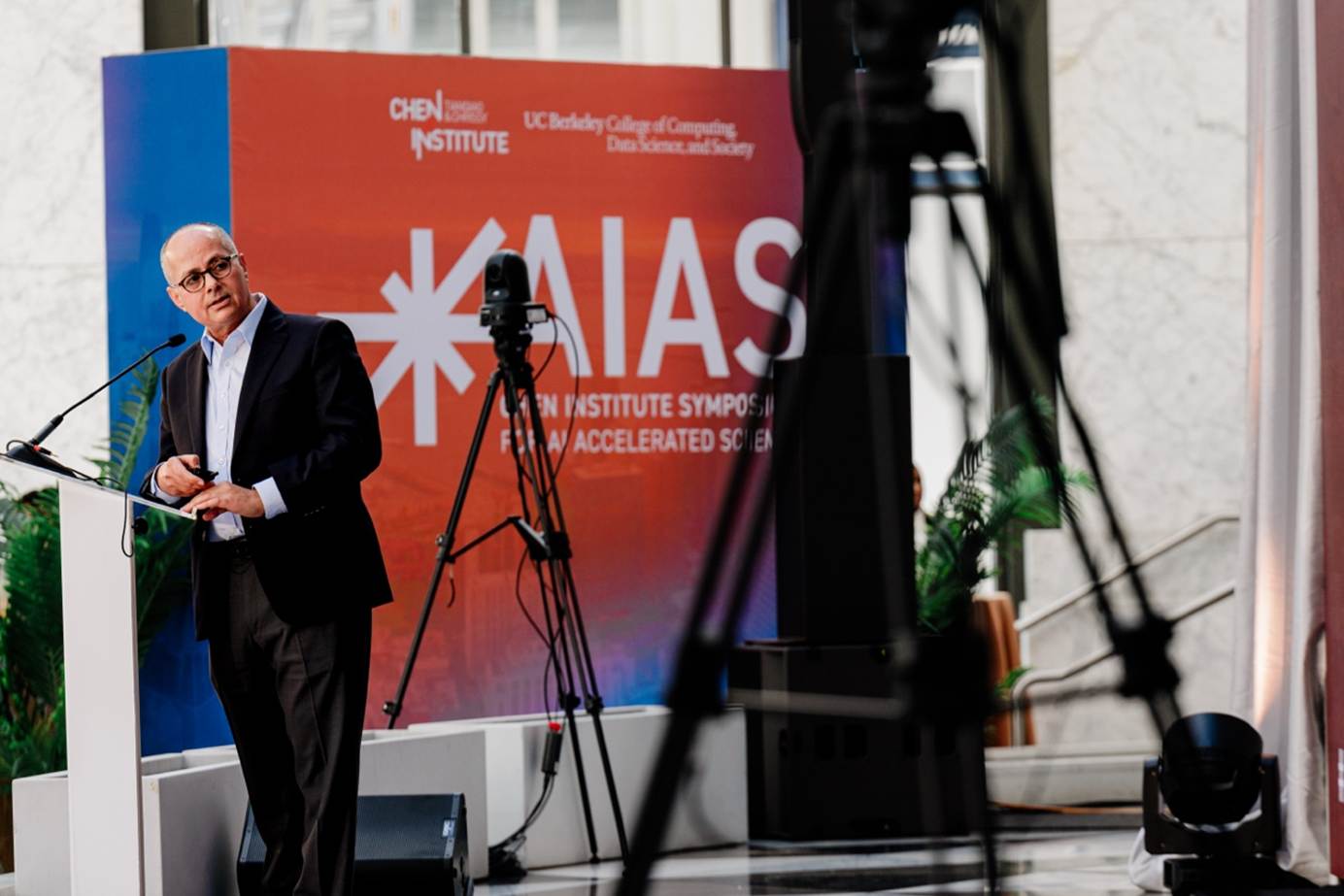
Beyond the AI-designed desert water harvester, Yaghi and his team created a virtual research group composed of seven agents based on ChatGPT. These agents performed various tasks, such as experimental design, literature retrieval, algorithm optimization, safety management, and data analysis. Working in parallel, the virtual team completed hundreds of experiments within days—a remarkable achievement.
They also trained ChatGPT to read thousands of synthesis reports and conduct reasoning, demonstrating that its predictive capabilities surpass many traditional heuristic methods. Thus, ChatGPT has evolved from a text generator into a scientific reasoning engine.
David Baker: AI Cracks the Code of Life
David Baker, the 2024 Nobel Laureate in Chemistry from the University of Washington School of Medicine, shared how AI is being leveraged to “design proteins from scratch” in the field of protein engineering.
He introduced his team’s RFDiffusion3 model—an advanced generative AI capable of operating in three-dimensional structural space. Researchers simply input the desired molecular function, and the model can then generate an accurate 3D blueprint of a novel protein with the specified functionality.
Based on this technology, the team has already achieved several groundbreaking results: In neurodegenerative disease research, they have designed novel peptide conjugates capable of specifically capturing β-amyloid proteins, providing new strategies for Alzheimer’s disease intervention; in the field of enzyme engineering, they successfully developed the first de novo designed protease.
Professor Baker pointed out that the rapid progress of AI models highly depends on a closely coupled feedback loop with experimental data. He emphasized that an efficient design-build-test-learn iterative cycle is indispensable: AI is used to predict and design, the laboratory conducts rapid validation, and the data generated from experiments is immediately fed back to the model to optimize algorithm parameters.
Jennifer Doudna: AI Ushers in an Era of Personalized Gene Therapies
A gene therapy for sickle cell disease developed using CRISPR technology was recently approved by the U.S. Food and Drug Administration, and the first personalized CRISPR gene-editing therapy has also been implemented.
Jennifer Doudna, Nobel Laureate in Chemistry 2020 and professor at the University of California, Berkeley, shared these breakthrough advances in her speech.
Doudna reflected on the complete journey from the discovery of Cas nucleases in bacteria to the eventual birth of CRISPR gene-editing technology, and also pointed out the great challenges the field faces: Despite the incredible power of CRISPR technology, up to 40% of fundamental genes even in the simplest organisms still have unknown functions, which greatly hinders the advancement of gene-editing technologies into deeper areas.
Doudna emphasized that biological data is limited, and building effective machine learning models for biology requires carefully curated, causally informed datasets. To address this, she proposes the co-evolution of CRISPR and machine learning, using CRISPR technology to systematically create gene perturbations in cell lines. This enables extensive, efficient screening and identification of the precise function of each gene, providing a key tool for building causal datasets.
John Hennessy: Humanity Must Retain Authority Over Key Decisions
Artificial intelligence is sweeping across the globe in unprecedented ways, reaching 50% adoption in American households in less than a year—a milestone that took personal computers decades, and smartphones more than ten years, to achieve.
John Hennessy, Turing Award winner, the 10th President of Stanford University, and current Chairman of Alphabet (Google’s parent company), pointed out this astonishing phenomenon in his speech titled "AI Empowering Science and Society".
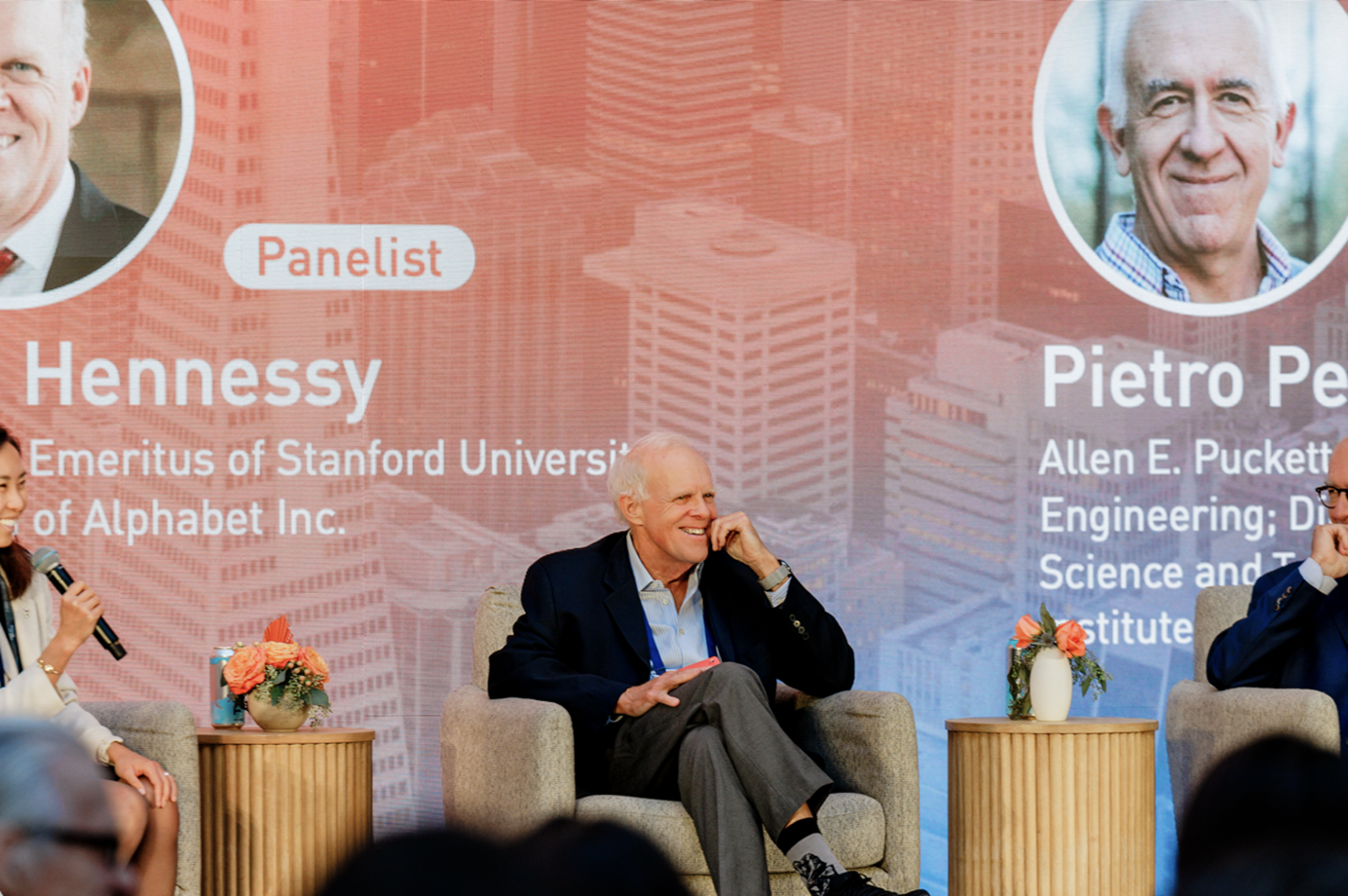
Hennessy pointed out several key principles that humanity must uphold in the face of the AI technology wave: when using or collaborating with AI, there must be transparent disclosure; AI-generated content must be rigorously verified; and detailed documentation must be maintained for data synthesized by AI. He stressed in particular that humans must never be excluded from key decisions involving artificial intelligence.
Hennessy also pointed out two concerns. The first is about the quality and quantity of data. At the current astonishing rate at which AI models consume data, the world’s existing data stockpile could be exhausted within four to five years. This raises the question of whether future data generation can keep pace with the training demands of large AI models.
The second concern is about energy efficiency. Compared to the rapid growth of computing power, improvements in energy efficiency for computation are happening much more slowly.
The symposium featured an award ceremony for the AI Driven Science Prize (Chen Institute & Science Prize for AI Accelerated Research), where last year’s three young laureates shared their research achievements and reflections on winning the prize.
Explore more exclusive insights at nextfin.ai.


