

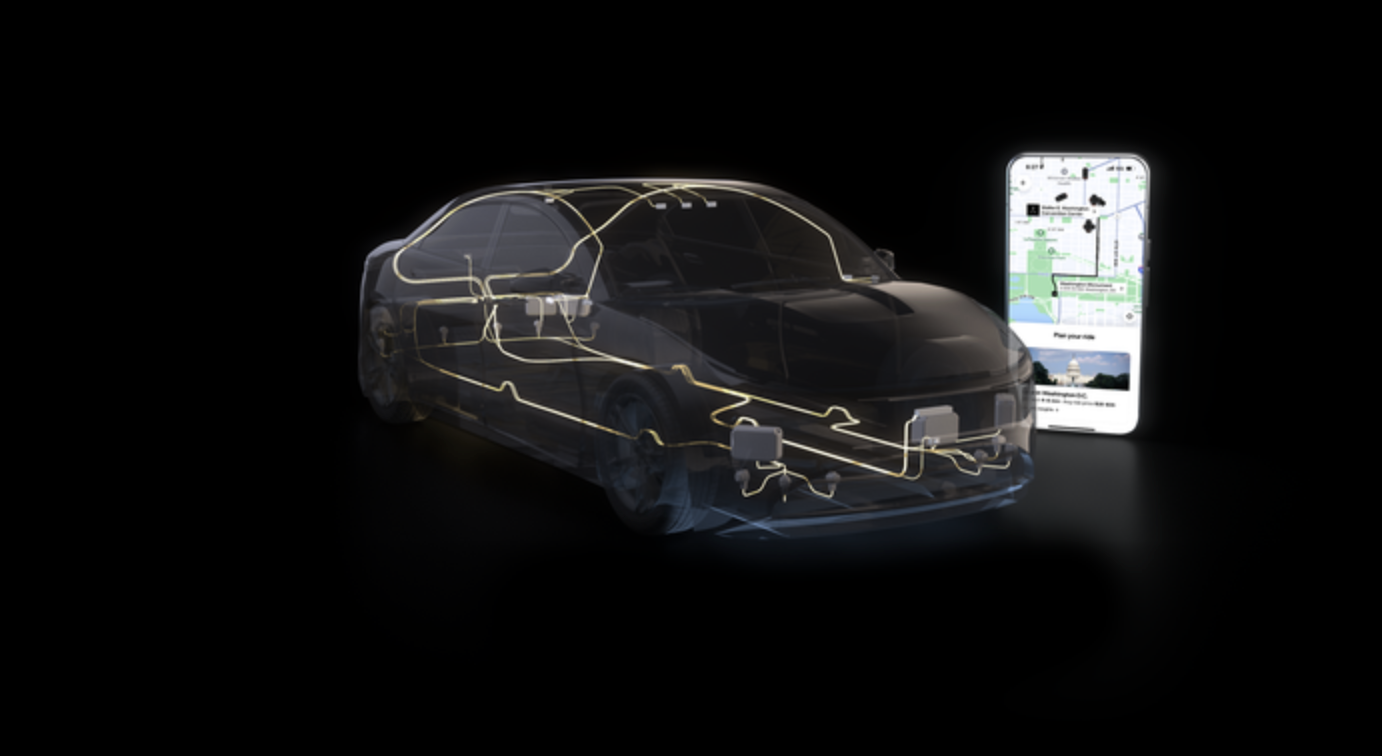
Image Source: NVIDIA Official Website
Nvidia Corp. launched its most advanced platform yet — Nvidia DRIVE AGX Hyperion 10 — at its GTC conference in Washington on Tuesday, marking another decisive step in reshaping the autonomous driving landscape.
The launch marks a turning point for the Silicon Valley giant, which is now positioning itself not just as a hardware supplier but as a full-stack autonomous driving solution provider.
For nearly a decade, Nvidia’s role in the auto sector was defined by its chips — from the early Drive PX series to Xavier, Orin, and last year’s Thor processors — all designed to power the world’s next generation of intelligent vehicles.
With Hyperion 10, however, the company is moving up the value chain, offering automakers an integrated ecosystem that bundles hardware, software, sensors, simulation tools, and AI models in a single package.
“Instead of just selling shovels, we’re now offering the entire gold-mining operation,” Nvidia CEO Jensen Huang said at the event. “We’re turning autonomous driving into an end-to-end, turnkey solution.”
At the core of Hyperion 10 are two Thor processors linked by Nvidia’s high-speed NVLink-C2C interconnect. Each Thor chip delivers more than 1,000 trillion operations per second (TOPS) with INT8 precision — double the performance of its predecessor, Atlan. Combined, the dual-chip system offers up to 2,000 TOPS, enabling both advanced driving and cockpit computing on a unified platform.
Thor’s architecture supports “cockpit-driving convergence”, allowing automakers to dynamically allocate computing power between infotainment and autonomous driving tasks. This flexibility gives carmakers the ability to configure their vehicles more efficiently and respond to evolving regulatory and consumer demands.
Hyperion 10 also introduces a closed-loop development cycle, integrating cloud-based simulation and real-world deployment. In Nvidia’s DGX supercomputing clusters, DRIVE Sim software generates high-fidelity synthetic data to train DRIVE AV models; on the vehicle, sensor data from Hyperion 10 feeds directly into Thor, closing the loop between training and inference.
In practical terms, this means that automakers can launch Level 4-capable vehicles without separately building massive integration, software, and data-training teams. They can instead use Nvidia’s reference architecture as a foundation — a model Huang likened to “Android for autonomous driving.”
Compared with Hyperion 9, the new platform uses fewer sensors — two fewer lidars and eight fewer ultrasonic modules — cutting costs and simplifying integration. Nvidia says this confidence stems from improvements in perception algorithms, which now require fewer inputs to achieve equal or higher safety performance.
Behind the hardware, Nvidia quietly unveiled a large vision-language-action model called Alpamayo-R1 (AR1) — the cognitive “brain” of Hyperion 10.
Built on what Nvidia calls a modular VLA architecture, AR1 can plug into mainstream vision-language backbones. Its key innovation lies in adopting a “causal chain” dataset, replacing the more ambiguous “chain of thought” method used in traditional AI models. The causal approach enforces explicit reasoning paths, improving the model’s interpretability and decision consistency — a critical requirement for safety-grade autonomy.
Early benchmarks show promising results. According to Nvidia, AR1 improves trajectory planning by 12%, reduces near-collision rates by 25%, and boosts inference-action consistency by 37% in complex scenarios.
However, AR1 still requires immense compute resources — currently running on RTX A6000 Pro Blackwell-class GPUs with up to 4,000 TOPS of INT8 performance, roughly six times that of Thor. For now, it remains a technical reserve, with commercial deployment expected later this decade.
Nvidia’s long-term goal came into sharp focus when Huang announced plans to deploy 100,000 robotaxis starting in 2027 — an audacious leap considering the world’s largest operator, Alphabet’s Waymo, currently manages only a few thousand vehicles.
The company’s confidence rests on three pillars: a robust partner network, massive data accumulation, and an open ecosystem strategy. Nvidia has forged collaborations with Uber, Mercedes-Benz, Stellantis, and Lucid Motors, among others, to build what it calls the world’s largest Level 4 autonomous fleet. Its cloud platform already hosts over 5 million hours of real-world driving data as of October 2025.
Rather than competing directly with automakers, Nvidia is constructing an “Android-style” robotaxi ecosystem. Players ranging from established carmakers to regional mobility startups can use Hyperion 10 as a foundation for rapid deployment, customizing the software stack while relying on Nvidia’s reference architecture.
This dramatically lowers the industry’s entry barriers. A local transport operator, for instance, could leverage regional data to launch a robotaxi service without billion-dollar R&D investments. Analysts say this could accelerate global robotaxi adoption as the market heads toward an estimated $44 billion valuation by 2030.
Still, challenges loom. Ensuring compatibility across brands, protecting data privacy, and balancing open collaboration with regulatory compliance remain unresolved questions. “Nvidia is entering the most complex stage of the autonomy race — not just engineering, but governance,” said one industry insider.
Nvidia’s ambition in self-driving technology dates back to 2015, when a small computer vision team began experimenting with neural network-based perception. Over the years, the company’s ambitions evolved from conceptual demos to production-grade systems.
The turning point came in 2020, when Nvidia inked a landmark deal with Mercedes-Benz to provide a full-stack intelligent cockpit and autonomous driving solution for its next-generation vehicles. Unlike traditional licensing models, the partnership linked Nvidia’s revenue to car sales performance, intertwining its success with that of automakers.
But the journey wasn’t without setbacks. Technical glitches in live demos once led Mercedes to consider shifting part of its autonomous driving R&D to China’s Momenta. That prompted Huang in 2023 to recruit Wu Xinchou, former VP of autonomous driving at Xpeng Motors, to lead the division and realign its product roadmap.
A decade later, Nvidia’s transformation is nearly complete. What began as a GPU supplier for infotainment has evolved into a global autonomous driving platform company.
As the race for Level 4 autonomy shifts from “who achieves it first” to “who can scale it fastest and cheapest,” Nvidia’s comprehensive ecosystem strategy — underpinned by its computing dominance — positions it as a frontrunner in the next era of mobility.
For Huang, whose company now commands a $5 trillion market valuation, Hyperion 10 is more than a product. It’s a declaration that Nvidia’s future in AI extends far beyond the data center — to every car on the road.
Explore more exclusive insights at nextfin.ai.


