

Elon Musk’s SpaceX is setting its sights beyond internet connectivity, envisioning a future where data centers orbit Earth.
On X, Musk announced plans to expand the Starlink V3 satellite fleet and develop in-space data centers, aiming to address surging global demand for computing power in the AI era.
The move marks a bold step into a nascent sector that has captured the attention of tech titans. Earlier this year, former Google CEO Eric Schmidt took the helm at Relativity Space to focus on space-based computing, while Amazon founder Jeff Bezos predicted gigawatt-scale orbital data centers within the next two decades.
Musk hinted that Starlink satellites, with their high-speed laser links, could serve as the backbone of these orbital computing networks.
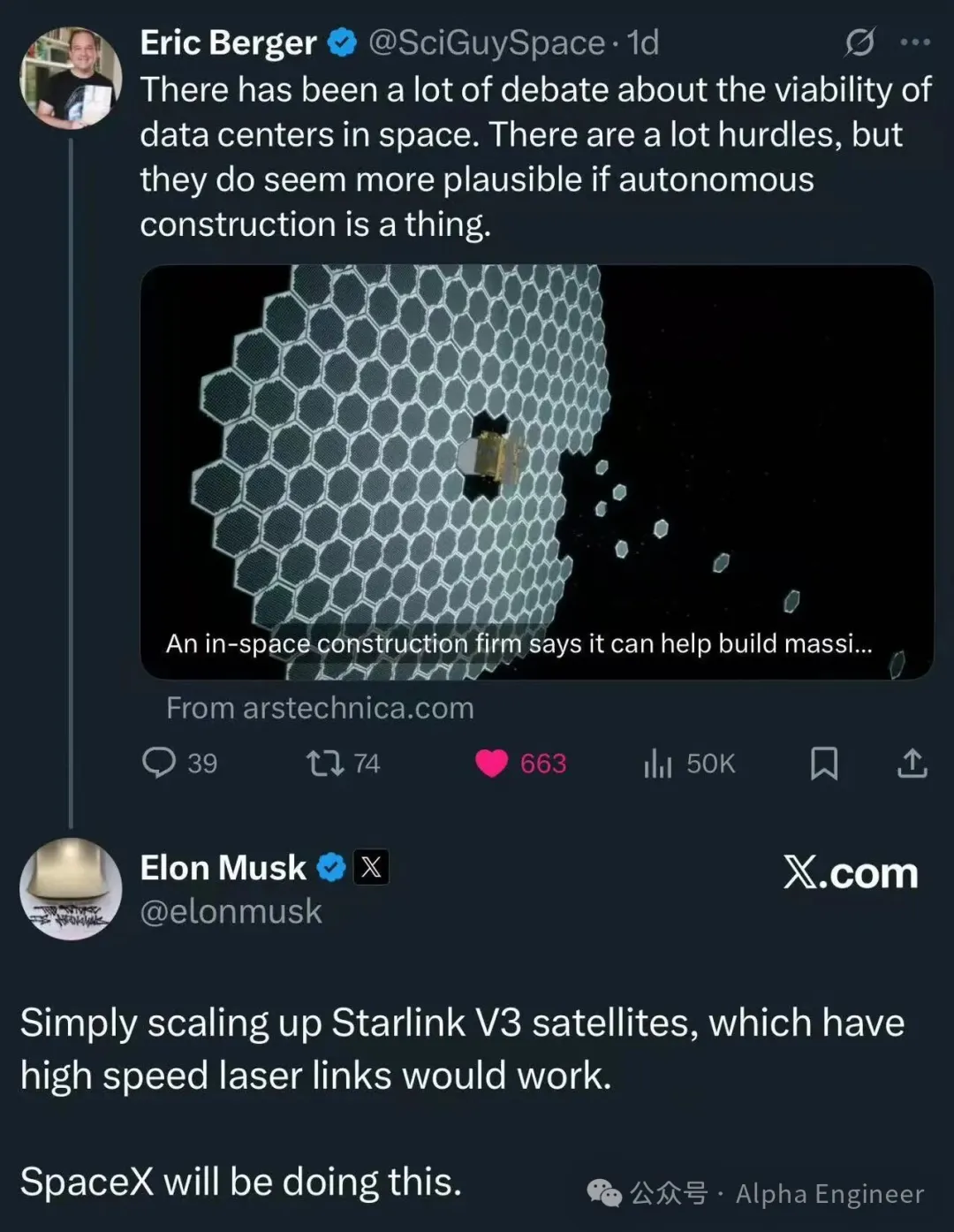
SpaceX’s current Starlink V2 Mini satellites support up to 100 Gbps downlink, but V3 satellites are expected to increase capacity tenfold to 1 Tbps. The company plans to launch dozens of these satellites per Starship mission, with deployments potentially starting in the first half of 2026. “It can be achieved simply by scaling up the Starlink V3 satellites,” Musk said, signaling a serious push into the intersection of space and AI computing.
Space-based computing centers are essentially modular, orbiting data hubs. By relocating computing infrastructure from Earth to orbit, these centers process satellite-generated data in situ, sidestepping terrestrial bottlenecks such as land scarcity and high energy costs.
Solar arrays in orbit can deliver five times the energy per unit area compared with ground installations, while the cold vacuum of space offers efficient radiative cooling, three times better than on Earth, without consuming water.
This “in-orbit processing” model could transform how satellite data is handled. Traditional workflows require transmitting massive amounts of raw data back to Earth, straining limited bandwidth and creating inefficiencies. Space-based centers, by contrast, perform real-time data analysis, cleansing, and extraction in orbit, sending only actionable insights to the ground. Starcloud, a leading startup in the field, is developing AI satellites equipped with NVIDIA H100 chips to process terabytes of data daily, including radar and deep-space signals, bypassing ground-based data bottlenecks.
Similarly, ZJ Lab’s “Three-Body Computing Constellation” of 12 satellites achieves up to 744 TOPS per unit, connected via 100 Gbps inter-satellite laser links. The constellation targets time-sensitive applications such as disaster monitoring and weather forecasting, demonstrating the practical potential of space-based AI.
Compared with terrestrial data centers, orbital computing offers dramatic cost advantages. A 40-megawatt ground data cluster would cost roughly $167 million over a decade, with $140 million in energy and $7 million in cooling. By contrast, a comparable space-based center would cost around $8.2 million, mostly from one-time launch and solar array expenses, with ongoing power supplied entirely by solar panels.
Despite the promise, space-based computing faces formidable technical hurdles. Radiation resistance is critical, as cosmic rays and single-event upsets can damage hardware. Redundant modules and military-grade components are essential, with some companies exploring lunar lava tubes for added protection.
Thermal management remains challenging, requiring radiators and liquid cooling to dissipate heat in a vacuum. Solar arrays must be large enough to provide uninterrupted power through orbital shadow zones, and inter-satellite laser links must overcome communication latency and atmospheric interference. Even with reusable rockets, launch costs and orbital congestion remain significant barriers.
The industry’s landscape includes startups and tech giants. Starcloud is pioneering orbital AI data centers, with its Cloud-0 satellite slated to house Nvidia H100 chips delivering performance 100 times greater than the International Space Station.
Amazon’s Project Kuiper plans low-Earth orbit internet services in Australia by mid-2026, leveraging AWS edge computing for future orbital AI processing. Microsoft’s Azure Space initiative and Meta’s Space Llama project are exploring in-orbit AI applications, while NVIDIA provides chips for multiple orbital computing ventures. SpaceX itself is advancing inter-satellite laser links to enhance Starlink’s network as a backbone for computing.
The space computing value chain spans upstream launch and satellite infrastructure, midstream modular computing and communications, and downstream applications like Earth observation, autonomous systems, and communication services.
Key players include satellite manufacturers such as Maxar and Thales Alenia, launch providers including SpaceX, Rocket Lab, Blue Origin, and Arianespace, and constellation operators like OneWeb and Hughes Network Systems. Modular in-orbit platforms from Axiom Space, Loft Orbital, and Skyloom enable deployment of orbital computing nodes, while applications range from disaster monitoring to autonomous vehicle AI.
Explore more exclusive insights at nextfin.ai.


