

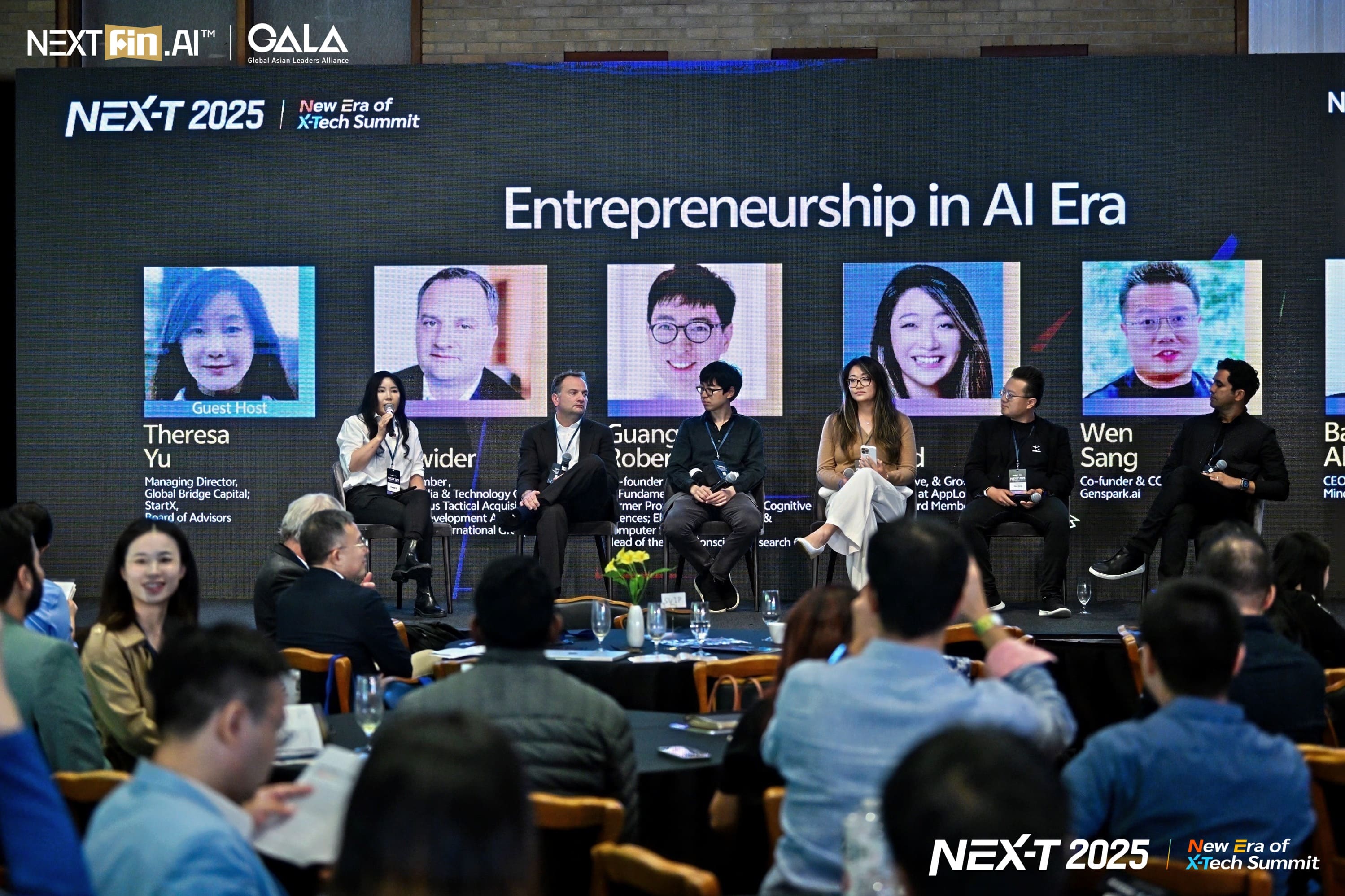
On-site photo
Artificial intelligence (AI) development offers a relatively level playing field for entrepreneurs, thanks to access to both open-source and closed-source AI models, Wen Sang, the co-founder & COO of Genspark.ai, has said recently.
Entrepreneurs now have access to extraordinary models from OpenAI, Anthropic, DeepMind, and others. This enables startups to build innovative applications without being constrained by the dominance of a single company, Sang said.
Sang made the remarks on September 27 at a panel during the NEX-T Summit 2025 hosted by NextFin.AI and Global Asian Leadership Alliance (GALA) in Silicon Valley. At the panel "Entrepreneurship in AI Era", he joined discussions with Eric S. Swider, a board member of Trump Media & Technology Group; Guangyu Robert Yang, the co-founder & CEO of Fundamental Research Labs; Alice Ahmed, the Creative, & Growth Leader of AdTech; and Babar Ahmed, the CEO of Mindstorm studios.
Sang also cautioned about the rapid pace of technological advancement. The speed at which new AI models are released and integrated into products reduces the effectiveness of traditional moats. Entrepreneurs must continuously adapt, experiment, and iterate to remain competitive. In this context, success in AI entrepreneurship requires agility, strategic foresight, and the ability to combine multiple models and tools into robust solutions.
Swider, also the CEO of Renatus Tactical Acquisition Corp, highlighted that one of the most critical opportunities for entrepreneurs lies in the strategic application of AI. He drew parallels to the blockchain and Bitcoin boom, noting how billions of dollars were spent by corporate America attempting to integrate blockchain technology, often misusing it by focusing solely on Bitcoin rather than the underlying blockchain infrastructure.
The result, he explained, was a widespread failure, as companies lost vast sums and became wary of investing in blockchain innovation for years. Swider emphasized, "Whether it is the application of a database or blockchain or AI, learning how to take a very powerful tool and apply it properly to get a result is a great opportunity."
Swider also pointed out the importance of democratizing data. By enabling broader access to data while maintaining user control, entrepreneurs can create applications that solve meaningful problems without replicating past mistakes of misapplied technology. His view underscores that AI is not simply a technology to be deployed, but a tool that requires careful contextual application aligned with business objectives.
Yang, also a former professor at MIT and head of the MetaConscious Research Group, offered insights on the competitive landscape for AI startups. He noted that while conventional wisdom often suggests avoiding competition with foundational AI model developers, the reality is more complex.
Startups may build large-scale applications on top of AI models, yet major labs can enter these application spaces directly by leveraging their resources and talent. "Nothing stops big labs from becoming application players themselves," Yang said. He added that these labs can hire experts across industries—from law to healthcare—effectively removing barriers that previously protected smaller companies from direct competition.
Yang also pointed outed a shift in venture capital dynamics. Historically, VC firms often backed smaller companies to counterbalance the power of big tech,fostering innovation. Today, many major VC firms have significant stakes in leading AI labs, creating a structural advantage for large players and altering the support landscape for entrepreneurial ventures.
Alice Ahmed, also the ex-VP Product at AppLovin, emphasized that AI presents not only grand transformational opportunities but also practical avenues for incremental improvement. Drawing on her experience at AppLovin, she discussed how AI could optimize recommendation systems in advertising, a domain that remains inefficient despite technological progress.
Even with state-of-the-art technology, conversion rates remain suboptimal. Improving them incrementally, even by one or two percentage points, can translate into substantial revenue growth across billions of users, she argued.
Her perspective shows a grounded approach to entrepreneurship: rather than pursuing overly ambitious, high-risk projects, startups can achieve meaningful impact and growth through disciplined execution and incremental innovation. She further noted that combining AI-driven analytics with creative intelligence allows companies to maximize efficiency and customer value in a highly competitive landscape.
Babar Ahmed stressed the critical importance of problem identification in entrepreneurship. He argued that the questions entrepreneurs ask often matter more than the problems themselves.
In today's environment, understanding the moving pieces is essential. Only then can you define your objectives and identify where to focus your efforts, he noted.
He added the multidimensional complexity entrepreneurs face, spanning emerging technologies such as quantum computing, biotechnology, and space tech, alongside geopolitical and regulatory shifts.
Babar Ahmed also discussed how AI democratizes access to knowledge, mentorship, and strategic insights. "Imagine every entrepreneur having access to the world's best mentors or investors. AI makes that possible, leveling the playing field for emerging markets and smaller companies," he elaborated.
Swider, also the strategic development advisor of High-Trend International Group, pointed out data management as a critical enabler for entrepreneurial success. By eliminating reliance on traditional relational databases, his team has developed platforms that enhance data accessibility, sharing, integration, and protection. This approach allows companies to offer highly personalized, seamless experiences across diverse domains, from media to healthcare. Swider illustrated this with the concept of an AI-driven "channel guide," integrating podcasts, news, sports, and other media in a user-friendly, tailored platform.
Alice Ahmed discussed the impact of AI on monetization and operational efficiency. At AppLovin, machine learning optimized user acquisition, bid management, and ad placement. Combined with creative intelligence, AI allowed rapid testing, iteration, and scaling across millions of users.
AI enabled the company to generate value faster for both the company and customers. It's about execution—making small, precise improvements that compound into significant business outcomes, she said.
She also highlighted organizational lessons for executing at scale. Focused teams, rapid decision-making, and rigorous prioritization of high-impact initiatives were critical to achieving exponential results.
Babar Ahmed provided a concrete example of scaling with limited resources. Using the gaming industry as a reference, he explained how small teams can achieve revenue comparable to larger organizations by applying AI to automate processes and maximize efficiency. AI, he argued, enables entrepreneurs to access expertise and operational capabilities at an unprecedented scale, effectively "lifting the floor" for emerging markets and smaller companies.
Explore more exclusive insights at nextfin.ai.


