

NextFin News -- In February 2026, Yu An, a Chinese national living in South Korea, was at the café in Seoul that he often went to when he saw young people in their early twenties heatedly debating SK Hynix’s share price—the roar was even louder than a wet market back in China. Upscale Korean beef restaurants and king crab spots were also suddenly packed with young faces—“It felt like they’d started making money.”
At the same time, several thousand kilometers away, in front of a computer at a Chinese civil aviation unit, Zhang Wenzheng, a technician born in 1996, stared at his screen. The Korean market had already closed, but U.S. overnight trading was rallying, and overseas capital was pouring into SK Hynix like a tide. To Zhang, the money seemed to “jump in its sleep 24 hours a day.”
But by March, Zhang went through 23 days of getting wiped out. What he had bought was an ETF (exchange-traded fund) that went long on SK Hynix. It fell from the 40-plus Hong Kong dollar range back to HK$20; all of the more than HK$1 million in profits in Zhang’s account evaporated, and even his principal started to go into the red. Every day he brainwashed himself: “The company’s fundamentals haven’t changed—war is a black swan.”
He held on. In mid-April, the stock was yanked back up. By the end of May, SK Hynix’s market cap broke through the US$1 trillion mark, and Zhang had netted more than HK$4 million.
But as June began, the surge didn’t last. Over the past two trading days (June 5 and June 8), Korean stocks triggered circuit breakers twice.
Losing more than a million in a matter of days, then watching the principal multiply fivefold again in just a few months—2026 was only halfway through, and the Korean stock market had already taken investors on several roller-coaster rides.
South Korea is often called the “canary in the global economy.” Its export data and the KOSPI (Korea Composite Stock Price Index) are seen as leading barometers of global trade conditions. In its stock market, nearly half the market-cap weighting is occupied by two semiconductor giants—Samsung and SK Hynix. Foreign ownership accounts for more than 30%, and the country’s energy supply is highly dependent on imports. That means a single artillery blast in the Middle East could cut off its lifeline, and a single Fed rate hike could drain its liquidity.
These violent ups and downs attracted capital from around the world. A group of Chinese retail investors also rushed in after catching wind of it—armed with chat logs with AI, “how-to” posts they’d seen on Xiaohongshu, and tips from Korean “high rollers.” They didn’t read financial statements, didn’t study corporate governance, and some didn’t even know what Hynix actually did. But catching this wave was enough to leave them raking it in.
But from the moment they bought in, they were already swept into another game of power—China and the U.S. were locked in a computing arms race, Nvidia was scrambling for HBM (high-bandwidth memory) capacity, Korean conglomerates were divvying up the spoils, and even a burst of gunfire on the peninsula could snap the supply chain in two.
What they bought wasn’t just a stock—it was a betting slip tied to all of these huge variables.
China’s Retail Investors Looking for the Next Big Wave
Turn back the clock to late 2025: Zhang Wen had already lost 290,000 yuan trading A-shares. Three years of short-term speculation—chasing rallies and dumping dips—he described it as “like gambling.” He would jump into whatever was surging to grab a quick bite, then cut his losses the moment he got trapped. As a wage worker earning only 200,000 yuan a year, he didn’t dare tell his family. He lied to his mother that he was making money, and even borrowed another 100,000-plus. He planned to take one last shot—if he lost, he’d come clean and get back to work for real.
He bought some AI-related names in the A-share market and earned back a bit, but not much. Then he started chatting with AIs like ChatGPT, Gemini, and Claude, asking how the AI industry chain was laid out. Following the checklist the AI spat out—GPUs, HBM memory, optical modules, liquid cooling…—he filtered it down layer by layer, looking for the leading company in each sector. In those Q&As, SK hynix was listed as No. 1 in the HBM industry.
“No matter which AI I asked, it was SK hynix—Doubao said the same thing,” Zhang Wen said. In late January this year, he used Hong Kong stocks to convert a little over 1 million yuan into an ETF that goes long SK hynix.
Yu An, who had worked and lived in Seoul for ten years, traded Korean stocks not by relying on AI, but on guidance from a “master.”
In 2016, a Korean CEO she was close with told her that if she wanted to save up money in Korea, she had to set aside part of her monthly income and plan to invest in the stock market. “You don’t need to buy a lot—one share is enough. You can’t get fat in one bite. Start by investing money you won’t feel bad about losing.” The CEO himself had built up assets worth more than 10 million yuan through stock trading, and Yu An trusted him.
On his advice, she started buying Samsung stock every month. Back then, one share cost only one or two hundred yuan (the minimum trading unit for Korean stocks is one share). “Instead of putting it in the bank, you might as well buy Samsung. Samsung won’t shut down—just treat it like a fixed deposit.”
When the two met in the second half of last year, the CEO asked her, “Still messing around with stocks?”
“Thanks to you, I’m still holding Samsung.”
“I’ll give you another one—you can make money on it.” The CEO solemnly gave a name she didn’t catch—it was a string of English words. Only after she got home and looked it up online did she realize it was Hynix.
She bought her first share for more than 300,000 won, roughly 1,500 yuan. Before buying, she complained to the CEO: “It’s so expensive. If it drops, I’ll feel sick about it.” The CEO said, “Just buy one share—treat it like buying a piece of clothing.”
The line the CEO said to her most often was: “Hold on to it—don’t touch it, no matter what. You won’t die without that money. Only sell when you’re truly so broke you can’t afford to eat.”
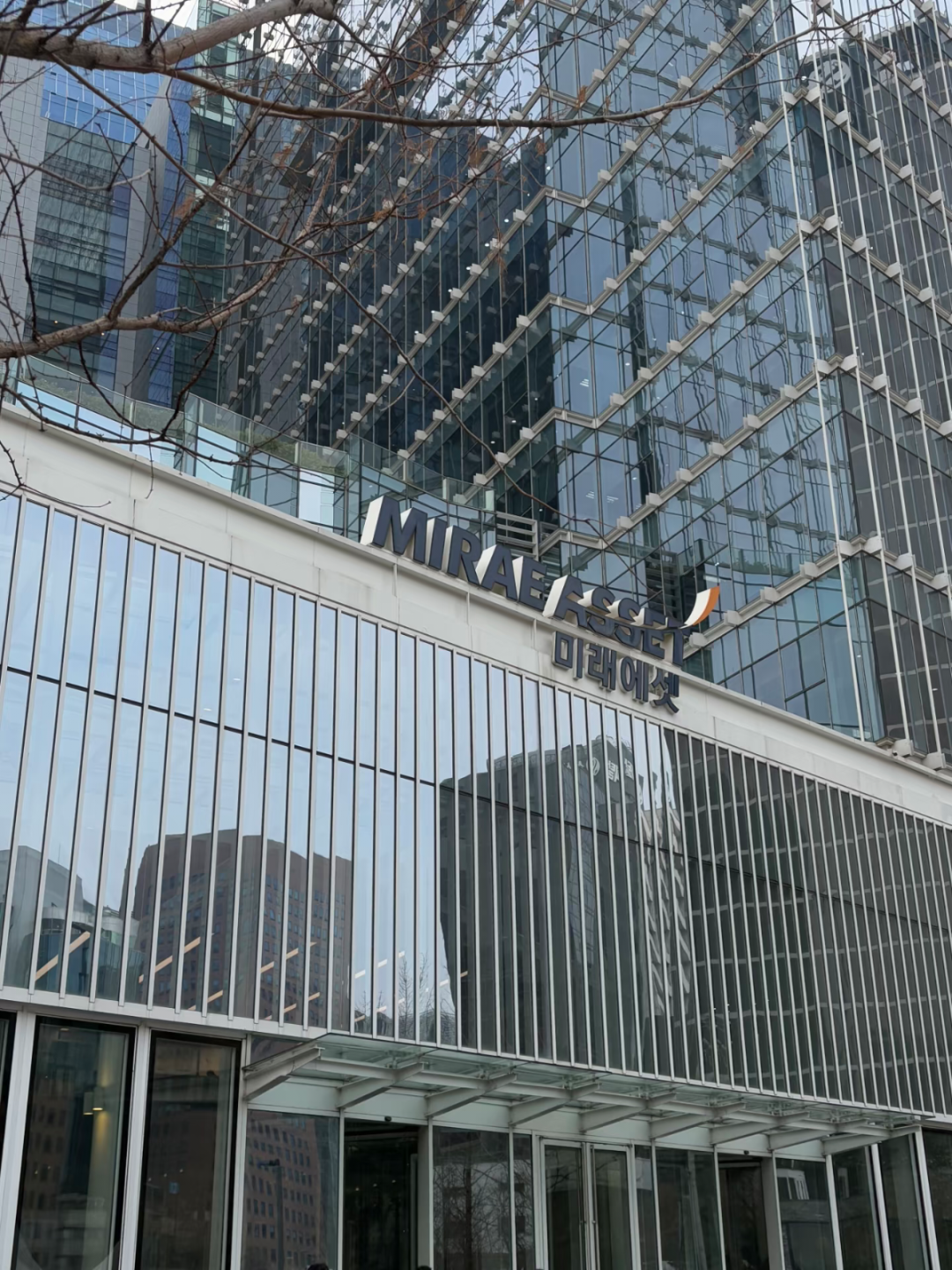
College students studying in South Korea were also itching to get in on the nationwide stock-trading frenzy. In April this year, Cai Kui saw Korean news reports and Xiaohongshu posts saying Korean semiconductor stocks were surging. He clicked into the relevant candlestick charts and watched the line climb, and “instantly wanted to buy a few and ride the wave.” When he went to open an account that month, he arrived half an hour before the brokerage opened and found a long line already forming outside—many of them Chinese international students.
By comparison, the signals retail investors in China picked up from the stock market were far more fragmented.
Wang Can was in college in China. She liked photography and often stocked up on camera memory cards. In December last year, she noticed that the price of the memory cards in her shopping cart had doubled or more, but she didn’t think much of it. In April this year, Xiaohongshu started frequently pushing her posts about SK Hynix; in the comments, retail investors enthusiastically discussed the stock’s outlook. It sounded reasonable to her, so she bought in.
Later, after talking with some retail investors, she realized that many people had already sensed the signal back when memory cards started getting more expensive, and had positioned themselves in storage-related stocks ahead of time. “I should’ve caught on back then,” she said regretfully. “I could’ve set up some storage positions in advance.”
Of course, there were also more professional hunters. Cheng Yi and Jia Qiao had years of buy-side and sell-side experience, having long served as ER (equity research analysts) at several major companies, and they founded Buzhuo Capital earlier this year.
They had their own methodology. After studying the U.S. railroad cycle in the 19th century and the internet cycle in the 1990s, they concluded that when a once-in-an-era tool emerges, the most certain opportunities are often at the hardware layer. Following that logic, they found storage in the AI era. And globally, the most advanced storage technology is concentrated in South Korea, with SK Hynix as the industry leader.
Before investing, they ran their analysis, set exit points, and even sent insiders to visit factories in South Korea—having meals with Samsung employees and conducting field research in different locations.
At the end of last year, they opened Korean stock market accounts and took a heavy position in SK Hynix.
Different paths, same destination. This group of Chinese retail investors and institutions, relying on completely different instincts, had zeroed in on the same prey. But the market behind that door was nothing like the A-share market they were familiar with.
A Storm in S. Korean Stocks
Once they pushed the door open, the first thing they saw wasn’t candlestick charts—it was Korean society’s full-blown frenzy over the stock market.
In February, during those days when SK Hynix’s share price was surging, Yu An walked into the café she often went to and found it packed with people in their early twenties. The volume of their stock talk, she said, was “even louder than a Chinese wet market.” She heard that some people were taking out loans to buy, while others were chasing the rally on credit cards—“the more cards you have, the poorer you are.”
After studying in South Korea, Huang Ziying stayed on. She used to think that only younger and middle-aged Koreans traded stocks, but later discovered that many seniors did too. When she ate at small diners, older men and women would stare at their phones watching the market whenever business was slow—an entire screen of red.
Once, she got into a taxi. The driver had a head of white hair and looked at least sixty. After driving for a while, he stopped at a traffic light and deftly opened an investing app on his phone. Nearly every chart in his portfolio was red, and the returns looked pretty good. “At that age, I was worried he could barely manage driving,” she sighed.
Later, at her workplace, “there wasn’t a single Korean who didn’t trade stocks.” During the market open and close, her bosses barely did any work—doing nothing but watching their stocks.
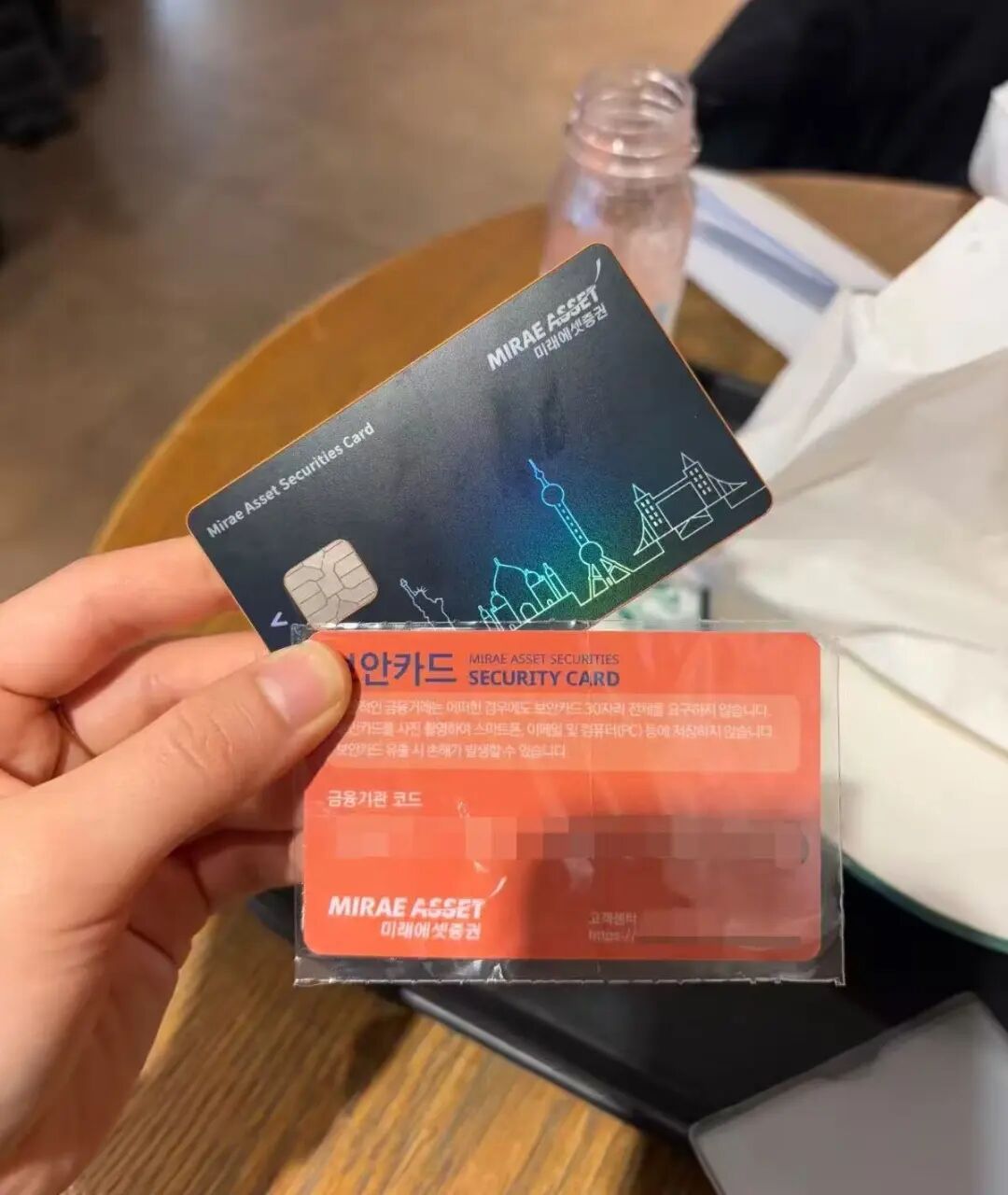
This February, Huang Ziying opened a South Korean stock trading account. After the account was set up, the brokerage mailed her a card; money deposited into the linked card could be used to invest in the stock market. Image source: interviewee
On the day Cui Xiuying—a Chinese ethnic Korean who has lived in South Korea for many years—went to open an account, she saw a mother and daughter walk into the brokerage lobby hand in hand. The mother was in her sixties, the daughter in her forties; the daughter had come along to help her mom unlock the password for a stock account she had opened three years earlier. Cui thought to herself: you’d rarely see a scene like this in China.
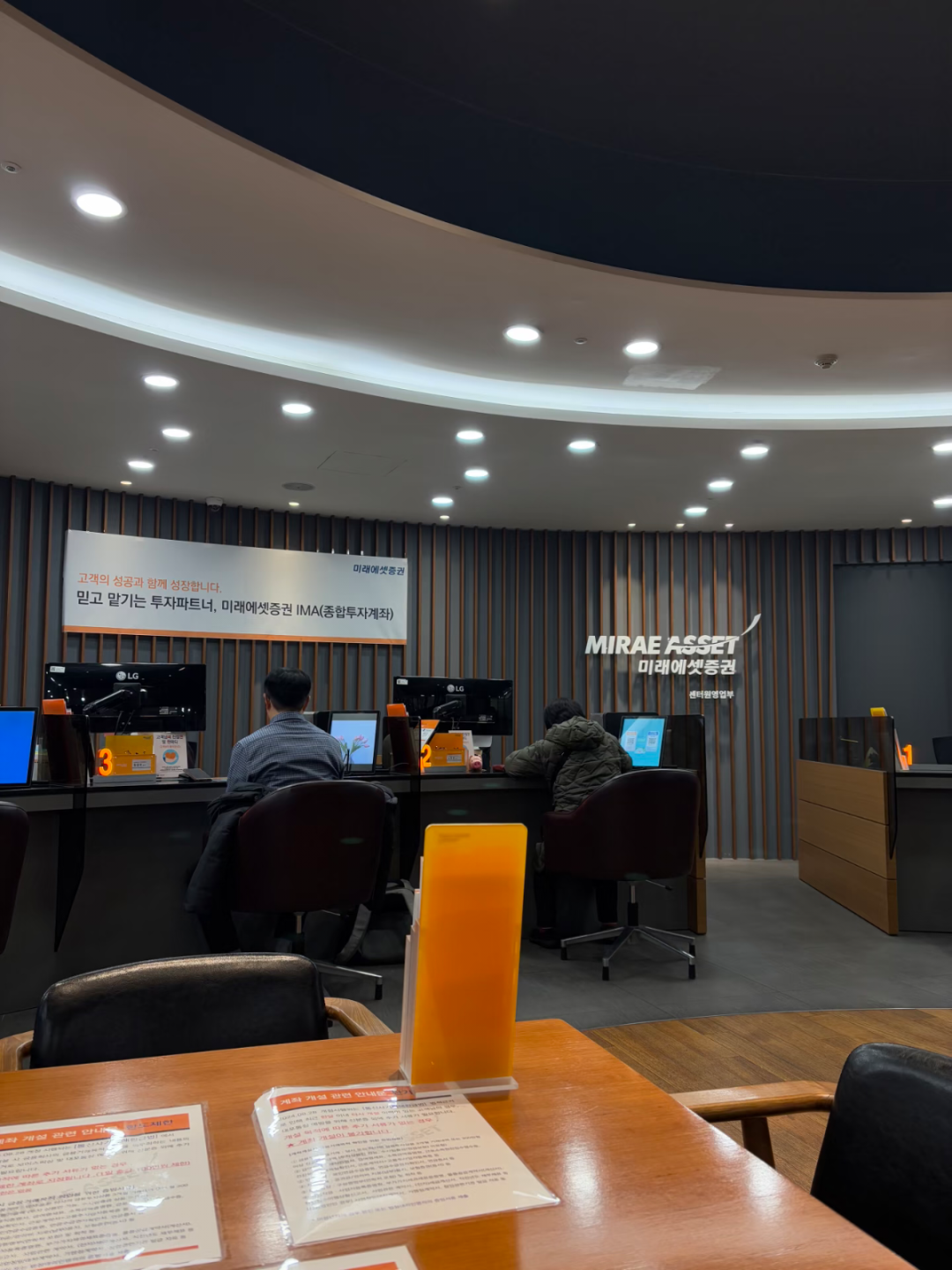
In February this year, people at the counter of a South Korean brokerage handling account-opening procedures. Image source: interviewee.
And then the surge arrived.
In February, Wu An saw SK Hynix’s share price jump by six to seven hundred yuan in a single day for the first time. She stared at the screen as the numbers visibly flickered upward. “I’ve never seen gains like this.” What puzzled her even more was the next morning: when the South Korean market opened at 9 a.m., the price gapped up straight away. “It closed yesterday at 1.5 million won—how did it open at 1.7 million? Where did that extra 200,000 come from?”
A friend told her, “Are you kidding—do you think there’s only one stock market in the world?” Only then did she realize that while she was asleep for those few hours, U.S. stocks were still trading, and overseas capital was pouring steadily into Korean equities. In South Korea’s stock market funding sources, foreign ownership accounts for over 30%, and roughly 40% of that is U.S. capital.
A Shenwan Hongyuan research report showed that since March 2026, both retail and institutional investors in the Korean stock market accelerated their entry, with average monthly net inflows of 1,644 trillion won into brokerage funds from March to May. Global and emerging-market funds’ allocation to Korean equities also climbed to record highs. Capital mainly poured into the technology sector; since the start of 2026, global inflows into Korea’s tech industry totaled US$16.7 billion.
Another data point also confirmed how active foreign capital was in the Korean market. Goldman Sachs data showed that as of the end of February 2025, the number of active Korean equity accounts surpassed 102 million, while South Korea’s total population was about 51.6 million. The number of brokerage accounts was roughly twice the country’s population.
Zhang Wen didn’t understand any of these macro rationales or statistics. He only knew that the AI told him SK hynix was the industry leader, so he bought it. At the peak, he had netted more than six million yuan across his domestic and overseas accounts. Watching the numbers jump higher, his family said it “felt like they’d gone numb.” After Wang Can bought in, the stock jumped 8% in a single day, and she felt “extremely awesome.”
But the Korean stock market has no daily price limits—when it rises, it can surge hard; when it falls, it falls even harder.
In March, a U.S.–Iran war broke out and the Strait of Hormuz was blockaded. In South Korea, more than 90% of energy is imported; the AI industry is heavily dependent on electricity; nearly half of the KOSPI’s market cap is concentrated in two semiconductor giants—Samsung and SK hynix—and chip fabs are “power guzzlers” that cannot afford to lose power 24/7.
Once the strait was cut off, the KOSPI triggered a circuit breaker in early March after two consecutive days of declines.
Zhang Wen’s SK hynix ETF slid all the way from the top back to his entry price. From January to March, the share price doubled—then returned to square one. Those 23 trading days were “brutal,” as he put it. All he could do was keep brainwashing himself every day: SK hynix’s fundamentals hadn’t changed, and the impact of a black-swan event would be limited. He held back from cutting his losses, and even added to his position at the lows.
In April, as the market soured, Wang Can saw many retail investors discussing selling their SK hynix holdings. She had the same thought, but she didn’t want to realize the loss and didn’t dare to average down, so she decided to wait until the stock rebounded and then sell.
She knew someone who lost 300,000 yuan in a week in March, then another 500,000 yuan the next week—but then made it all back, recouping everything earned over the previous month. She admired that kind of decisiveness, but she couldn’t do it herself.
For students trading stocks with their living expenses, staying calm through this kind of volatility is not easy. Huang Jia is an international student in South Korea. She entered near the highs in April; at first, she checked the price every few minutes. The first time she saw it down 3%, she “almost exploded with anger,” and only calmed down after taking several deep breaths.
After the storm, some people began to sense, faintly, that this market wasn’t quite what they had imagined.
Yu An put it most bluntly: “The rise is just absurd. There’s no way domestic buying power could bid it up this high—I think overseas market forces have come in.” She lived in South Korea for ten years and knows that the purchase cost for local retail investors is generally around 300,000 to 400,000 won. “There’s no way it could climb to 1.5 million or 1.6 million and we’d still go in and buy.”
She sensed the presence of foreign capital, but she didn’t think it through any further—she herself was part of that “foreign capital.”
A Grassroots Gamble
After those 23 days in which his profits fell to zero, Zhang Wen actually became even more resolute. He noticed a pattern: from last year’s U.S.–China tariff war to this year’s Middle East conflict, every time a black swan hit, good companies’ stocks dropped, then eventually climbed back—and came back even harder. “Black swans are actually add-on opportunities, as long as it’s a good company,” he said.
He used U.S. stocks as a benchmark, looking at the Nasdaq index: over several decades, it fell in only three or four years, and rose in more than a dozen. He also ran the numbers for SK Hynix using the P/E (price-to-earnings) valuation method: SK Hynix’s current P/E is only 6 to 7 times, while Nvidia was already at 24 times before the AI boom. “Even if SK Hynix just goes to 12 times, it can still double from here.”
His investment decisions relied almost entirely on his own research, plus asking AI—he didn’t follow the directions institutions predicted the market would take.
He was convinced he had bought a “good company.” But Korean stocks are complicated: corporate quality isn’t the only variable, and they can’t offer 100% high certainty.
For a long time, the share prices of South Korea’s large conglomerates traded below those of comparable companies globally—investors called it the “Korea discount.” The root cause was that controlling shareholders treated companies as family property; most profits were kept within the conglomerate, leaving minority shareholders with little.
After South Korea’s current president, Lee Jae-myung, took office, he pushed hard for revisions to the Commercial Act. Measures such as increasing minority shareholders’ participation in board appointments, checking the power of controlling shareholders, and canceling treasury shares were written into law. Foreign investors then began repricing Korean assets.
Part of what Zhang Wen earned on SK Hynix came from the AI industry’s surge, but another part actually came from this ongoing corporate governance reform. Whether the reform can continue depends on where South Korean politics goes. He had no real sense of any of that.
Yu An didn’t understand it either. But she had her own set of criteria.
When the editor-in-chief first recommended SK hynix, she actually didn’t really want to buy it. Not because she was bearish on memory chips, but because “I don’t really like SK Group’s chairman. His wife and mistress had this huge blowup, and I just really don’t like a boss like that.” It wasn’t until the editor-in-chief kept urging her that she reluctantly bought a single share.
Later, when SK hynix surged, she called the editor-in-chief and, half joking, demanded: “Why didn’t you tell me to buy ten back then?” The editor-in-chief replied: “With that cautious little heart of yours, could you even have bought ten?” She admitted he was right—she’s the type who’ll be happy for a moment after making money, but will never chase a rally.
Her confidence in Samsung came from the exact opposite reason: “Lee Jae-yong is incredibly charismatic—he’s the kind of person who just attracts fans. I know his talent-selection system, and I know Samsung’s after-sales service; they’re both excellent.” The way she judges a company, she said, is pretty much the same as judging a restaurant—whether the boss is trustworthy, and whether the stuff is actually good to use.
This year, Samsung Group went through a union strike. During that period, she asked a Samsung employee she knew, and the person told her that the memory division had made money, and the home-appliances division wanted a piece of the pie too. She felt the union had gone too far: “Even the president singled it out and criticized it.” The strike ultimately eased somewhat after the government stepped in, and Wu An became even more convinced of her own judgment: “As long as South Korea exists, these two companies won’t go under.”
After Samsung and SK hynix climbed, Wu An chose not to chase higher prices. Instead, she bought the dip in the stock of a Korean messaging app. She figured that software everyone uses wouldn’t just go out of business. Every stock she buys is something she can reach out and touch in her daily life.
Choi Soo-young makes decisions in a similar way. In total, she invested 500,000 won, buying Korean Air at a little over 20,000 won per share—more than a dozen shares. Her reason for choosing Korean Air was simple: in March she bought a plane ticket to travel to Shanghai, and in April, after oil prices rose, the same ticket went up from 1.48 million won to 1.64 million won. She thought that once the war ends, everyone will go traveling, and airlines will make money.
As for SK hynix, she glanced at the price—1.92 million won per share. “If I buy this and then buy Samsung, my entire month’s salary is gone. No need.”
By contrast, Cheng Yi and Jia Qiao were playing a different game. In late May, on the day SK hynix’s market cap topped US$1 trillion, they weren’t surprised at all. If anything, they felt the market’s consensus that SK hynix could reach the trillion-dollar mark had formed later than they’d expected.
What they cared about more were the bad signals—had companies started cutting their AI budgets? Were big clients’ long-term orders starting to loosen? Could Samsung’s HBM yields suddenly catch up? And could there be a “DeepSeek moment” in the storage world—some new tech company popping up out of nowhere and overturning the entire landscape?
“In theory, there will come a day when the Korean stock market falls. We want to be out before that happens,” they said.
They invested in Korean stocks not because they were bullish on Korea. “When you study AI infrastructure long enough, you eventually realize you can’t get around Korea.” They thought the country’s stock-market structure was “pretty distorted”—two stocks accounted for nearly half the index weighting—but in the AI memory race, there was no other choice right now.
Some people used P/E valuation, some judged the founder’s character, some compared airfare prices, and some kept their eyes fixed on bad news. This group of retail investors and institutions from China were placing their bets in a complicated market using their own homegrown methods. No one saw the whole picture, but everyone was voting with real money.
Everyone Has Their Own Ace in the Hole
Cheng Yi and Jia Qiao knew very well that what they were betting on wasn’t a single company, but a narrow gap to squeeze through.
SK hynix’s ace in the hole was that it got into NVIDIA’s HBM supply chain ahead of others. But manufacturing memory chips depends on ASML’s EUV lithography machines, and the technology licensing is held in Washington’s hands. Meanwhile, on the other end of the chain, one of SK hynix’s largest fabs is built in Wuxi, China—and its most important end market is also in China.
This caught-in-the-middle position has turned the entire Korean stock market into the most intense fault line in the U.S.-China tech showdown: every time the U.S. tightens its chip export controls on China, expectations for NVIDIA’s orders shift, and on the Korean market tape that translates into core names surging by as much as 20% in a single day—or hitting circuit breakers.
At the same time, China’s homegrown memory chips were iterating at an unprecedented pace, continually squeezing the time window for Korea’s giants.
For Cheng Yi and Jia Qiao, what they were betting on wasn’t technology in the pure sense, but that sliver of “asymmetric time arbitrage” wedged into the cracks of geopolitics. They weren’t just calculating storage cycles; they also had to calculate how many months were left in the equipment-exemption window for SK Hynix’s Wuxi plant, and when domestically made AI chips in China would be able to fully shake off their reliance on external memory.
When the frenzied tsunami of compute and the tug-of-war of geopolitics intertwine across the trading board, what these speculators ultimately have to face is where the money ends up—and where fate finally lands.
Zhang Wen still drives the old car his father bought in 2013. He usually takes the subway to work and doesn’t think there’s any need to replace it. His clothes and pants are still the 100–200 yuan kind he buys online. He doesn’t buy bags or watches. “I’m not in business—I don’t need that stuff to keep up appearances.” But when his wife was pregnant, he didn’t hesitate for a second: he booked a 40,000–50,000 yuan postpartum care center and hired a maternity nanny.
What he’s after isn’t indulgence; it’s a sense of security. He wants to make a big enough profit on SK Hynix, then convert it into something “that won’t drop like a house”—NVIDIA, Google, the S&P 500. By then, he wouldn’t have to work anymore. “Windfall profits aren’t sustainable. In the end, you always have to return to plain-vanilla assets.”
This hunger for security isn’t limited to retail investors.
Cheng Yi said that when they left to start their own fund, beyond seizing a wealth opportunity, the deeper driver was fear—fear of missing the AI era’s window, and even more, fear of being replaced by AI. “If research and the investment-research process itself can be distilled, assimilated, and made reproducible, what value is left? That fear is rooted in the heart of every knowledge worker.” They wanted to secure a spot early in the wave, to prove they still had irreplaceable value.
What gives Yu An confidence is an open-minded, easygoing attitude. Over ten years of investing, she has put less than 200,000 yuan into the stock market in total. “If it all goes to zero, I’ll just treat it as having one less car.” She calls her approach “buying stocks like buying handbags”—the pricey ones are Chanel, the cheaper ones are Coach; if it doesn’t work out, it’s like a bag that’s worn out and tossed. She isn’t counting on getting rich overnight: “I make the real money through my job. This is just a little dessert after the meal.”
Cui Xiuying’s trump card was the smallest—and the heaviest. After years as a full-time mother, her husband urged her to trade stocks, but she refused—“Using my husband’s living expenses to trade—what if I lost it? I’d feel guilty.” Only after she found a job selling insurance again did she open an account. Those 500,000 won were money she earned herself: “Now no one can blame me.” She said what it opened up wasn’t just a retail investor’s life—“it was my life.”
The storm was not over yet. When the market opened on June 8, South Korea’s KOSPI index widened its opening drop to more than 8%. Samsung Electronics and SK Hynix both fell nearly 10%, triggering a Level-1 circuit breaker and halting trading for 20 minutes.
But they had long since grown used to this kind of volatility. Zhang Wen still checked the market every day; Yu An still made her monthly fixed investments; Cui Xiuying still sold insurance. What they’d gained, what they’d lost, and what they were still waiting for had long since become about more than money. Everyone was looking for something that could hold them up—some call it core assets; others call it “my life.”
(At the interviewees’ request, Yu An, Zhang Wen, Cai Kui, Cheng Yi, Jia Qiao, Cui Xiuying, and Huang Jia are pseudonyms)
(Reporting by Ouyang Sifan and editing by Hu Miao; Copyright: Mirror Studio)
Explore more exclusive insights at nextfin.ai.


