

With the Chinese New Year approaching, Chinese workers are heading back to their hometowns, but drone pilots like Li Zhen had already made enough money and slipped into “vacation mode” two or three months earlier.
Before winter set in, they wrapped up their work in a major agricultural region. Each drone could cover 800 mu a day, and each pilot pocketed 700–800 yuan per day. After just half a year of work, many had already earned over 100,000 yuan and called it quits.
In his first year in the industry, Li watched with his own eyes as many pilots—without elite degrees, and without resources or connections—pulled off a turnaround with nothing more than a drone. He became increasingly convinced that “drones are a ‘technology dividend’ ordinary people can actually share.”
Rain, an internet-industry worker, stays wary of the tempting slogan “easily earn over 10,000 yuan a month,” but he agrees with Li Zhen’s assessment: in hot areas like new energy, AI, and robotics, either competition has turned them into a blood-red ocean, or the barriers to entry are simply out of reach. The low-altitude economy has become one of the few remaining chances for ordinary people to change their fortunes.
Rain may not be able to get into an OEM, nor take part in infrastructure build-out, but the doors to low-altitude operations and supporting services are still open to him—from lifting and hauling, inspections, and aerial filming to flight-school training. Every niche is brimming with growth stories and hiding the code for an ordinary person’s leap upward.
According to data from the Civil Aviation Administration of China (CAAC), China’s low-altitude economy market was expected to reach 1.5 trillion yuan in 2025, and it is projected to surpass 3.5 trillion yuan by 2035—truly “the next golden track.”
“It’s not too late to get in now.” Rain decisively chose to switch careers. But he soon realized that while you can ride the tailwind, the only way to truly stand firm is to rely on your own capability.
In the past few years, drones have already been widely adopted: out in the fields, one drone can replace more than a dozen workers; on the power grid, workers no longer have to climb and risk their lives—drones can spot hidden dangers at a glance with thermal imaging; in rugged mountain areas, rebar and fruit crates are hoisted and moved by drone, truly freeing up human labor.
For a time, drone pilots were the in-demand “hot commodity.” Hou Ye, a vocational-college graduate, even found jobs more easily than quite a few 985-university graduates.
He majored in drones and enrolled in a “targeted-track” program jointly run by companies and schools. He had systematic professional training, internship experience, and could start work with a license. “My classmates were basically snapped up before we even graduated,” Hou Ye said, marveling at how lucky he was.
Back then, the industry was shouting “we’re short of people” everywhere, with a talent gap said to be as high as a million. As soon as Hou started school, he heard a power-grid inspection pilot share his experience——there was more work than he could finish; pay wasn’t calculated by the day but by output: the more you flew, the more you earned. “Base pay plus commission meant 30,000 to 40,000 yuan a month.”
Even for complete newcomers with zero experience who only had the certificate, landing a job paying 6,000 to 7,000 yuan a month wasn’t difficult.
The turning point came in 2024, widely recognized as the “first year of the low-altitude economy.” Hou’s phone was flooded with good news: Shanghai’s “air taxis” completed test flights; a certain county-level city packaged its low-altitude airspace and auctioned it off like land……Wave after wave of hype pushed drones to unprecedented heights.
Yet even this explosion of flight schools still couldn’t keep up with the pace of trainees pouring in. At a school for training drone pilots , tuition was several thousand yuan, and it stayed fully booked all year round. In regions where training resources were scarce, certification costs climbed from 5,000–6,000 yuan all the way to over 10,000.
A lot of peers took the chance to expand, opening several cohorts at once—dozens of students per cohort—and monthly revenue of over a million yuan became routine. Yinuo could easily understand the frenzy: “Drones are both cutting-edge and full of upside. Young people see them as a career springboard, while middle-aged people want an extra skill to fall back on.”
Yu Lin was the kind of person who was determined to go all in. To get a drone pilot license, he shelled out a full 30,000 yuan.
Now past 30, Yu had worked as a salesperson, a stock clerk, and a mover, and he had also assembled parts on a production line. After losing his job a year earlier, he kept hitting walls—no skills, no degree. Watching money at home drain away while he sat idle, he grew so worried his hair started falling out.
Then one day, a scene on TV of a drone skimming over rice paddies and misting water suddenly caught his eye. He hurried to search for “the low-altitude economy,” and what jumped out at him was wall-to-wall messaging about policy support, “get certified and you’re in,” and “make over 10,000 yuan a month.” His blood surged again.
Yu decided to take another shot. He dug out his last savings to sit for the exams, dreaming that before long he, too, would be soaring through the sky.
But the reality was this: he earned a multi-rotor drone captain certificate, then went on to pick up an instructor certificate and a drone maintenance certificate—yet none of it translated into a high-paying, respectable job.
No pay for the first few months after starting, and on top of that you have to hand over a 9,800-yuan training fee—the absurdity of “paying to work” also happened to Rain.
Furious, he deleted the job-hunting apps, but he was still seething. Three months after getting certified, every résumé he’d sent out vanished without a trace. A lot of HR reps would reject him on the spot the moment they heard he was new. Even when companies were willing to take beginners, the base salary was slashed to 3,000–4,000 yuan—and sometimes they still wanted an upfront payment.
“The drone industry sounds all shiny and glamorous, but once you’re in it, it’s trap after trap,” said Rain.
But he hadn’t been entirely blindsided by how things turned out. While getting his certificate, he’d noticed that many classmates were already veteran pilots who were only there to make things official so they wouldn’t be “flying illegally.” Others worked in surveying and mapping or inspection and had been sent by their employers to train.
That meant the areas with the strongest hiring demand—crop protection, inspection, surveying and mapping—had long been taken over by insiders. Meanwhile, newer concepts like low-altitude tourism, urban air mobility, and logistics delivery were mostly hype: large-scale rollout was still a long way off. Newcomers jumping in now could become cannon fodder in minutes.
Li had seen far too many pilots who thought, “One certificate in hand, and I’ve got a high salary.” “They’re not just overestimating the market,” he said. “They also can’t see that a certificate is only a ticket in.”
Once, Li sent two newly licensed drone pilots to help farmers spray pesticides. Both set off brimming with confidence. Before long, he got an urgent call asking him to “come salvage the situation.” When he arrived at the field, he saw one of them clutching the controller and fiddling with it for ages, yet the drone simply wouldn’t take off. The other didn’t even know how to start the generator used for the job.
“A training drone and an agricultural drone carrying more than ten kilos aren’t the same thing—and training doesn’t include a generator,” Li said, shaking his head. Flying a drone is like driving: having a license only means you’re allowed on the road; being able to drive a truck or handle long hauls is a completely different matter.
Every pilot has to spend time building experience and honing skills. Doing crop-protection work requires not only planning flight routes, but also understanding pesticide mixing ratios and being able to do professional data analysis. Lifting and transporting solar panels and timber calls for different techniques: the former must be handled gently, while the latter requires solid sway-control skills. Power-line inspections often take place in ever-changing environments, and one small mistake can mean a crash.
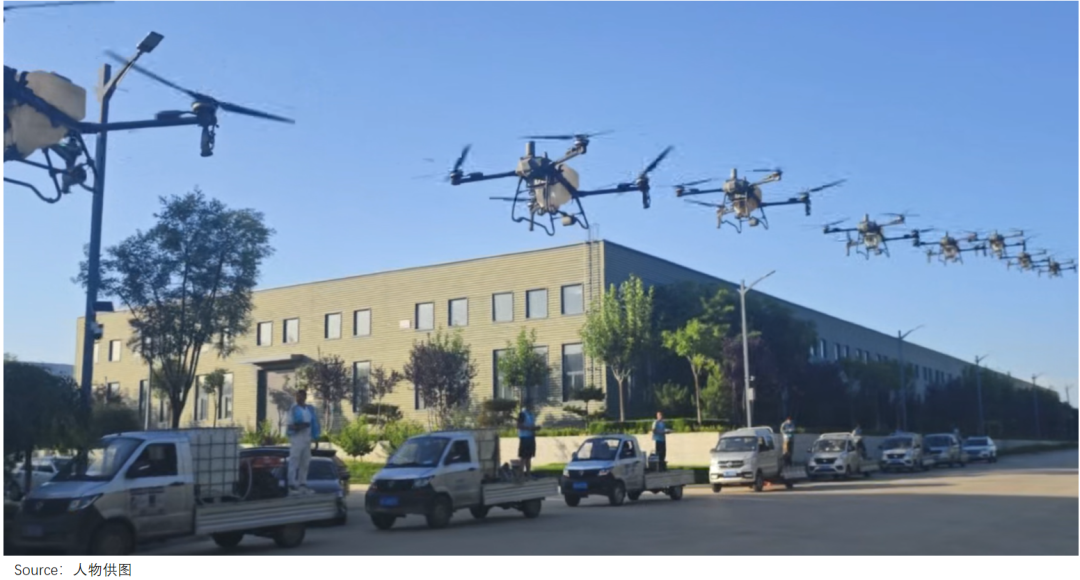
A drone pilot training school in China
“But when a drone costs tens of thousands of yuan, no company is going to hand it to a complete newbie to practice on,” Li said bluntly. That’s why newcomers today either start with low pay or have to prepay training fees—and if a pilot refuses to compromise, it’s easy to end up unable to find a job.
Difficulty finding employment also has a “man-made” cause. Some instructors at flight schools don’t even have instructor certifications. The drones they fly aren’t real professional models used on the job, but toy-like training machines. And even though five hours of practice is the minimum standard, classes end early when the time isn’t met.
They don’t care about reputation—once they’ve cashed in, they switch brands and repeat—leaving many trainees paying steep tuition but receiving training that doesn’t match the price. So even when job opportunities come, they can’t seize them.
“At the end of last year, a state-owned enterprise asked us to recommend 300 interns who understand drone assembly, calibration, and maintenance, with direct conversion to full-time roles after the internship—but we couldn’t find enough people,” Yinuo said. In her view, demand for talent still outstrips supply; it’s just that most people don’t meet the bar. On top of that, high-quality employers often recruit through partner organizations, so ordinary people can’t even see the good openings on job apps.
Still, she believes that as the Low-Altitude Economy Department is formally established and measures such as the “strictest ever” new drone regulations in 2026 are rolled out, the industry will move toward standardization, and various forms of disorder and information asymmetry will ease.
“When an industry is truly about to take off, regulators’ policy guidance is always out in front,” Yinuo said. She has already heard the opening notes of the industry’s transformation. What she needs to do now is claim a niche in the ecosystem first.
Anxiety is fertile ground for business opportunities. At Yinuo’s base, kids focused on drone competitions are propping up a business with a per-customer price tag close to 10,000 yuan.
After “science-and-technology specialty students” replaced arts and sports specialty students as the new “must-have credential” for moving up the education ladder, she threw herself into the youth training track—and got more and more invested. Now, middle-class parents are “intensively parenting” their kids into learning drones; when, in the future, there are fewer children and competition shifts from test scores to overall capabilities, drones will become an even more common first choice for parents.
“It integrates knowledge like aerodynamics and mechanical structures, and involves hands-on work like assembly, programming, and flying. It looks like play, but it’s really training comprehensive skills,” Yinuo said. Still, she hasn’t given up on the adult market either: “Drones aren’t just tools for production and education—they’re also becoming a trendy consumer product.”
She had noticed early on that drones had become bag charms for young people, and even fashion accessories for bicycles and cars. “More and more people won’t travel without a drone now—even retired uncles who are into photography are gearing up with one.”
“The whole industry has only been developed to about 30% so far—the room for imagination is still huge,” Yinuo said. Data also shows that sales of both consumer and industrial drones in China have been rising rapidly, with total sales projected to approach 8 million units by 2030.
That’s why she doesn’t just run a drone “driving school”—she has gone deeper into targeted adult training: based on each person’s strengths, she provides specialized career guidance for niches like agricultural spraying, lifting and transport, and performances, while gradually building a “talent pool” to connect companies with pilots. This not only eases job mismatches, but also boosts her popularity; the base’s total area has expanded from 50 mu to 80 mu.
Li has taken things a step further than Yinuo. Trainees who sign up with him are often baffled: for what seems like the same set of courses, how can one cost 3,800 yuan while another costs 12,000 yuan?
Whenever that happens, he patiently explains: the cheaper one only covers the licensing exam, while the more expensive one also includes job placement support. “But it’s not about finding you an employer—anyone who promises that is, nine times out of ten, setting a trap,” Li said. He chose to bind himself closely to the pilots—after graduation, he lends trainees drones and work vehicles for a period of time, solving the pain point new entrants face: no equipment and no capital to take on jobs.
Of the income the drone pilots earn, the branch office takes 30%. Once they’ve saved up enough to buy their own equipment and strike out on their own, they can still stay in the group and pick up jobs. This “teach a man to fish” move not only lets Li Zhen earn a cut, but also helps him build up a readily deployable “pilot squad”—a trump card when fighting over projects.
“Right now, projects like agricultural crop protection and surveying/inspection are mostly aimed at governments or big enterprises—you can’t win them without scale,” he said bluntly. At present, he had trained 17 cohorts of students, with more than 300 pilots he could dispatch externally, and his business had expanded from the north to the south, where demand stays strong year-round.
“Wealth lies in technique and strategy, not in grinding your body; profit lies in riding the momentum of the situation, not in sheer hard labor.” Li Zhen stressed that during turbulent times in the industry, those who know how to “leverage the trend” have a better chance of making it through.
Hou, a frontline pilot, deeply related to this. Not long ago, he joined a driving school as an instructor, only to find that the team there “turns over once a year,” with almost no stable members.
Only after asking around privately did he understand why: right now, “instructors are in oversupply,” and to cut costs, institutions replace a batch every year. It sent a chill down his spine. In the two years after graduating, he’d worked traditional roles like power-line inspection and realized promotions required an electrical-power background; after switching to being an instructor, he’d become a disposable “consumable” again—replaceable at any time.
He quit without hesitation and found an organization with a broader promotion path to sharpen his skills: “If you want to really make something of yourself in this industry, you have to grow horizontally. Just ‘knowing how to fly’ only earns you hard-earned money.”
Even so, as Hou was going through challenges at this moment, he still kept faith in the industry: “On an upward track, every step is full of energy.”
Explore more exclusive insights at nextfin.ai.


