
 Everything About AI

Geoffrey Hinton, a winner of the Nobel Prize in physics often referred to as the “Godfather of AI,” said Monday that he feels a form of regret as artificial intelligence advances faster than expected, but does not feel guilty about his role in pushing the technology forward.
Hinton shared his reflections in a conversation with Jany Hejuan Zhao, the founder and CEO of NextFin.AI and the publisher of Barron's China, during the 2025 T-EDGE conference, which kicked off on Monday, December 8, and runs through December 21. The annual event brings togehter top scientists, entrepreneurs and investors to discuss pressing issues of the AI era.
His comments came in response to Zhao’s question about whether he felt responsible for pushing humanity “into such a dangerous situation.” 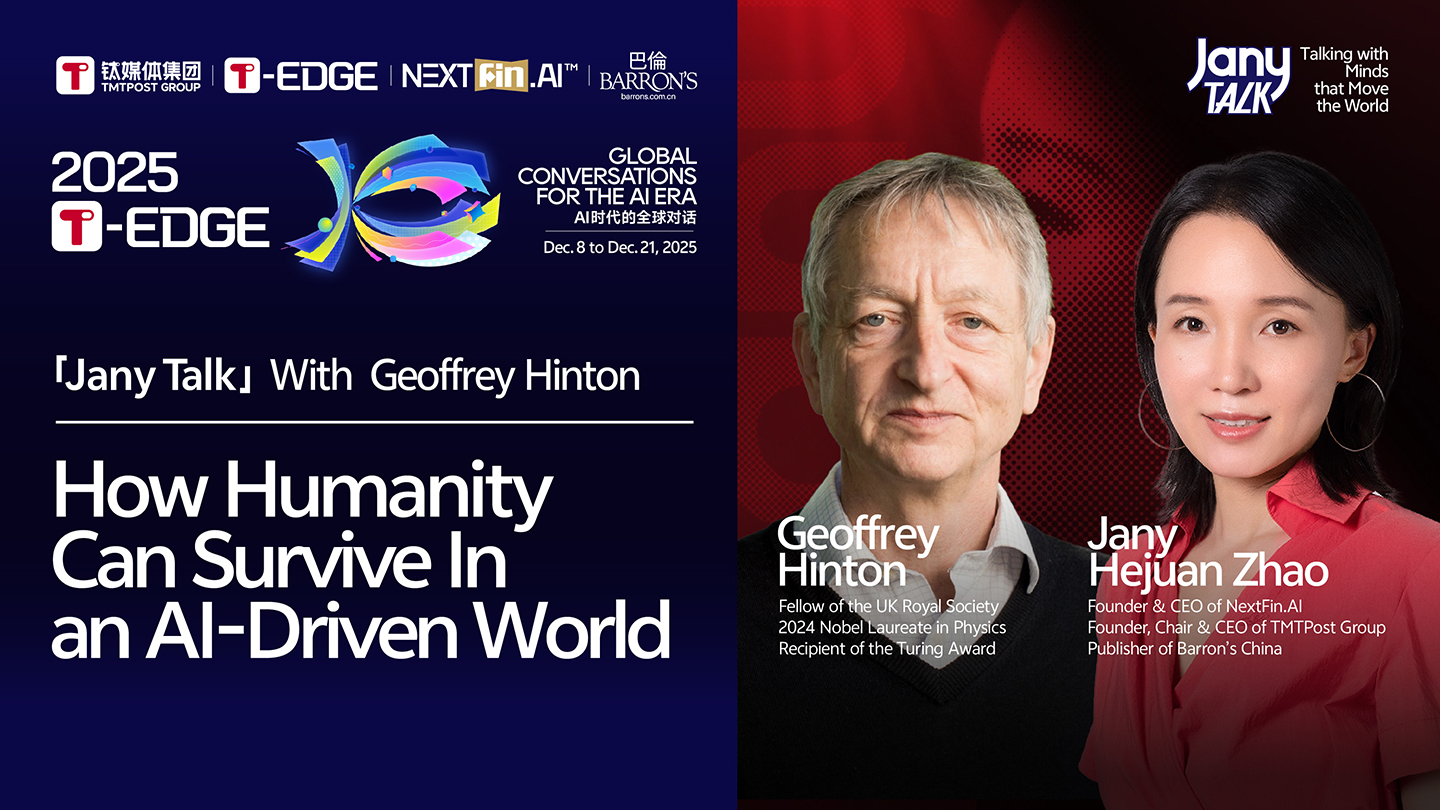
Hinton told Jany Hejuan Zhao that he feels a form of regret but not guilt
Hinton, also a recipient of the Turing Award and a professor of computer science in the University of Toronto, emphasized that he distinguishes between guilt and hindsight-based regret. “There's two kinds of regret. One is guilty regret—when you did something and, at the time you did it, you knew it was wrong. I don't have that kind of regret,” he said.
He explained that his early work on AI was driven by optimism. “At the time I was helping develop AI, I thought it would be mainly good. It would do amazing things like increasing productivity, and be wonderful in health care, education, and all sorts of things. I wasn't very aware of the risks, and so I don't feel guilty.”
If placed back in the same circumstances, he said, he would not have acted differently. “If I lived it again with the same knowledge I had then, I would do the same thing again.”
However, he acknowledged that the field’s rapid acceleration has created a new source of concern. “Now it's very unfortunate that it turns out that it's coming faster than we expected, and we may not have enough time to figure out how we can coexist with it. So in that sense, I regret a bit that,” he said.
Still, he rejected the idea that any single researcher should be viewed as responsible for AI’s trajectory. “Remember, there were a large number of people working together who developed AI. The media loves to have a story where one person did something—they attribute it all to one person. That’s kind of always nonsense. At least in science, it’s nearly always nonsense.”
He added that his own contribution was only incremental. “There are a few people like Newton and Einstein. If they hadn't been around, things would have been delayed a lot. If I hadn't been around, things might have been delayed a week or two… so I don't feel that guilty, because if I hadn't chosen to work on it many years ago, I don't think it would have made much difference.”
Explore more exclusive insights at nextfin.ai.
