

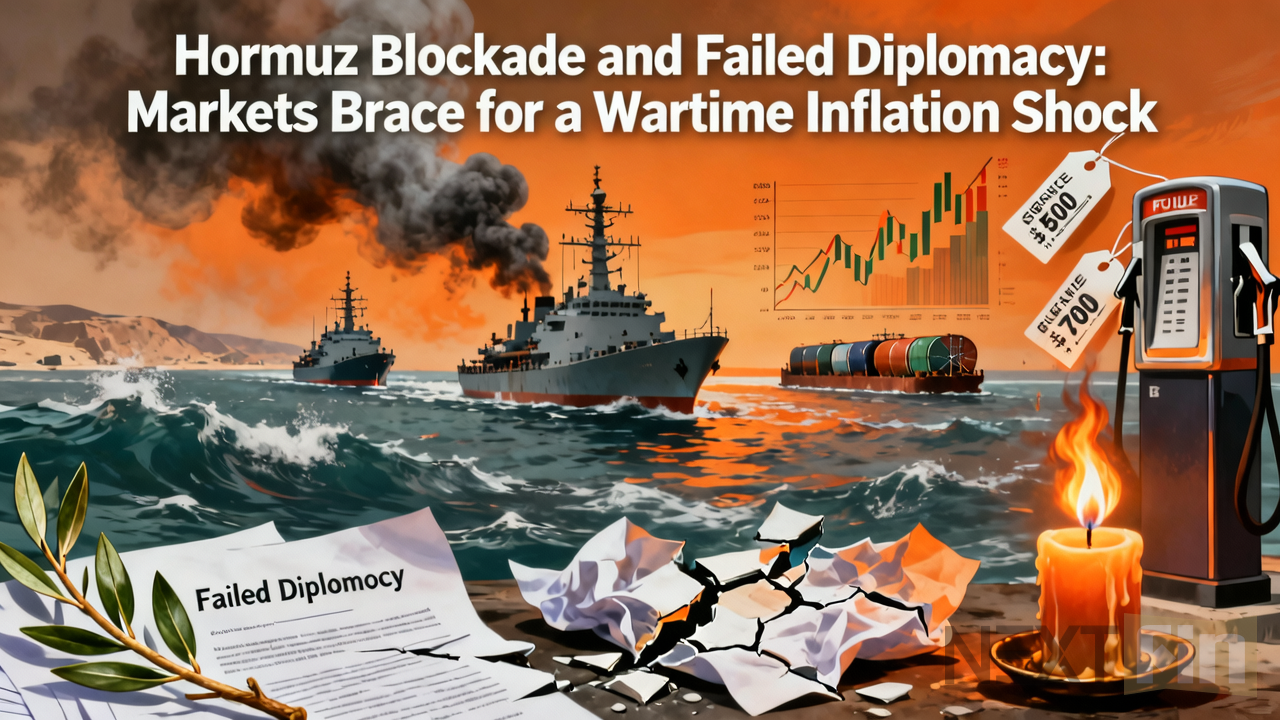
NextFin WeekAhead - The collapse of high-stakes peace negotiations in Islamabad over the weekend has thrust the global economy into a period of acute peril, as U.S. President Trump ordered a naval blockade and mine-clearing operations in the Strait of Hormuz. The failure of Vice President JD Vance’s 21-hour marathon session with Iranian officials has effectively ended a fragile two-week ceasefire, signaling a shift from diplomatic maneuvering to direct maritime confrontation. With the U.S. Navy now actively engaged in "clearing out" the world’s most vital energy chokepoint, the financial markets entering the week of April 13 are bracing for a "triple threat" of supply-side shocks, resurgent inflation, and a hawkish pivot from the Federal Reserve.
The immediate catalyst for the market’s anxiety is the physical reality of the Strait of Hormuz. While Iran claims "full control" over the waterway, the deployment of U.S. destroyers to begin de-mining operations suggests a high probability of kinetic skirmishes. For the week of April 13-17, the primary market narrative will be the "Hormuz Premium." Crude oil prices, which have already breached the $110 per barrel mark, are likely to test $120 if the blockade remains intact and mine-clearing efforts face Iranian resistance. The divergence between "paper" and "physical" oil prices is narrowing; as global inventories thin, the market is no longer just trading on fear but on the actual disappearance of 5 million barrels of daily supply.
This energy shock is colliding with a deteriorating domestic inflation picture. The March Consumer Price Index (CPI) report, released just before the weekend, showed a jump to 3.25%—a significant 85 basis point increase from February. This spike, largely driven by the "war tax" on gasoline and logistics, has effectively killed any remaining hope for a Federal Reserve rate cut in the first half of 2026. The CME FedWatch tool now shows a staggering 98% probability that the FOMC will hold rates steady at 350-375 basis points through June. For equity investors, this means the "higher for longer" regime is not just a policy preference but a geopolitical necessity to combat war-induced price pressures.
U.S. equities are expected to open the week under heavy selling pressure, particularly in the technology and consumer discretionary sectors. The S&P 500, already trading at a historically high Shiller P/E ratio above 40, is vulnerable to a sharp valuation reset as the discount rate remains elevated. Companies like Amazon have already begun implementing "fuel and logistics surcharges" of 3.5% for third-party sellers, a move that will likely be mirrored across the retail landscape, further dampening consumer sentiment. Conversely, the defense and domestic energy sectors—specifically U.S.-based oil exporters—may see a flight-to-safety bid as they become the primary alternative to Middle Eastern barrels.
The digital asset market is providing a unique, if volatile, window into the crisis. Bitcoin fell 2.5% to roughly $71,000 immediately following the Islamabad failure, reflecting its role as a "risk-on" asset during periods of extreme liquidity tightening. However, a fascinating counter-narrative is emerging: Iran’s reported demand for Bitcoin as a $1-per-barrel transit toll for tankers. This creates a floor of recurring, real-world demand for the cryptocurrency, even as broader risk aversion pulls prices down. For the coming week, Bitcoin is likely to remain range-bound between $68,000 and $74,000, caught between its identity as a speculative tech play and its emerging utility as a tool for bypassing traditional financial blockades.
The geopolitical endgame for the week hinges on the success of the U.S. Navy’s mine-clearing mission. If the U.S. can demonstrate a safe corridor for non-military vessels by mid-week, some of the "fear premium" may evaporate. However, the Iranian Revolutionary Guard’s threat of a "forceful response" to military transits suggests that the risk of a miscalculation is at its highest point since the war began. Investors should prepare for a week of "headline volatility," where a single social media post from U.S. President Trump or a report of a naval encounter could trigger 2-3% intraday swings in major indices. The era of cheap energy and predictable monetary policy has been replaced by a wartime economy where the most important chart is no longer the Fed’s dot plot, but the shipping lanes of the Persian Gulf.
Key Singals
The week of April 13–17, 2026, is a high-stakes period for global markets. A pivot from "truce hope" to "escalation risk" occurred over the weekend after U.S.–Iran talks in Islamabad failed to reach an agreement.
U.S. Stock Market Outlook
The market faces a "tug-of-war" between strong corporate earnings and severe geopolitical headwinds.
- Geopolitical Drag: Expect a volatile "risk-off" open on Monday. The U.S. Navy's planned blockade of the Strait of Hormuz starting Monday at 14:00 GMT is the primary downward pressure.
- Q1 Earnings Season: Big banks provide the only potential counter-balance.
- Monday: Goldman Sachs (GS) reports before the bell.
- Tuesday: JPMorgan Chase (JPM), Citigroup (C), and Wells Fargo (WFC).
- Key Technical Levels:
- The market is caught between strong AI earnings momentum and extreme geopolitical tension.
- Nasdaq Composite (IXIC) Levels:
- Immediate Support: 22,500 – 22,700. If the index breaks below 22,500, it signals a deeper correction toward the 50-day moving average.
- Resistance: 23,100. Breaking this would require a de-escalation in the Middle East or a massive "beat and raise" from the early bank earnings.
- S&P 500: Resilience depends on whether AI and Tech growth (projected at +44%) can outweigh energy-driven inflation.
- Earnings Volatility: This is a heavy week for Financials (JPM, GS, BLK, C, WFC). Their guidance on credit quality amidst rising inflation (due to oil prices) will dictate if the S&P 500 can hold its ground.
- Nasdaq Composite (IXIC) Levels:
- The market is caught between strong AI earnings momentum and extreme geopolitical tension.
Global Asset Impacts
The collapse of peace talks has invalidated the "dovish pivot" markets priced in last week.
- Energy (Oil): Brent crude has surged above $100/barrel (up 8%+). If the blockade fully halts traffic, analysts warn of a spike toward $135.
- Safe Havens (Gold): Gold is currently trading in a choppy but bullish range between $4,740 and $4,790, with a potential breakout toward $4,860 if regional conflict widens.
- Currencies: The USD remains the dominant haven, pressuring the Euro and GBP as energy costs threaten European growth.
Middle East & Geopolitical Shifts
The situation has escalated into a maritime and diplomatic crisis following the collapse of U.S.–Iran talks in Islamabad.
- Maritime Escalation: The U.S. is implementing a blockade of the Strait of Hormuz, prepared to stop vessels paying fees to Iran.
- Regional Conflict: Israel continues strikes in southern Lebanon, having rejected a ceasefire with Hezbollah.
- Diplomatic Focus: Critical talks between Israeli and Lebanese officials are set for Tuesday in Washington, D.C..
Explore more exclusive insights at nextfin.ai.


