
 Everything About AI

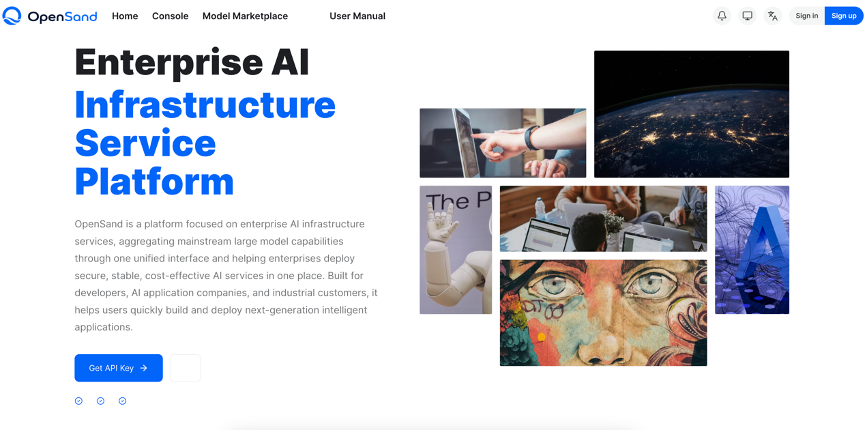
NextFin News -- The enterprise-grade AI model aggregation platform OpenSand has officially gone live.
By unifying the capabilities of leading global large language models—including Claude Code, ChatGPT, DeepSeek, GLM, and Gemini—into a single interface, OpenSand delivers a secure, stable, and cost-effective one-stop AI infrastructure service tailored for model developers, AI engineers, and business stakeholders alike.
The Explosion of AI Applications: Five Real-World Challenges for Enterprises
As large language models transition into the industrial deployment phase, enterprises are facing an urgent demand for streamlined model integration, strict cost control, regulatory compliance, and service stability.
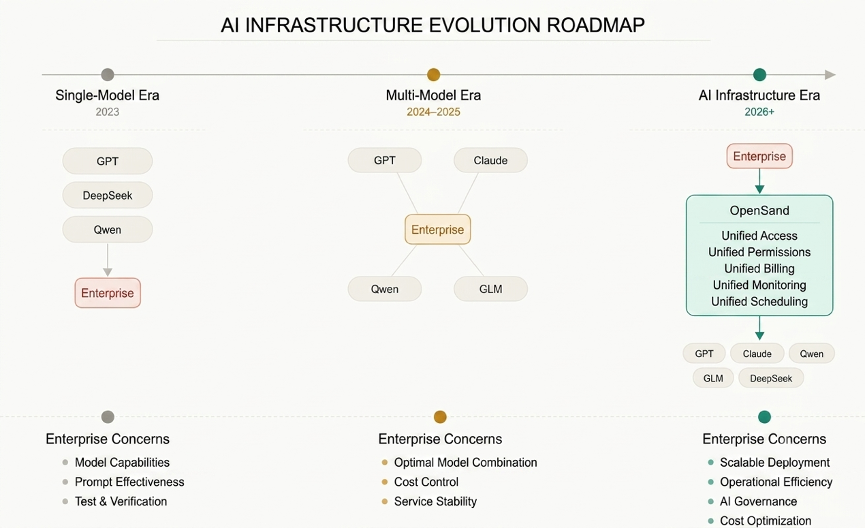
In the early stages of AI adoption, most companies relied on a single model. However, as business scenarios grew more complex, the limitations of this approach became clear. For instance, software development demands specialized coding models; knowledge QA requires heavy reasoning capabilities; content creation calls for multimodal models; and internal enterprise Agents often require multiple distinct models working in tandem.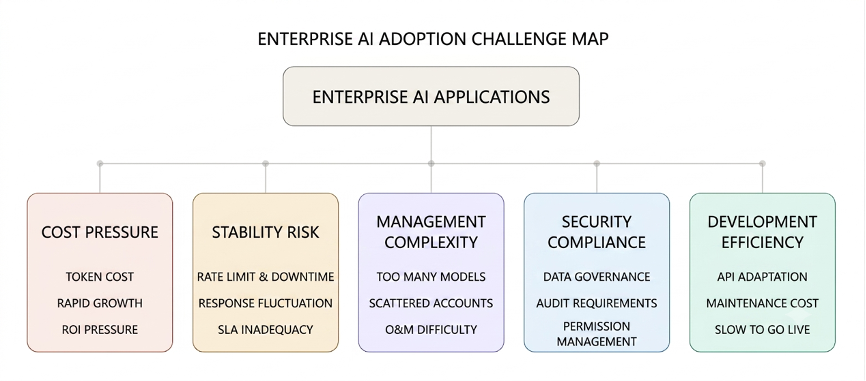
Consequently, more businesses are shifting toward a "multi-model collaboration" framework. In the long run, the way enterprises procure AI capabilities is mirroring the logic of cloud service procurement. Companies no longer focus on individual models; instead, they care about how efficiently they can manage their entire model ecosystem.
However, inconsistent interface standards across different model providers, fragmented billing structures, and scattered account management have driven up both technical and operational costs. A unified, stable, and highly efficient LLM infrastructure platform has become the new necessity.
OpenSand: The Unified Gateway Connecting Enterprises to AI Capabilities
As an enterprise-grade AI model aggregation platform, OpenSand has completed the unified integration of the world's leading proprietary and open-source models, covering core capabilities such as code generation, reasoning and analysis, multimodal creation, and intelligent Agents. Developers no longer need to waste time adapting to multiple distinct platforms; they can now call various model services via a unified API, drastically lowering integration barriers and R&D costs.
To deliver maximum value, OpenSand has engineered four core operational advantages:
l Enterprise-Grade Service Stability: Built on an enterprise-grade account architecture and distributed node infrastructure, the platform boasts high concurrency handling and ultra-stable API performance, fully meeting the continuous uptime demands of enterprise production environments.
l Ultimate Cost Optimization: Leveraging economies of scale and resource integration, OpenSand helps clients secure highly competitive model invocation costs, paving the way for large-scale AI application deployment.
l Unified Developer Experience: Fully compatible with mainstream SDKs and development tools, the platform allows existing projects to be migrated instantly. Development teams can integrate OpenSand without rewriting massive amounts of underlying code, significantly shortening development cycles.
l Robust Security & Compliance: OpenSand strictly adheres to enterprise-grade data security and content governance standards. While ensuring seamless service operation, it provides enterprise clients with a highly reliable and compliant AI infrastructure.
Who Benefits Most from OpenSand?
Currently, OpenSand’s application scenarios span eleven major industries, including: Internet/Software, Semiconductors, Robotics, Autonomous Driving, Game R&D, Industrial Software, Cross-Border E-Commerce, Academic & University Research, Cultural Content Creation, and Advertising & Media.
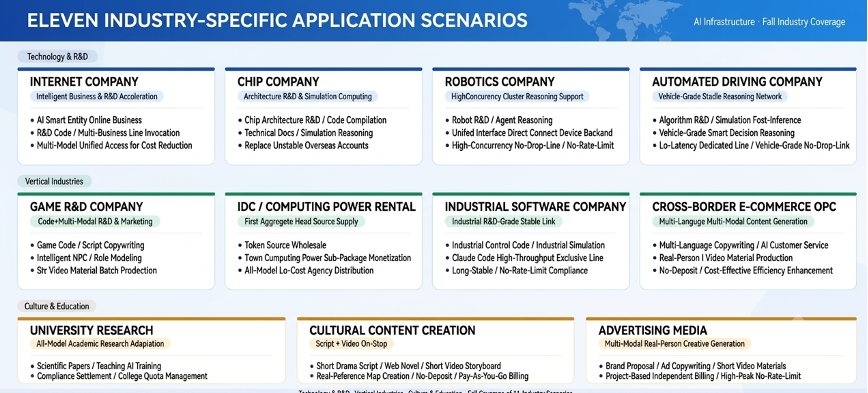
For these clients, the core requirement for AI has evolved. It is no longer just about "calling a specific model," but rather about establishing a sustainable infrastructure around high-frequency invocations, stable reasoning, cost control, team permission management, project-based billing, and compliance security.
Through a unified API, centralized management, and rock-solid service stability, OpenSand helps clients across various sectors rapidly inject LLM capabilities into real-world business workflows, smoothly transitioning from isolated experimentation to scale.
"AI is shifting from an era of technical innovation to an era of large-scale application," stated the head of OpenSand."What enterprises truly need is not just the models themselves, but a stable, compliant, low-cost, and sustainable AI service ecosystem. We aim to be the infrastructure that connects enterprise AI capabilities with actual business scenarios."
Over the past decade, cloud computing solved the problem of how enterprises acquire computing power.
Ove the next decade, AI infrastructure will solve the problem of how enterprises acquire intelligence.
As enterprise AI invocation volumes continue to surge, managing diverse models, optimizing costs, guaranteeing stability, and meeting compliance mandates will stand as the ultimate hurdles. Moving forward, OpenSand will continuously expand its model ecosystem and enterprise services, driving the scaled adoption of large language models across industries and providing long-term, stable, and efficient support for enterprise digital transformation.
OpenSand: Enterprise-garde AI Infrastructure Platform
OpenSand is an enterprise-grade AI infrastructure platform dedicated to providing a secure, stable, and cost-effective one-stop AI solution by unifying the capabilities of leading global large language models through a single interface. Designed for developers, AI-driven enterprises, and industry clients, OpenSand empowers businesses to rapidly build and deploy next-generation intelligent applications.
Explore more exclusive insights at nextfin.ai.
