

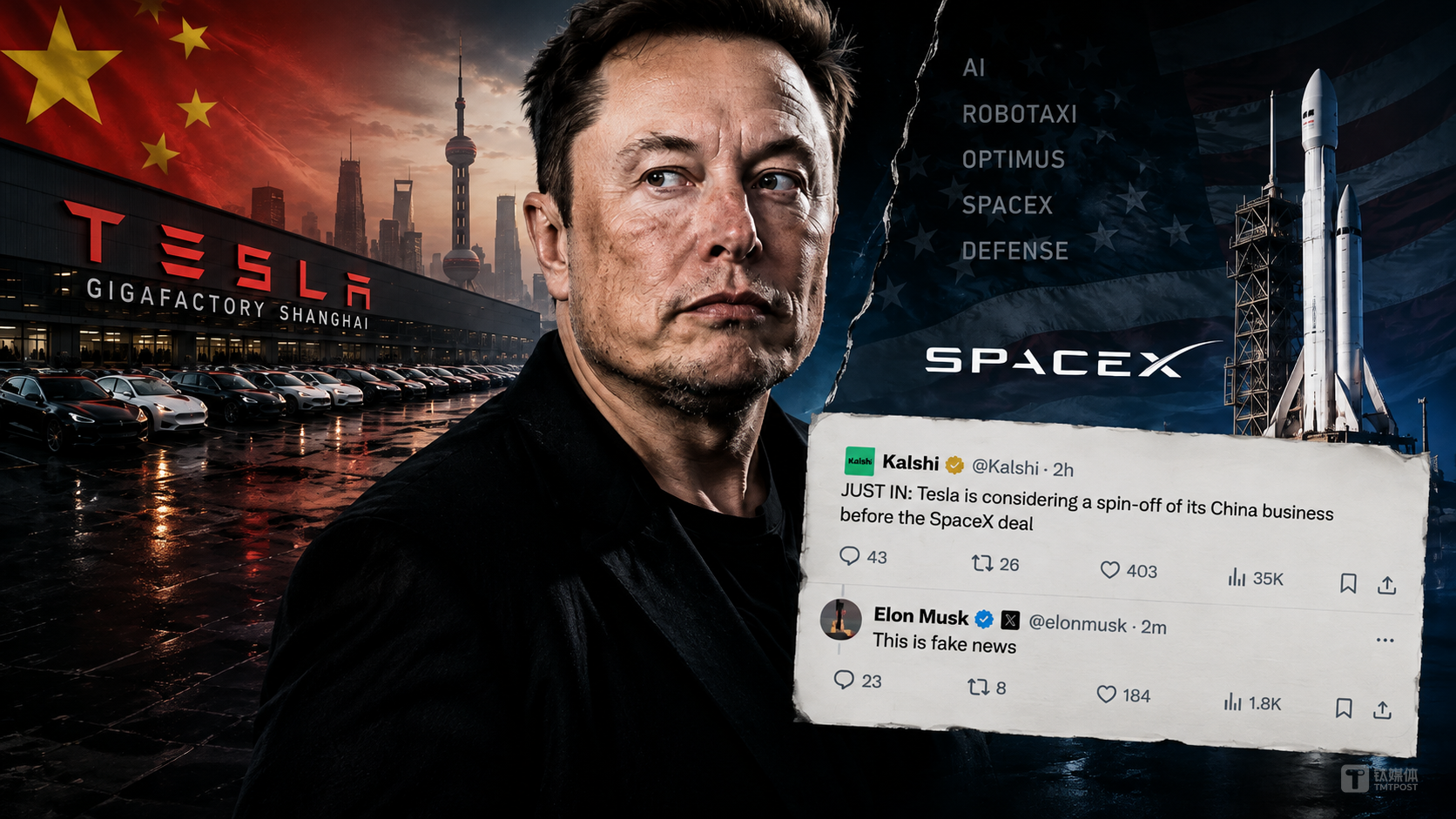
Image generated by AI
NextFin News -- A market rumor that Musk denounced as “absurd fake news” has once again thrust Tesla’s China business into the spotlight.
According to media reports, against the backdrop of a potential capital integration between Tesla and SpaceX, Tesla advisers and parts of management had discussed how to handle the China business. The options reportedly included selling it, spinning it off, shutting it down, or further isolating the China business from the U.S. business by creating an independent sales entity and separating office systems and permission settings. Musk later publicly denied the report, saying such discussions had never taken place. Another news outlet also said it could not independently verify the report. As of now, Tesla has not disclosed any plan to restructure its China business in regulatory filings.
This obviously should not be read as “Tesla is preparing to exit China,” but it is also not as simple as the rumor appears.
What Musk denied was that Tesla had already discussed spinning off its China business, but that denial did not eliminate the business conditions that gave rise to the rumor: Tesla is accelerating its effort to package itself as an AI, robotics, chips, and energy company, and may even move further into a SpaceX-led aerospace and defense capital ecosystem; at the same time, its auto business still relies heavily on the Shanghai plant and China’s supply chain.
The more Tesla tries to break away from the valuation logic of a traditional automaker, the more awkward the Shanghai plant’s place becomes within Musk’s business empire. It remains a core asset—highly efficient, high-capacity, and hard to replace—yet it could also become the most difficult risk to deal with in any future capital integration.
The Boundary Between Tesla and SpaceX Being Redrawn
This rumor is not entirely baseless.
On July 22, Musk did not rule out the possibility of integration with SpaceX during Tesla’s earnings call. Instead, he emphasized that the overlap between the two companies’ businesses was growing, involving batteries, manufacturing, engineering talent, chips, and AI infrastructure. Even more direct links have already shown up in the financial statements: In March this year, Tesla spent $2 billion to buy SpaceX shares, taking a stake of less than 1%; in the first half of this year, SpaceX purchased products such as Megapack from Tesla, contributing $405 million in revenue to Tesla.
In other words, the capital and business ties between Tesla and SpaceX had already formed ahead of any organizational merger.
This also aligns with Tesla’s strategic pivot in recent years. In its latest 10‑Q filing, Tesla defined its mission as “bringing artificial intelligence into the real world,” with a clear emphasis on FSD, Robotaxi, and the humanoid robot Optimus. The company expected capital expenditures to exceed $25 billion in 2026, mainly directed toward AI compute, data centers, production lines, and AI-related assets. Cars still generate the vast majority of revenue and cash flow, yet they increasingly resemble a platform—providing data and manufacturing capacity—for the broader AI narrative.
However, SpaceX is not an ordinary tech company; it is deeply involved in U.S. government, aerospace, and defense programs. When Tesla was merely an independent automaker, the Shanghai plant primarily faced regulatory scrutiny tied to the auto industry—trade, data, and supply chains. If the two companies further share capital, technology, chips, personnel, and manufacturing resources, the compliance standards applied to Tesla’s China operations could change.
For U.S. regulators, the focus may no longer be limited to which Chinese components are used in a Model Y. It could extend to whether China-based employees can access group systems, whether Chinese suppliers participate in sensitive programs, whether China-based manufacturing and R&D resources are shared with SpaceX, and whether there are hard-to-sever channels linking the two companies’ capital and data.
This is precisely what makes the rumor most worth watching. A break-up plan may not exist, but the pressure to enforce operational separation is real.
Tesla's Shanghai Plant Still Strategic
Judging from the financials, China’s importance to Tesla appears to be diminishing.
In 2025, Tesla’s revenue from the China market was $20.962 billion, accounting for 22.1% of the group’s $94.827 billion in total revenue. In the first half of this year, China revenue was $8.859 billion, or 17.5% of global revenue of $50.623 billion—down to less than one-fifth. While China revenue in absolute terms still posted a slight increase year over year, its weight in the group’s revenue mix has clearly shrunk.
Pressure on the market side is even more tangible. Data cited by foreign media said Tesla sold about 240,000 vehicles in China in the first half of this year, down 9% year over year; over the same period, domestic Chinese brands’ share of the EV market had risen to 72%. Tesla remains a key player in China’s premium BEV segment, but it no longer enjoys the overwhelming brand, product, and technology advantages it once did.
But a declining revenue share does not mean Tesla can already break free of China.
The Shanghai Gigafactory has annual capacity of more than 950,000 vehicles and accounted for over half of Tesla’s global deliveries in 2025. Beyond serving the China market, it is also a major export base for Europe, Canada, and the Asia-Pacific region. The Shanghai plant’s parts localization rate exceeds 95%, linking it with more than 400 Chinese suppliers—over 60 of which have already entered Tesla’s global supply system.
This creates the core mismatch at the heart of Tesla’s China business: China’s share in the revenue mix can gradually become lighter, but China-based manufacturing still carries heavy weight in the global delivery system.
Tesla can reduce the proportion of revenue coming from China sales through growth in Europe, North America, and other international markets, but it cannot, in the short term, find another production base comparable to the Shanghai plant in terms of cost, efficiency, supply-chain density, and export capability. Even if the Berlin factory and U.S. plants increase output, it would still be difficult to quickly replicate the parts ecosystem already formed in the Yangtze River Delta, the speed of engineering response, and the manufacturing cost structure.
For Tesla, China has long since ceased to be merely a regional market; it is a complete production operating system embedded in its global business. Spinning off a sales company is relatively easy; carving out the Shanghai manufacturing system would directly hit global vehicle supply, cost structure, and cash flow.
That is also why “spinning off Tesla China” sounds clean and simple, but is not very realistic in practice.
Hard to Separate Assets, Technology, Supply chain, and Valuation
If Tesla were to seriously consider carving out its China business, it would first have to answer a basic question: what, exactly, would be spun off?
If it only spins off the China sales business, the Shanghai plant would still belong to Tesla’s global manufacturing system, and the scrutiny issues arising from capital integration with SpaceX would not go away; if it spins out the factory, sales, R&D, and supply chain together, the new company would still have to keep using the Tesla brand, vehicle platforms, software systems, charging network, and after-sales system, maintaining a large volume of long-term related-party transactions with Tesla.
A company can be legally independent without being truly independent in business terms.
Behind the Shanghai plant sits a complex web of assets and financing arrangements. As of the end of June this year, the outstanding principal on Tesla China’s working-capital loans reached US$5.888 billion. Manufacturing assets on that scale—along with local financing, supplier contracts, and export arrangements—cannot possibly be cleanly severed through a single, simple equity transaction.
Valuation is another challenge. Tesla’s market cap has long been built on expectations around Robotaxi, FSD, Optimus, and AI compute, giving it valuation multiples far above those of traditional automakers. Some overseas media noted that as of the end of July, Tesla’s share price implied a forward P/E of more than 200x for 2027, versus about 10x for Toyota. A standalone Tesla China would, in essence, look more like an automaker with mature models, a highly efficient factory, and a vast supply chain—and it would be hard for it to continue enjoying the group-level AI and robotics premium.
That means that whether through a sale or a separate listing, Tesla China’s valuation would, in all likelihood, trade at a discount to the group.
Potential buyers would also face a paradox: if the new company continues to rely on Tesla’s software, brand, and technology licensing, it will struggle to prove it is truly independent; if it cuts those ties completely, its product competitiveness, brand value, and export capability would quickly decline.
While a spin-off could reduce some political risk, it could also trigger a string of business problems at the same time—valuation haircuts, related-party transactions, and supply-chain restructuring, among others. It looks like a sharp knife, but when you actually bring it down, you realize Tesla China has long since grown into the group as one.
Shutting the business outright is even less realistic. The Shanghai plant remains one of Tesla’s most efficient production bases, with one of its most mature supply chains. Closing it would amount to preemptively destroying the company’s most important manufacturing capability today just to eliminate a regulatory risk that might emerge in the future. From a business standpoint, that would be nearly impossible to justify to shareholders.
"Soft Isolation" is More Realistic than an Equity Split
Weighing the political costs against the business price tag, the odds that Tesla would fully sell off or shut down its China operations are not high. A more likely path is to keep ownership and manufacturing capacity intact while applying a more granular “soft isolation” to the China business.
The independently operated export-sales entity, the separation of office systems between China and the U.S., and restrictions on employee permissions mentioned by foreign media are exactly in line with this thinking. Musk denied that such discussions had taken place, but from a corporate-governance perspective, measures like these are far more realistic than selling a factory.
The first layer of isolation could occur on the data and systems side. The China team would continue serving the China market and Shanghai production, but it would not be able to access SpaceX, global AI chips, or certain core U.S. R&D programs, while internal access to information, code, personnel, and suppliers would be further segmented.
The second layer could occur at the organizational and legal-entity level. Tesla could set up more independent entities for Shanghai’s exports, procurement, or R&D, establish separate board-reporting lines and compliance mechanisms, and package the China business as a regional segment that keeps its distance from U.S.-sensitive operations.
The third layer could land in the supply chain. Chinese suppliers could still provide parts for the Shanghai plant, but when it comes to Tesla’s global AI, chips, robotics, or projects related to SpaceX, they would face stricter reviews around staff nationality, production locations, and data-access controls.
This kind of arrangement would not produce a dramatic “exit from China,” but it could gradually reshape Tesla’s past model of globalization.
The Shanghai plant would still produce the Model 3 and Model Y, still export overseas, and might even continue to receive additional investment. Tesla is also still pushing ahead with the ramp-up of capacity at its Shanghai energy-storage Gigafactory, which likewise shows it has not stopped expanding manufacturing in China.
But at the same time, the distance between the China team and U.S. AI, chip, and aerospace operations could grow larger and larger. Tesla China would continue to exist, yet it would gradually shift from a highly interconnected growth hub inside the group into a manufacturing and sales region with clearer, independent boundaries.
This is subtler than a one-off spin-off—and may also be more profound.
Two Versions of Tesla
In the past, the Shanghai plant was Tesla’s most successful asset in its globalization drive. It helped Tesla cut costs, expand capacity, open up the Chinese market, and support deliveries across Europe and the Asia-Pacific region. For an automaker pursuing scale and manufacturing efficiency, it was an almost indisputable core asset.
But Musk is pushing Tesla toward a different capital logic.
In the narratives of AI, robotics, and Robotaxi, car manufacturing is merely a gateway for data and a vehicle for technology; in a potentially deeper integration with SpaceX, Tesla will also have to contend with the U.S. defense supply chain, government contracts, and national-security reviews. The Shanghai plant’s efficiency will not decline as a result, but because of where it is located and its supply-chain ties, it may be saddled with higher governance and compliance costs.
As a result, the same China-based asset is being judged in two completely different ways.
For the auto business, it is Tesla’s most irreplaceable manufacturing hub; for the AI-, chip-, aerospace-, and defense-oriented capital map Musk is building, it may instead become a sensitive interface that requires firewalls. This is also why, even after Musk publicly denied it, the discussion is unlikely to fade away anytime soon.
In the short term, selling the Shanghai plant, shutting down its China business, or a complete spin-off is not the option that best serves commercial interests. Tesla is more likely to keep the efficiency of China-based manufacturing while reducing the links between its China operations and U.S. core technologies and the SpaceX system.
What may ultimately be split apart is not necessarily the equity of the Shanghai plant, but the globally integrated system this company once took pride in. (Reporting by Li Yupeng and editing by Yang Lin.)
Explore more exclusive insights at nextfin.ai.


