

Physical-level AI Operator company Violoop on Thursday announced that it had completed seed and angel financing totaling tens of millions of RMB within a single month.
The proceeds will primarily be used for scaling the product into mass production and real-world deployment, global market expansion, and the ongoing construction of the Action Model dataset—helping Violoop accelerate the build-out of infrastructure for the AI-era operating system.
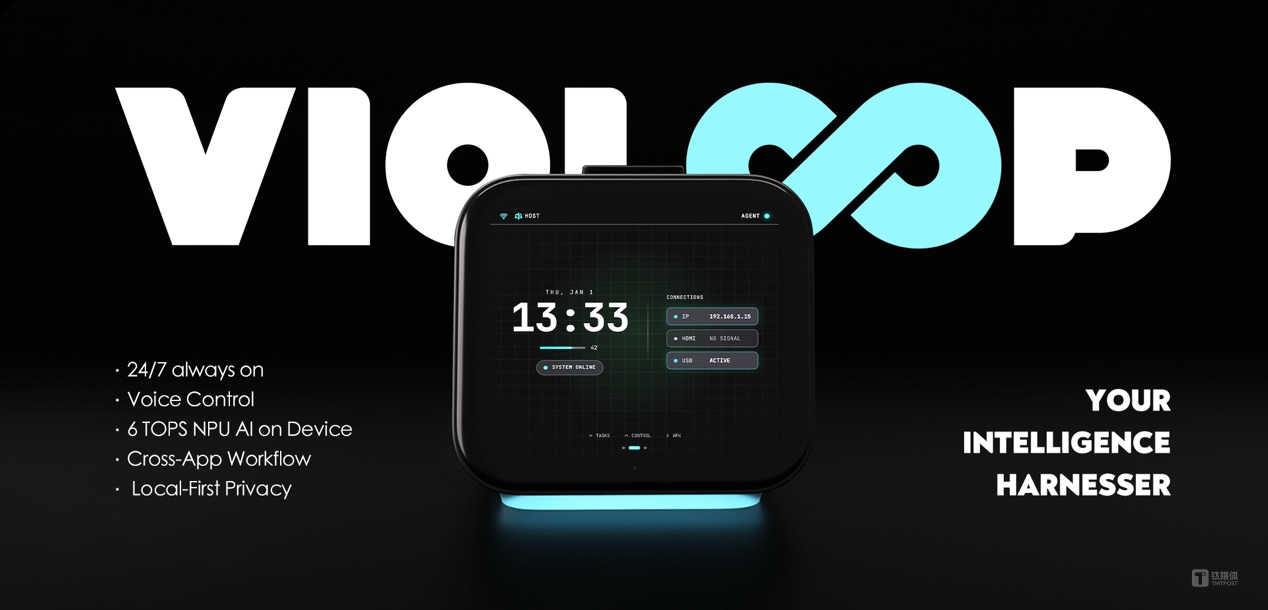
Positioned as a core bridge connecting the traditional software world with the next-generation AI world, Violoop has innovatively created a physical-level AI Operator that integrates an AI-PC Agent, hardware control, and a workflow platform. Through the "PC + Violoop" combination, it delivers uninterrupted 7×24 automated work, becoming a “always-on digital employee” for enterprises and individuals. Unlike Openclaw and other players in similar tracks on the market, Violoop takes hardware as its foundation and has built an unreplicable structural moat across technical architecture, user experience, and the construction of its Action Model dataset—redefining the AI-era OS.
Technically, Violoop adopts a dual-chip, hardware-level security architecture to eliminate, at the physical layer, the risk of malicious command hijacking. By simulating real keyboard-and-mouse inputs via purely physical signals, it achieves zero detection and zero bans at the application layer, and is naturally compatible with closed-source software that has no APIs, such as WeChat, Jianying, and QuickBooks. At the same time, dedicated optimization for its on-device NPU—paired with proprietary OCR training tailored to desktop UIs—reduces task execution costs by more than 20x compared with solutions like Open Claw. Moreover, its in-house chip driver plus vertically integrated hardware-software stack enables BOM costs at the same NPU compute level to be just one-third of the industry’s, significantly lowering the barrier in users’ purchasing decisions.
On the user-experience front, Violoop delivers a plug-and-play experience with zero deployment hassle. At the hardware layer, it captures the full set of keyboard/mouse inputs plus on-screen visuals and timing/sequence information, addressing the pain points of software-only approaches—fragile data pipelines and repeated failures to learn a user’s workflow—so even complete beginners can use it. It also stores the user’s workflows and preferences on the device itself, enabling seamless migration across devices and across cloud-based models, so the data asset truly follows the user. In addition, Violoop offers a unique proactive perception capability: it can observe the screen in real time, understand the user’s work habits, and proactively generate reusable workflows—upgrading from “passively responding to commands” to “anticipating needs,” and becoming a genuinely “thoughtful” 24/7 assistant.
As for building long-term defensibility, Violoop connects via physical HDMI access, making it the only device globally that can losslessly and comprehensively obtain a complete data chain of “video stream + operating system APIs + HID interactions.” It is building the world’s largest Action Model dataset. This exclusive “gold mine” of user-behavior data becomes the most critical competitive moat in the AI era, laying a solid foundation for subsequent model iteration and ecosystem expansion.

Violoop’s rapid rise has been inseparable from its “perfect-match” complementary founding team—nine post-90s founders with highly synergistic strengths. CEO Jaylen combines a technical background with sharp commercial insight, with market experience spanning China, the U.S., and Africa. He previously scaled a real-estate transaction platform’s GMV from zero to over US$100 million, led the team into YC W19, and brings exceptional capabilities in supply-chain negotiations, commercialization, and community operations. CTO King completed MIT EECS (full scholarship) bachelor’s and master’s degrees in just three and a half years. A full-stack expert across both software and hardware, he previously worked at ADI on chip design and contributed to mass-shipped products such as Microsoft Xbox and HoloLens. He also holds two patents in video compression and retrieval, laying the core foundation for Violoop’s “screen memory” technology.
The two founders have known each other for seven years and worked together for three. Before founding Violoop, they deployed private large models for a global top-100 consumer goods company and generated nearly €10 million in revenue—proof that both their working chemistry and monetization ability have already been validated. The team combines Silicon Valley DNA with the advantages of China’s supply chain, and also possesses exceptionally strong domain insight and self-iteration capability—forming the core confidence needed to break out in this hotly contested arena.
According to sources, Violoop’s product is set to launch on Kickstarter in April to begin global crowdfunding. Its supply chain has been fully implemented and is expected to enter mass production within two weeks. An interaction revolution in the AI era is underway: the keyboard and mouse defined desktop interaction for the past 40 years, touch ushered in the mobile era, and Violoop is now driving a paradigm upgrade for AI-era desktop interaction with a new model of “humans express intent, agents execute actions.” Leveraging hardware as its core advantage, Violoop has found a new opportunity at the boundary between software and hardware—enabling an exponential leap in productivity for users worldwide and becoming an AI-era “physical employee” anyone can use.
Explore more exclusive insights at nextfin.ai.


