
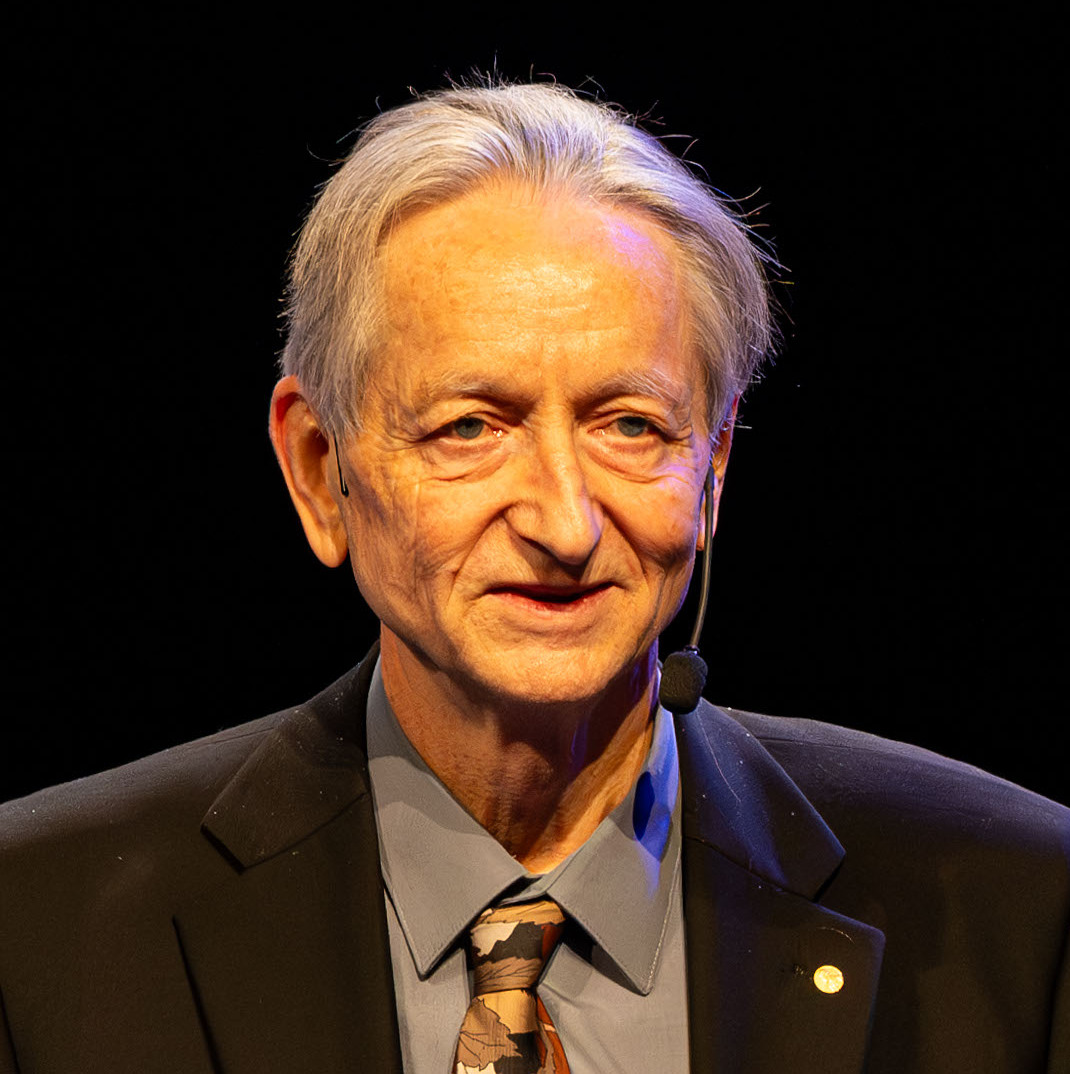

NextFin News - On November 18, 2025, Georgetown University's Gaston Hall hosted a public conversation titled "AI: The Promise and the Peril," featuring Dr. Geoffrey Hinton and Senator Bernie Sanders, moderated by Mo Elleithee of the Georgetown Institute of Politics and Public Service. The program brought students, faculty and staff together for a wide-ranging discussion followed by an extended student question-and-answer session.
The discussion centered on the technical capabilities and social consequences of today's rapidly advancing artificial intelligence systems. Dr. Hinton set out both the powerful benefits he expects AI to bring and the serious social challenges it poses; Senator Sanders framed those challenges in political and economic terms, emphasizing who controls the technology and how its gains are distributed.
AI’s Practical Upsides: Health care, education and prediction
Dr. Hinton highlighted tangible benefits that AI can deliver across many sectors. He stressed that AI is not simply destructive technology and illustrated concrete improvements:
it's going to make health care hugely better. It's going to make education hugely better.
Hinton pointed to personalized tutoring and diagnostic improvements as immediate examples. He explained that a high-quality AI tutor will draw on millions of examples to identify exactly what a student does not understand, and that AI can read medical scans and combine genomic and clinical data to provide better diagnosis and drug design.
We know that a private tutor allows you to learn about twice as fast as a classroom. And AI is going to be even better than that.
He also stressed the value of better prediction generally — from weather forecasting to hospital logistics — arguing that improved forecasting can make systems more efficient and productive.
Jobs, productivity and the risk of displacement
Hinton warned that AI will replace large numbers of jobs and that the scale of creative destruction is an open, high-stakes question. While recognizing the productivity upside, he repeatedly returned to the labor-market consequences:
for the fact that it will replace a lot of jobs ... I don't believe it's going to create as many new jobs as it replaces
He noted disagreement among economists about whether new job categories will offset losses, referencing economists such as Daron Acemoglu as offering differing views and emphasizing the deep uncertainty about future outcomes.
When asked whether society should simply pursue ever-stronger AI so machines can "take care of all of our problems," Hinton separated technical possibility from political choice: powerful AI could be used to free people from toil if governed by institutions that prioritize human welfare.
We should have very powerful AI that does everything for us. We should be very careful to design it so it cares more about us than it does about itself.
Designing safe AI: "maternal instincts" and alignment
Exploring how to make AI systems that reliably protect human interests, Hinton introduced an evocative framing: learn from relationships where a more powerful agent cares for the less powerful.
We need AI with maternal instincts. We don't know how to engineer that, but we're still in charge and we should be able to engineer that.
He suggested that engineering a form of caring or aligned objective in AI is part of the puzzle for coexistence with systems that may become far more capable than humans.
Misinformation, deepfakes and the limits of detection
On the rapid rise of synthetic media and political misinformation, Hinton argued that technical detection methods will inevitably be matched by generative systems, creating an arms race that cannot be solved by recognition alone:
there's no future, I believe, no long-term future in getting AI to recognize fakes produced by AI because you can always make better fakes.
Instead, he advocated provenance systems and public inoculation strategies. He described proposals for source-based verification — for example, embedding QR codes that link to a canonical campaign website — and urged media literacy measures, including intentionally labeled fake content released ahead of elections so that the public becomes familiar with what deepfakes look like.
The way to do it is to have provenance ... your browser can take the QR code, go to the website, check it's a website of that campaign ... it should be possible for your browser to tell you that this is a genuine video.
Autonomous weapons and international governance
Hinton said he has long opposed lethal autonomous weapons — systems that decide whom to kill or maim without meaningful human control — but acknowledged moral and practical complexities in wartime contexts. He expressed support for international limits while conceding that treaties often follow, rather than prevent, abuses:
For a long time I've been against lethal autonomous weapons ... we should forbid that. We should have Geneva conventions against that which probably wouldn't come into place till very nasty things had happened.
He also noted how battlefield realities, such as the use of drones in Ukraine, complicate simple bans and argued that international treaties can work but may require painful precedents.
Energy, data centers and environmental concerns
Responding to student questions about the environmental footprint of data centers, Hinton acknowledged the real costs of electricity and water consumption and pointed to practical siting solutions. He suggested locating data centers near abundant hydroelectric resources as a way to reduce transmission losses and environmental impacts:
They should be building their data centers on Hudson Bay. On Hudson Bay, you could build more hydro power stations ... if you put a data center next to a hydro power station, you don't need any transmission lines because the only thing you need to send out is information.
Education, research funding and the long game
Hinton warned that sustained public funding for basic research underpins long-term technological leadership. He cautioned that cutting university research and grants will erode national competitiveness over decades:
If you cut off that money, it's like eating the seed corn. In 10, 20 years time, America will be way behind China.
He urged continued investment in research universities and federal grants as essential to future innovation.
Senator Sanders on politics, inequality and public policy
Senator Sanders framed much of the conversation as a political question about control and distribution. He emphasized that AI's effects will depend on political choices and that concentrated corporate power is central to the debate:
The struggle is not whether AI is good or bad. It's who controls it and who benefits from it.
Sanders repeatedly argued for policies to share AI's gains with society: stronger unions, shorter workweeks, universal healthcare and public investment in education. He denounced the role of profit-driven insurers and called healthcare a human right:
It is totally absurd and embarrassing that the United States of America ... is the only major country not to guarantee healthcare to all people as a human right.
He raised concerns about bailouts and corporate influence, warning that powerful firms could expect government rescue in a market downturn and stressing the need for a democratic government that represents ordinary people rather than big-money interests.
What individuals and students can do
Both speakers urged students to engage politically and think beyond technical fixes. Hinton emphasized technical uncertainty and the importance of shaping deployment, while Sanders called for political organizing and public demand for policies that protect workers and expand public goods. To the question of practical preparation, Sanders framed much of the response as civic and political action:
The real question to me is a fundamental political question and we need your generation ... standing up and creating a government that works for all of us and not just the big money interest.
Closing observations
Together, Hinton and Sanders presented a two-part warning and a conditional hope: AI brings clear technical benefits that could improve healthcare, education and productivity, but those benefits will not be fairly realized without political systems and institutions aligned to share gains and limit harms. The program closed with students reflecting both optimism and deep concern about their futures in an AI-driven economy.
References
Event page and recap: Georgetown Institute of Politics & Public Service — AI: The Promise and the Peril.
Media advisory from Senator Sanders: U.S. Senate — Advisory: Sanders and ‘Godfather of AI’ to Discuss the Future of AI.
Department of Computer Science recap: Georgetown University Department of Computer Science — Students meet Sanders and Hinton.
Explore more exclusive insights at nextfin.ai.
