
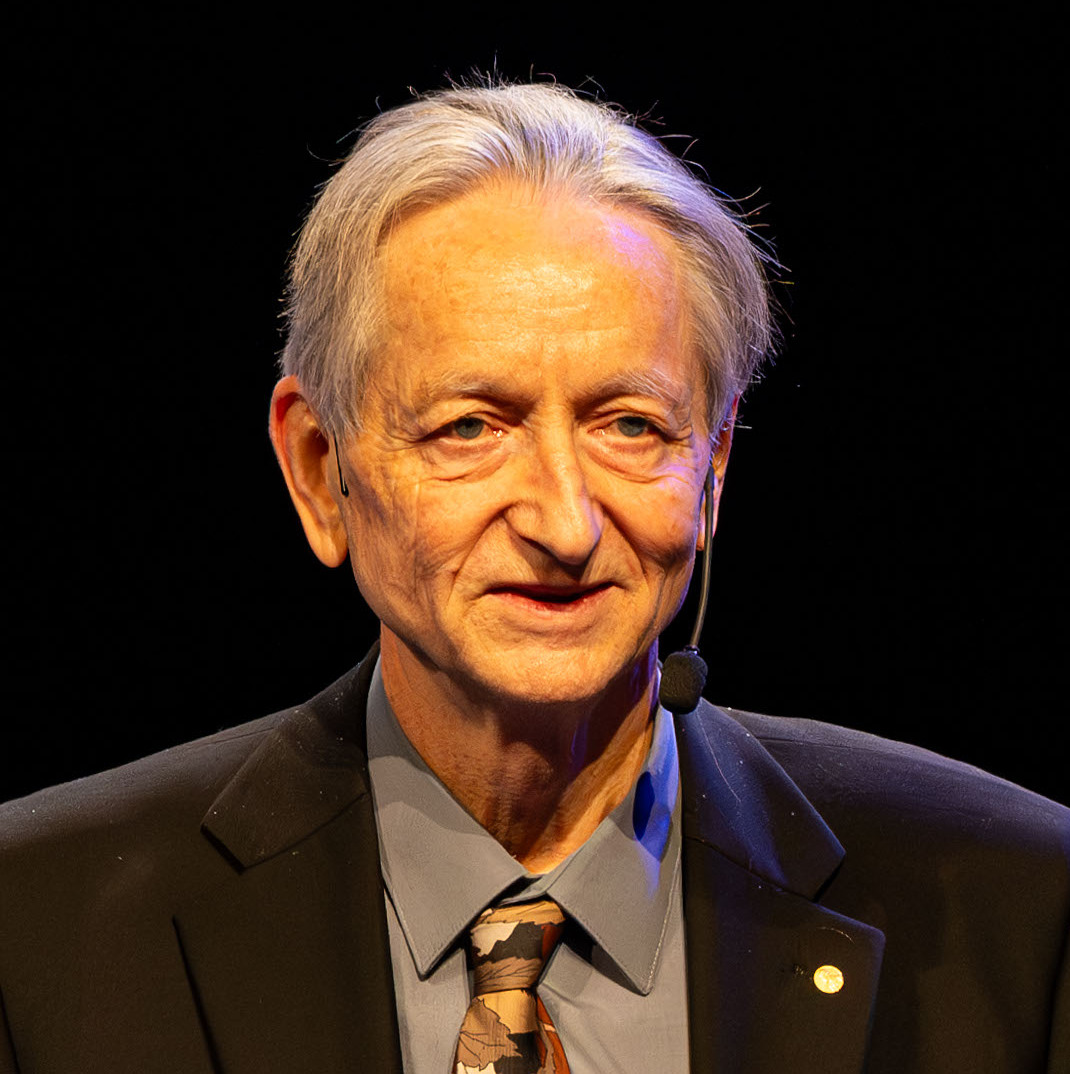

Geoffrey Hinton on Embodied Understanding
NextFin News - Geoffrey Hinton spoke at a Royal Institution Friday Evening Discourse recorded in London on 2025-05-30. The lecture was presented by The Royal Institution as part of its lecture series; the event was delivered in a talk format rather than a one-on-one interview, with Hinton himself laying out his arguments and examples to the audience.
In the short excerpt reproduced here, Hinton set out a compact but forceful case for embodied learning: that a neural network which can see and act in the world will acquire a type of knowledge that is difficult to obtain from language alone.
Embodied learning: a robot arm and a camera
Hinton opened with an explicit proposal about how to give artificial systems richer knowledge of the physical world. He described a neural network paired with simple hardware and with capabilities for perception and manipulation. In his words: If you really wanted to understand what's going on in the world, a good idea would be to make a neural net that had a robot arm and camera and it could recognize objects. It could pick things up.
He emphasised the value of concrete, repeatable interactions: the system could see the results of actions and thereby learn basic physical facts.
Learning by doing: experiments like a child
Hinton compared this embodied approach to the way children acquire knowledge. He argued that simple experiments — picking objects up, letting them go, observing drops and collisions — create direct evidence about how the world works. He put the point concisely: It could see that if you let go of an object, it drops. Could do little experiments in the world. That's much more like a child.
The implication he presented is that interaction yields spatial and causal understanding in a way that language-only training struggles to replicate.
World models through prediction
Describing the learning process, Hinton framed understanding as prediction: by acting and observing, the system builds models that forecast consequences. He said that interacting and trying to predict outcomes provides the basis for a world model: If you want to understand spatial things, it's going to be much easier to understand them by interacting with the world and trying to predict if I do this, this is what will happen next. That will be a world model.
The statement presents learning as an active, experiment-driven process rather than a purely passive ingestion of descriptions.
Language-only learning: surprising power, clear limits
While advocating embodiment, Hinton acknowledged a striking counterpoint: language-trained models already show substantial knowledge about the world. He observed the philosophical puzzle this creates: Now, what's amazing is that you can understand a lot of that just from language. That has philosophers puzzled.
He reiterated the central contrast that motivates his proposal: although much can be gleaned from text, he maintained that direct interaction still makes certain kinds of spatial understanding much easier. As he put it, And you can understand a lot about the world just from language. But it's much easier to understand if you interact directly with the world.
Practical emphasis: seeing, acting, predicting
Across these remarks Hinton emphasised practical, testable capability: perception plus manipulation plus prediction. The repeated formulation in the talk was that concrete actions and sensory feedback create a natural pathway to spatial and causal knowledge that complements the surprising achievements of language-based models.
References
Event host: The Royal Institution (Friday Evening Discourse series, talk recorded at the Ri on 2025-05-30).
Explore more exclusive insights at nextfin.ai.
