
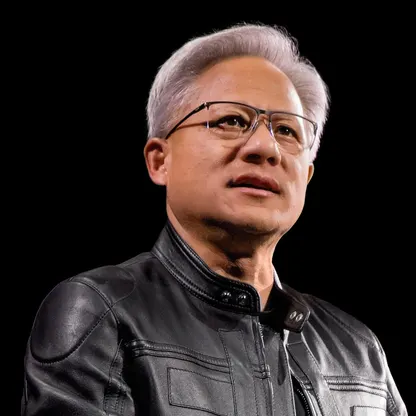
NextFin News - On December 3, 2025, NVIDIA founder and CEO Jensen Huang spoke at a fireside chat hosted by the Center for Strategic and International Studies in Washington, D.C., with CSIS president and CEO Dr. John J. Hamre serving as interviewer. (csis.org)
The conversation presented Huang’s staged account of how AI is built and deployed, and why national advantage in AI depends on capacity across multiple layers of that stack. Over the course of the hour Huang repeatedly framed NVIDIA as a platform company that supplies the lower layers on which a wide variety of applications are built. (csis.org)
AI as a five‑layer platform
Huang opened by defining AI as a layered platform and insisted the industry must be viewed holistically rather than reduced to a few high‑profile models. He said the stack can be simplified into five layers: energy, chips, infrastructure, models and applications. On NVIDIA’s place in that stack he emphasized that the company provides the platform technology — chips, systems and software libraries — on top of which others build applications. Our business model is purely technology,
he said, and he pointed to CUDA and a broad set of software libraries as core elements of NVIDIA’s platform. (rev.com)
Energy as the foundational constraint
Huang described energy as the bottom layer and a pacing constraint for large‑scale AI buildouts. He warned that without sufficient power generation and distribution, it is not possible to site chip fabs, supercomputer plants or the large AI data centers he called AI factories.
He stated plainly that China has invested heavily in capacity, telling the audience that China has twice the amount of energy we have as a nation
and urging the United States to accelerate energy growth — including a more robust approach to generation and behind‑the‑meter solutions. (rev.com)
Chips and manufacturing: an edge, but not a guarantee
On semiconductors Huang underscored that U.S. and Western firms remain ahead in chip design and technology. We're generations ahead on chips,
he said, but cautioned against complacency because semiconductors are a manufacturing process and China is capable of closing the gap quickly if conditions favor rapid scale‑up. He highlighted policy and cost differences — for example, energy discounts and transportation and workforce supports given to Chinese fabs — and noted that such incentives can dramatically lower the effective cost of manufacturing in China. (rev.com)
Infrastructure and velocity of buildout
Huang contrasted the United States’ longer timelines to stand up large AI data centers with China’s faster construction pace. He estimated that building an AI supercomputer in the U.S. from breaking ground to operation typically takes roughly three years, and he used a pointed comparison — They can build a hospital in a weekend
— to illustrate China’s higher velocity of physical buildout. That speed, he argued, is a competitive advantage at the infrastructure layer. (rev.com)
Models, open source, and the diffusion of AI
Moving up the stack, Huang said frontier large language models in the United States remain world class and estimated U.S. frontier models are about six months ahead. But he stressed that the global AI ecosystem includes roughly one and a half million models across many domains and that most of those models are open source. He argued China is well ahead, way ahead on open source
and explained why open source matters: it enables startups, university research and broad diffusion of tools that drive innovation. Huang warned that without open source, the broader ecosystem of researchers, startups and developers would be constrained. (rev.com)
Applications, social attitudes and deployment
Huang emphasized that AI’s impact is measured by who applies it first and most widely, not only by who builds headline models. He contrasted public sentiment about AI in China and the United States — saying a majority in China view AI as likely to do more good than harm, while sentiment in the U.S. is more cautious — and warned that U.S. social anxiety could slow application and diffusion. He urged practical attention to automation and industry deployment across healthcare, manufacturing, robotics and other domains. (rev.com)
Market access, competition with Huawei, and the risk of conceding markets
When pressed about competition with Huawei and the meaning of his earlier remark that China was winning the AI race,
Huang offered a nuanced, layer‑by‑layer assessment. He praised Huawei as one of the most formidable technology companies the world has ever seen
and acknowledged the company’s agility and the support it receives. He also described NVIDIA’s current market access constraints, saying the company has effectively been banned on both sides
and that, as a result, NVIDIA is simply not competing in China
at the moment. Huang warned that conceding the second‑largest technology market to China creates an ecosystem risk and urged competition for that market rather than surrender. (rev.com)
Policy and industry recommendations
Throughout the discussion Huang returned to policy themes: the need to reindustrialize and reshore manufacturing, to scale energy production, to support open‑source ecosystems, and to ensure American technology standards and companies remain globally competitive. He argued that public‑private partnerships and continued R&D investment are necessary so the United States can both lead in innovation and equip allied partners. He framed these steps as essential not only to commercial leadership but to national security. (csis.org)
The session closed with Huang reiterating that AI spans every industry and that NVIDIA’s role is to supply the platform technologies on which others build applications — from self‑driving cars to drug discovery to robotics — and that success will depend on aligning energy, manufacturing, infrastructure and open innovation to accelerate deployment. (rev.com)
References
Event and transcript: CSIS — NVIDIA’s Jensen Huang on Securing American Leadership on AI (Transcript and event page). (csis.org)
Published transcript: Rev — Nvidia CEO Fireside Chat: AI Jensen Huang (Transcript). (rev.com)
Commentary and coverage: Global Times — Coverage of Huang’s CSIS remarks and China‑U.S. AI competition. (globaltimes.cn)
Explore more exclusive insights at nextfin.ai.


