
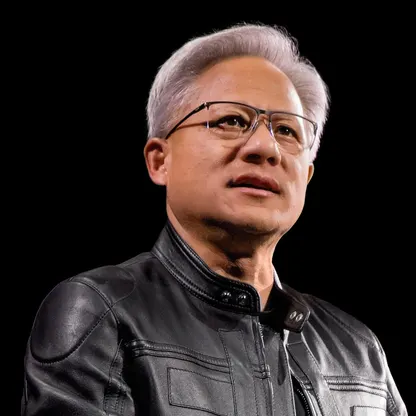
NextFin News - On December 3, 2025, NVIDIA founder and CEO Jensen Huang joined CSIS president and CEO John J. Hamre at the Center for Strategic and International Studies in Washington, D.C., for a fireside conversation titled "NVIDIA’s Jensen Huang on Securing American Leadership on AI." The hour-long discussion focused on the structure of the AI industry, U.S. competitiveness, China, industrial policy, energy constraints, and the societal impact of rapidly advancing AI technologies.
Huang spoke from the perspective of a company he described as a pure-technology platform and addressed policymakers and an expert audience about what it will take to retain and extend American leadership in the age of generative AI.
NVIDIA as a technology platform
Huang opened by defining NVIDIA's role: the company is a platform "built in layers" that others build upon. He described NVIDIA as "the largest pure play technology company the United States has ever seen" and emphasized that its product is "pure technology." He explained that the company's architecture, developed 25 years ago as CUDA, and the libraries and algorithms that sit on it are the connective language by which many AI applications are built.
"A platform is something that you build other things upon... Our final product is pure technology."
AI’s five-layer stack
Huang presented AI as a five-layer stack—energy, chips, infrastructure, models and applications—and used that framework to locate NVIDIA within the ecosystem. He emphasized the interdependence of these layers and warned that focusing on models alone misses the broader industrial requirements for AI to scale.
"Layer one is energy... layer two are essentially the chips... layer three is infrastructure... and then the models and applications above that."
Competition with China and Huawei
Responding to questions about global competition, Huang said China holds real advantages at several layers of the stack while the United States remains ahead in chip design. He noted China’s energy capacity advantage, its rapid infrastructure buildout, widespread open-source development and a vast pool of researchers. He described Huawei as "one of the most formidable technology companies the world has ever seen" and said that, because of export restrictions, NVIDIA has effectively been excluded from China—conceding a major market.
"At the moment we're simply not competing in China... we have conceded essentially the second-largest AI market."
Huang warned that open-source proliferation and rapid domestic scale in China accelerate their progress: "Without open source, startups can't thrive... China is well ahead, way ahead on open source."
Industrial policy and reindustrialization
Huang endorsed targeted industrial policy where "dramatic action needs to be taken," and praised initiatives to onshore manufacturing and build AI infrastructure. He said the current AI wave is precisely the opportunity to rebuild domestic manufacturing and supply chains, pointing to NVIDIA's efforts to build chip, supercomputer and AI factories in the United States and to partnerships with Taiwanese and Korean firms supporting onshoring.
"If we want to fix our social issues... we have to create prosperity for every segment of the economy. The largest segment is manufacturing and we've offshored that too long."
Energy and infrastructure constraints
Huang repeatedly described energy as a pacing constraint for AI buildout. He said the U.S. must accelerate power generation and infrastructure to enable chip fabs, system plants and AI data centers, and argued for a mix of solutions including behind-the-meter generation and an accelerated nuclear program. He quantified the mismatch between improving chip energy efficiency and the explosive growth in compute demand.
"Without energy how do we build chip plants... Every single one of them requires energy."
National security and technology diffusion
Huang drew a distinction between "small-s" national security (military capabilities) and a broader "large-S" national security rooted in economic dynamism, technology leadership and institutional strength. He argued the United States should safeguard sensitive technologies while also promoting American standards and diffusion so domestic industry retains first-mover advantages.
"We should... safeguard our national security... and then proliferate American technology standards, compete around the world, fuel this flywheel of funding our R&D."
Robotics and embodied AI
On robotics, Huang described how recent progress in generative video and perception demonstrates that translating pixel manipulation to motor control is imminent. He said embodied AI—putting models into mechanical systems—will enable robots that can perform physical tasks and that China and other manufacturing-heavy countries have structural advantages for rapid adoption.
"The idea that I can tell the robot 'pick up the cup' is clearly just around the corner."
Jobs, tasks, and the humanities
Huang urged a careful distinction between tasks and jobs: AI will automate many tasks but can augment and expand jobs. He cited radiology as an example where AI transformed the task of image interpretation while the number of radiologists and the scope of their work increased. He encouraged engagement with AI, saying tools can increase productivity while original human judgment and voice remain central.
"We have to think about these two words differently. One is task, the other one is job."
Closing: optimism and responsibility
Huang closed by expressing strong optimism about the coming decade, calling the present moment the best of times and urging policymakers to align industrial policy, energy growth and technology leadership to ensure American success. He described his personal affinity for the United States and the opportunity to explain how AI works to policymakers working to shape long-term consequences.
"A thousand percent. The best of days are ahead of us."
References
Event page and transcript: CSIS — NVIDIA’s Jensen Huang on Securing American Leadership on AI (event).
Transcript and analysis: CSIS — Transcript: NVIDIA’s Jensen Huang on Securing American Leadership on AI.
Explore more exclusive insights at nextfin.ai.


