
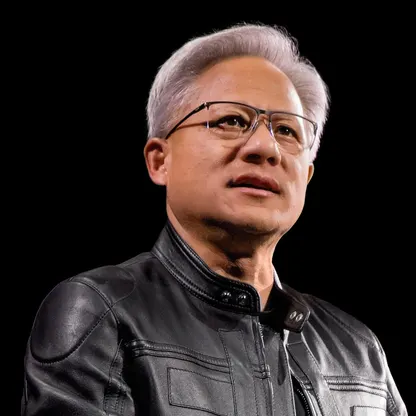

NextFin News - Recorded for the No Priors podcast and released in early January 2026, NVIDIA founder and CEO Jensen Huang sat down with hosts Sarah Guo and Elad Gil to take stock of where artificial intelligence stands and where it is headed. The conversation, recorded January 8, 2026, covers whether the current moment is a bubble, how AI will affect work and industry, and which fields are likely to see breakthrough, domain-specific AI first.
On the "AI bubble" and the shift to accelerated computing
Huang reframed the bubble question around capacity and the underlying shift in computing. He argued that even without today's high-profile chatbots, NVIDIA would remain a multibillion-dollar company because "the foundation of computing is shifting to accelerated computing." He cautioned listeners to look beyond the narrow chatbot narrative and to consider the broader set of AI uses. As he put it in the interview, If generative AI, well, excuse me, if chatbots... If none of that existed today, Nvidia would be a multiundred billion dollar company.
He emphasized that demand is outpacing infrastructure and that what many call an AI bubble is in fact a capacity problem: "they need factory capacity in order to increase their revenue growth."
On jobs, productivity, and new kinds of work
Huang approached job displacement with a supply-and-demand framing focused on labor shortages. Rather than predicting mass layoffs, he argued that increased productivity often creates new lines of business and more demand for skilled labor. "If Nvidia was more productive, it doesn't result in layoffs. It results in us doing more more things," he said. He pointed to persistent shortages in sectors such as factory work and truck driving and argued that automation can cover those gaps: "having robotic systems is going to allow us to cover the labor shortage gap which is really severe and getting worse because of aging population."
Huang also described the second-order jobs AI will generate: maintenance and service industries for fleets of embodied machines. "Look at all the maintenance crews ... just imagine, we have a billion robots. It's going to be the largest repair industry on the planet," he said, using the rise of robo-taxis as an example of new operational ecosystems and personnel needs that will emerge alongside automation.
On "God AI" and the limits of monolithic models
Huang pushed back on alarmist timelines for a single, all-capable intelligence. He acknowledged the abstract possibility—"I guess someday we will have God AI"—but placed that idea far beyond practical sight: "that someday is probably on biblical scales, you know, I think galactic scales." He contrasted that distant hypothetical with today's engineering reality: I don't think any company practically believes they're anywhere near God AI. And nor do I see any researchers having any reasonable ability to create god AI.
For Huang, the more useful view is a diverse ecosystem and a full technology stack capable of delivering many specialized capabilities rather than one monolithic crown-jewel model.
On sectors likely to have their own "ChatGPT moment": digital biology
Huang identified digital biology as a field approaching its generative-AI inflection. He pointed to advances in multi‑protein understanding and generative models for molecules and chemicals. "Protein understanding is advancing very quickly now. Protein generation is going to advance very quickly," he said, noting internal work on multi-protein models and representation learning. He described the convergence of multimodality, long context, and synthetic data generation as the technical ingredients that will produce a "ChatGPT moment for digital biology."
On physical AI, reasoning systems, and robotics
Closely related to digital biology, Huang emphasized that adding reasoning, memory, and long-horizon planning moves AI from passive software toward agents that can act in the world. He forecasted improvements in autonomous vehicles and embodied robots driven by those capabilities: "because of reasoning, cars are going to be able to perform better... these cars are going to be thinking all the time." He suggested reasoning systems will address out-of-distribution situations by breaking new events into familiar components and constructing solutions: "the out of distribution part of AI is going to very much be addressed by reasoning systems." He expects large breakthroughs in human-scale robots and multimodal vision-language-action models that combine perception, generation, and planning.
On the technology stack and the role of open ecosystems
Throughout the discussion Huang returned to the idea that AI is a layered industry: accelerated computing hardware, memory and wafers, model capacity, simulation and data, and application-level engineering. He warned against thinking of AI as a single model or single vendor advantage, and urged attention to the entire stack as the locus of sovereign or competitive advantage: "the American advantage is actually... in the whole stack. right the capability to deliver any piece of it."
Closing practical note
Huang urged a grounded, practical approach to AI policy and discussion. He discouraged extreme narratives that either fetishize an imminent all-powerful intelligence or paralyze investment with end-of-the-world framing. "We don't need to wait around for some mythical god AI to show up before things start changing in very real ways," he said, calling instead for common-sense focus on capacity, safety through engineering, and the many near-term, domain-specific opportunities for AI to improve economic outcomes.
References:
Business Insider coverage of Jensen Huang's No Priors interview
Explore more exclusive insights at nextfin.ai.
