
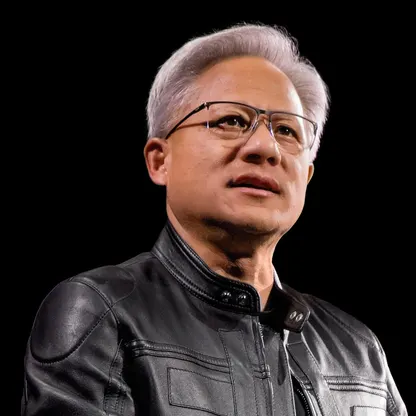

NextFin News - At the World Economic Forum Annual Meeting in Davos, Switzerland, NVIDIA founder and CEO Jensen Huang joined Laurence D. (Larry) Fink, Chair and CEO of BlackRock and Co‑Chair of the Forum, for a conversation in the Congress Hall on 21 January 2026. The session, scheduled for 11:30–12:00 CET, framed AI as a transformative platform and focused on infrastructure, models, applications and the impact on jobs and regions. (linkedin.com)
AI as a platform shift
Huang began by asking the audience to reason from first principles and to see AI as a platform shift comparable to the PC, the internet and mobile cloud. In his words, "this is a platform shift" because new applications will be built on top of AI in the same way they were built on earlier computing platforms. He emphasized that while consumers experience AI through applications such as ChatGPT, those are only the beginning: "very importantly new applications will be built on top of chat GPT... and so it's a it's a platform shift in that way."
The five‑layer stack: energy, chips, cloud, models and applications
To explain the industrial nature of AI Huang described it as "essentially a five layer cake." He listed the layers and their roles: energy at the bottom; chips and computing infrastructure above that; cloud and cloud services; the AI models layer; and, at the top, the application layer where economic value will be realized. He urged listeners to remember that "in order for those models to happen, you have to have all of the layers underneath it."
"AI is essentially a five layer cake. At the bottom is energy... chips and computing infrastructure... the cloud... the AI models... but the most important layer... is the application layer above that."
Largest infrastructure buildout in human history
Huang argued that the reinvention of the computing stack has triggered a global infrastructure effort. He stated that the world is already a few hundred billion dollars into the buildout and that "there are trillions of dollars of infrastructure that needs to be built out." He described chip fabs, computer factories and AI factories being built worldwide, cited investments in memory and foundry capacity, and used the phrase "the largest infrastructure buildout in human history" to characterize the scale of what he sees as necessary to power AI at scale.
Advances in models: grounding, agents and open models
Huang identified three major model‑layer developments in the prior year. First, he said models became better grounded and more capable of step‑by‑step reasoning, producing fewer hallucinations and performing research‑level tasks. Second, he pointed to the emergence of open reasoning models — naming the launch of such open models as a milestone that enabled industry, research and education to build domain‑specific systems. Third, he highlighted the growth of "agentic AI," language models that act as systems capable of reasoning and planning.
"Last year we saw the evolution of language models becoming AI systems that we call agentic systems... The second major breakthrough is the breakthrough of open models."
Physical intelligence and real‑world applications
Huang said the third breakthrough was progress in what he called "physical intelligence" — AI that understands the physical world, including proteins, chemistry and physics. He noted that these models are learning the structures and "languages" of domains such as proteins and fluid dynamics, enabling advances in manufacturing, drug discovery and scientific research. Huang cited a partnership with Eli Lilly as an example of how AI's understanding of molecular structure can accelerate discovery.
Dispersion into industries: healthcare, manufacturing, robotics
Pointing to the application layer as the source of economic benefit, Huang explained that AI applications will emerge across financial services, healthcare, manufacturing and robotics. He said that because the top layer sits on all the infrastructure beneath it, investments are flowing into AI‑native companies across industries, and that those applications — not just the models — will deliver the bulk of economic value: "This application layer could be in financial services, it could be in healthcare, it could be in manufacturing. This layer on top ultimately is where economic benefit will happen."
Jobs and the "purpose versus task" framework
Responding to concerns about displacement, Huang framed the question as one of purpose versus task. He illustrated the idea with radiology: while computer vision has automated scanning tasks, radiologists' purpose — diagnosing disease and caring for patients — has been enhanced. He argued that automation of tasks can increase throughput, raise hospital revenues and lead institutions to hire more clinicians. He used nursing as another example, saying AI can reduce charting burdens so nurses spend more time with patients and hospitals can serve more people.
"If you reason about what is the purpose of the job and what is the task of the job... the purpose is enhanced and made more productive because the task has been automated."
Huang also emphasized trade and construction jobs created by the infrastructure buildout: "It's wonderful that the jobs are related to tradecraft... plumbers and electricians and construction and steelworkers... we're talking about six‑figure salaries for people who are building chip factories or computer factories or AI factories."
Developing countries, accessibility and closing the technology divide
Huang urged nations to treat AI as part of national infrastructure. He advised governments to build AI infrastructure, adapt open models to local languages and cultures, and use local expertise to create useful, domain‑specific systems. He argued that AI's ease of use and abundance make it well placed to narrow rather than widen the technology gap: "AI is super easy to use... recognize that AI is likely to close the technology divide."
Europe, industry and robotics
Addressing the European audience, Huang highlighted Europe's strong industrial and scientific base as fertile ground for physical AI and robotics. He advised European firms and governments to invest in energy and infrastructure so they can "fuse your industrial capability, your manufacturing capability with artificial intelligence" and seize what he described as a once‑in‑a‑generation opportunity for robotics and industrial automation.
On the question of an AI bubble and investment
Asked about bubble concerns, Huang said the scale of investment reflects necessary infrastructure spending and model maturity. He offered a market signal: GPU rental spot prices are rising — even for older generations — which he interprets as evidence of sustained demand. He closed by urging broad participation in the investment opportunity, particularly through infrastructure that pension funds and savers can access: "Infrastructure is a great investment option... this is the single largest infrastructure buildout in human history."
References and further viewing
Video: "Conversation with Jensen Huang, President and CEO of NVIDIA" (World Economic Forum, Davos, 21 January 2026) — watch the session via the World Economic Forum livestream and video pages. (weforum.org)
Related coverage and session listings: World Economic Forum — Live from Davos 2026 (Day 3), The Guardian — Davos live coverage (21 Jan 2026), The Washington Post — WEF coverage (21 Jan 2026), Event schedule listing (21 Jan 2026), Yahoo Finance — session video and excerpt.
Explore more exclusive insights at nextfin.ai.
