
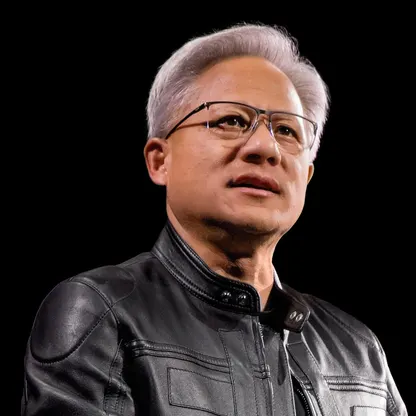
NextFin News - The conversation between Jensen Huang, founder and CEO of NVIDIA, and Elon Musk, founder of xAI, Tesla and SpaceX, took place at the U.S.–Saudi Investment Forum at the John F. Kennedy Center for the Performing Arts in Washington, D.C., on November 19, 2025. The session was moderated by Saudi Minister of Communications and Information Technology Abdullah Alswaha and appeared as part of a broader agenda of panels and announcements tied to the Crown Prince's visit and a new Saudi–U.S. AI strategic partnership. (reuters.com)
AI as national infrastructure
Jensen Huang repeatedly described AI as foundational infrastructure for nations and industries. He argued that digital intelligence will be "used by every company, every industry, every country," and that this pervasiveness makes AI part of a nation's infrastructure. Underlining a technical shift, Huang contrasted past "retrieval‑based" computing with today's generative models, saying that "today software is going to be generated in real time" and that this real‑time, context‑sensitive generation is a new mode of computation. In his words, the change from retrieving prebuilt artifacts to generating unique outputs for each prompt requires global "AI factories" to deliver that generation at scale.
It used to be retrieval‑based. Today it's generative and if it's generative then ... you need AI factories all over the world to generate the content in real time.
Work, productivity and the future of jobs
When asked about the future of employment, Elon Musk offered a long‑range prediction: that work could become "optional," likening future work to a hobby such as gardening or playing sports. Musk set a speculative horizon of 10–20 years for what he called the long term and suggested that continued progress in AI and robotics might make currency and traditional constraints on labor less relevant over time.
My prediction is that work will be optional.
Jensen Huang pushed back on simple narratives of job loss, arguing that AI will change how people work rather than simply eliminate roles. He used radiology as a concrete example: rather than reducing demand for radiologists, AI‑accelerated radiology has enabled radiologists to study more images, treat more patients and, in fact, led to more hiring in that specialty. Huang emphasized that greater productivity often leads to new ideas and new work: "we have so many ideas we want to pursue... if we were more productive, we can get to those things faster."
Productivity, new value pools and examples from healthcare and nanotech
Huang illustrated his point with two Saudi research examples highlighted by the moderator: an AI‑accelerated discovery in metal‑organic frameworks for water capture and carbon capture, and a nanorobot project for gene editing aimed at treating sickle cell disease. He stressed that both began as long‑running research efforts and that AI compressed timelines and opened new "value pools" by accelerating outcomes and bringing new applications into reach.
With AI... we can move into new value pools. Humanity is going to always manage to shift to new value pools when it comes to workforce and productivity.
Partnerships, data centers and the 500‑megawatt announcement
The session included a set of concrete infrastructure announcements. Elon Musk said xAI will build a large‑scale data center project in Saudi Arabia, describing plans for an initial 50‑megawatt phase and a longer‑term 500‑megawatt ambition hosted in partnership with HUMAIN and NVIDIA. Jensen Huang described NVIDIA's broader collaboration with HUMAIN — including Omniverse digital twins, sovereign AI deployments and supercomputers intended to support simulations and quantum error‑correction workloads — and noted AWS's involvement in related projects.
These infrastructure plans were reported alongside the forum's broader announcements about Saudi investment commitments and the creation of an "AI Zone" in Riyadh that would host large numbers of AI accelerators and data center capacity. (nvidianews.nvidia.com)
The shift to accelerated computing and Huang's view on an "AI bubble"
Huang framed the technological context as a long‑running shift from general‑purpose CPUs to accelerated computing on GPUs and specialized accelerators. He cited the dramatic change in the supercomputing landscape — noting that CPUs once dominated the top supercomputers and that the industry has moved to accelerated architectures — and argued that understanding that underlying shift changes how one should think about AI economics and investment cycles.
If you take into consideration the movement of computing from general purpose to accelerated computing... you'll come to the conclusion that in fact what is left over to fuel that revolutionary agentic AI is not only substantially less than you thought.
When asked whether there is an AI bubble, Huang warned listeners to think from first principles about computing demand, data‑processing workloads, recommendation systems and the layered emergence of agentic AI. He described the present moment as an inflection toward accelerated computing rather than unsustainable hype. (The session ended before a longer Q&A due to the event schedule.)
AI in space
Musk described a long‑term vision for AI in space, arguing that to reach civilization‑scale levels of energy use and compute, solar‑powered AI satellites in deep space will be essential. He suggested such an approach could be more cost‑effective than ground‑based compute because of continuous solar exposure and simpler radiative cooling, and predicted that solar‑powered satellites could become the lowest‑cost way to run large AI workloads within a few years.
My estimate is that the cost effectiveness of AI in space will be overwhelmingly better than AI on the ground... not more than 5 years from now.
Closing remarks and tone of the conversation
The session combined high‑level forecasts with immediate commercial plans. Throughout, Huang emphasized practical engineering and the shifting architecture of computing, while Musk offered sweeping social and civilizational forecasts. The moderator and forum framed the discussion within broader U.S.–Saudi cooperation on AI infrastructure and investment. Several news outlets and organizational statements summarized the announcements and context following the forum. (reuters.com)
References
Video and coverage of the session and related announcements:
- Reuters — Elon Musk, Jensen Huang to talk AI at US‑Saudi investment forum (Nov. 19, 2025). (reuters.com)
- NVIDIA Newsroom — Saudi Arabia and NVIDIA to Build AI Factories (May 13, 2025). (nvidianews.nvidia.com)
- The National — AI and energy deals take shape at Saudi‑US business forum (Nov. 19, 2025). (thenationalnews.com)
- RealClearPolitics — Full video: Donald Trump, Elon Musk, Jensen Huang at Saudi‑US Business Forum (Nov. 19, 2025). (realclearpolitics.com)
- People — Elon Musk suggests AI will make work optional and money irrelevant (coverage). (people.com)
Note: The article above reports the speakers' statements as delivered during the forum and summarizes media and corporate announcements that followed the event.
Explore more exclusive insights at nextfin.ai.


