
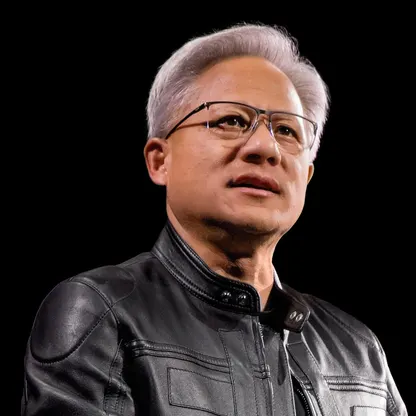
NextFin News - On Monday, December 1, 2025, Nvidia founder and CEO Jensen Huang appeared on CNBC’s "Squawk on the Street" following the company’s announcement that it had taken a $2 billion stake in Synopsys and expanded a long‑running partnership. The interview, conducted on CNBC’s Squawk on the Street with hosts from the program, took place in the morning broadcast of the show and accompanied the companies’ joint disclosure about a broader collaboration to co‑develop GPU‑accelerated design and engineering tools.
The conversation focused tightly on the technical and market significance of the collaboration, and on Nvidia’s long‑term view of how accelerated computing and AI will reshape design, engineering and industrial software. Below are Jensen Huang’s core statements and descriptions from the interview, organized by topic.
Partnership and its significance
Huang opened the discussion by framing the agreement as a major milestone. As he put it succinctly about the announcement, This is a huge deal.
He described the partnership as one that is intended to "revolutionize one of the most compute‑intensive industries in the world: design and engineering."
"The partnership we're announcing today is about revolutionizing one of the most compute intensive industries in the world. Design and engineering."
Pivot to GPU acceleration and the software stack
Huang explained that Synopsys is "pivoting across their company" to move longstanding design and engineering tools from CPU‑only workflows to GPU‑accelerated implementations on Nvidia technology. He said the shift will be built on the NVIDIA software stack and highlighted specific building blocks the company will leverage: CUDA, physics‑aware AI and Omniverse.
"They're going to pivot the company to build on top of NVIDIA CUDA, physics, physical AI, as well as Omniverse so that we can revolutionize all of these tools ..."
From weeks to hours: simulation speed and scale
One of Huang’s central claims was that GPU acceleration, combined with the new software stack, will allow simulations that once took weeks to be completed in hours. He said that work historically run on CPUs can now be accelerated dramatically, enabling much larger, faster and more detailed digital simulations.
"We're able to do simulations at a speed and scale unimaginable in the past so that we could do basically the entire engineering work inside a computer in a digital twin before we have to build it at all."
Digital twins and inventing at speed
Huang repeatedly returned to the concept of the digital twin — creating full engineering and design work inside a computer — as the transformative outcome of the collaboration. He argued that the combination of GPU speed, AI that obeys physics and new simulation tools will change what products can be invented and how quickly engineering teams can iterate.
"So the type of products we can invent and the quality that we can do and the speed that we could do it at is going to be extraordinary."
Expanding the market for accelerated computing
Huang described the collaboration as an expansion of Nvidia’s addressable market into the world of design and engineering for the first time at scale. He said the work will expand the total addressable market (TAM) for computing because it brings GPU‑accelerated workflows into industries that until now relied on CPU‑based tools.
"This is going to expand the market of computing into the world of design and engineering. For the very first time. This partnership is going to be revolutionary for that entire industry, expanding their TAM, expanding the capabilities."
Years of groundwork and software development
Huang emphasized that the announcement did not spring from a single moment but was the culmination of years of engineering. He said Nvidia has spent significant time building the software stack necessary for the electronic and system design automation industries to take advantage of GPU acceleration.
"It's taken this long for us to create the software stack necessary for Synopsys and the rest of the EDA industry and SDA industry in order for them to accelerate the software that they've historically only ran on CPUs."
Physics‑aware AI and industrial complexity
Huang stressed that the AI work in this context is not generic consumer‑oriented models but what he called "physics physical AI" — AI that respects the laws of physics and interacts with the physical world. He noted that this class of work is complex and required time to develop.
"This is a physics physical AI. This is AI that obeys the laws of physics, that AI that interacts with the physical world. This is extremely complex stuff."
Enterprise scale versus consumer applications
During the exchange Huang reinforced the idea that enterprise use cases demand far greater scale than consumer applications. He urged a shift in thinking from consumer chat‑style deployments to large enterprise infrastructure, arguing that the new workloads and simulations will be measured in an order of magnitude larger requirements.
"You better start thinking enterprise. Enterprise is you are using a number that is ten times the size of what I was thinking about."
References and related materials:
Reuters — Nvidia takes $2 billion stake in Synopsys (Dec 1, 2025)
Business Insider — Nvidia just made a $2 billion investment in Synopsys (Dec 1, 2025)
iHeart — Squawk on the Street: Exclusive with Nvidia CEO Huang and Synopsys CEO (Dec 1, 2025)
Squawk on the Street — program information (CNBC)
Explore more exclusive insights at nextfin.ai.


