
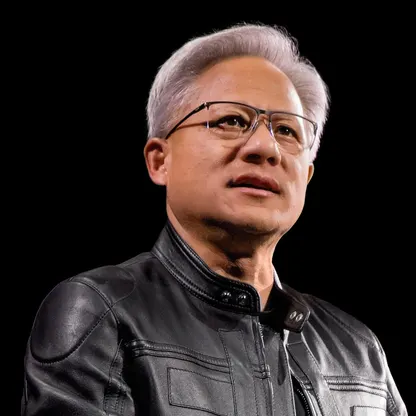

NextFin News - Jensen Huang, founder and chief executive of Nvidia, spoke at a Weiya (year‑end) banquet in Taipei during his latest visit to Taiwan. The gathering — held as part of Nvidia’s end‑of‑year and Lunar New Year celebrations — doubled as an opportunity for Huang to thank employees and local partners and to preview a busy set of partner meetings and dinners he planned for the weekend. The visit coincided with recent government approval of Nvidia’s investment plans for a Taiwan headquarters and wider outreach to Taiwanese partners, underscoring the company’s deepening ties to the island’s technology ecosystem.
The remarks in this article are drawn from Huang’s on‑stage comments and a short Q&A at the banquet, when he addressed employees and guests and responded to questions about partnerships, product work and Nvidia’s operations in Taiwan.
Arrival, mood and purpose of the visit
Huang opened by describing the occasion as personally meaningful and celebratory. He told those gathered that he was "feeling great" and that the event was "one of my favorite things all year," framing the banquet as both a New Year celebration and an expression of thanks to the teams that supported Nvidia’s work over the past year. He said the gathering was meant to recognize "the amazing work from last year" and to celebrate with employees and partners who have been "very supportive" of Nvidia’s expansion in AI.
Meetings and schedule in Taiwan
Huang summarised his short itinerary, noting he had already had several engagements and expected more over the weekend. He said he had met partners for dinner, referenced seeing Morris (Morris Chang) with pleasure, and described an employee meeting at Nvidia’s new office in Nankang. Reflecting on the days ahead he said, "this next couple of days, today's Friday... Saturday and Sunday I have partner dinners and I have some partner meetings," and that he was "very, very grateful" that partners could meet him over the weekend.
MediaTek collaboration and the N1 process rumor
Asked directly about reported cooperation with MediaTek on an N1 process product, Huang confirmed a partnership with MediaTek, describing the work as building "a very powerful SOC". He characterised the design as "low power but very powerful" and said it was "designed for computers with very strong artificial intelligence," adding that "the applications are quite many."
How Nvidia’s chip portfolio has expanded
Huang emphasised that Nvidia’s engineering and product scope in Taiwan had broadened significantly. He described how the company once focused on a single product class but has since diversified. "We used to build just GPUs but now we build networking chips, switch chips and two different types — we build smart data processors for storage and networking, we also build CPUs," he said, noting that the number of chip types the company designs "went from one to now seven."
Engineering scale and the nature of modern GPUs
Explaining why the expanded product set demands more local engineering and partner support, Huang observed that today's GPUs are not simply graphics chips but entire supercomputing platforms. In his words, "people think that Nvidia builds GPUs which is true. But our GPUs today are supercomputers and these supercomputers require so many partners here." He connected that technical scale to the need for a wide supply chain and many engineers, saying "we need a lot of engineers" and that Nvidia's growth required building many "complicated systems." He framed Taiwan as the start of Nvidia’s supply‑chain and ecosystem, calling the island a critical partner in the company's broader ambitions.
Gratitude to partners and employees
Throughout his remarks Huang repeatedly thanked local partners and employees for their support. He said he was "very grateful" for the help Taiwan partners provided as Nvidia rolled out new products and helped many companies adopt artificial intelligence. He praised employees for working "very hard" and emphasised the evening’s purpose as a celebration of that collective effort.
Event tone and closing
The tone at the banquet was informal and celebratory. Huang exchanged greetings, accepted invitations to multiple dinners and highlighted his pleasure in reconnecting with longstanding industry figures. He closed the on‑stage portion by indicating he would take a couple more questions before moving on with the evening, reinforcing the personal and appreciative nature of the visit.
References:
- MOEA approves Nvidia HQ investment on eve of Jensen Huang visit — Focus Taiwan (Jan. 28, 2026)
- ‘Beitou Shilin’ announced as new Nvidia office site — Taipei Times (May 19, 2025)
- Nvidia CEO Huang unveils host of AI tech, new Taiwan hub during Computex keynote — Investing.com
Explore more exclusive insights at nextfin.ai.
