
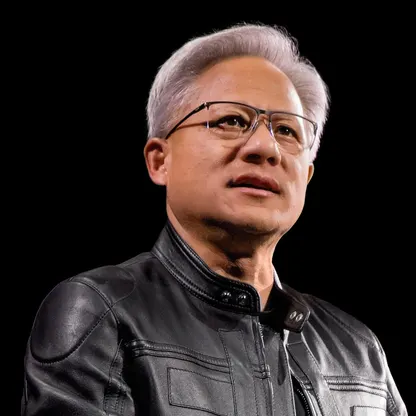

NextFin News - On January 6, 2026, following his keynote at CES in Las Vegas the previous day, NVIDIA founder and CEO Jensen Huang spoke with Bloomberg about autonomous driving and the industry’s competing approaches. The exchange—conducted with Bloomberg’s program shortly after Huang’s CES presentation—focused on how NVIDIA’s platform compares with Tesla’s Full Self-Driving (FSD) stack and on the technical trade-offs between end-to-end vision systems and multi-sensor designs.
Huang’s remarks were concise and pointed: he acknowledged Tesla’s achievements, described technical similarities and differences between the two companies’ approaches, and urged continued progress while flagging the challenge represented by rare, hard-to-solve driving scenarios.
Assessment of Tesla’s autonomy stack
Asked about Elon Musk’s response to Huang’s CES keynote and the broader comparison between NVIDIA and Tesla approaches, Huang offered unequivocal praise for Tesla’s work. He stated plainly that, in his view, Tesla’s software and operations lead the field. As he put it in the interview:
I think the Tesla stack is the most advanced AV stack in the world. And I think the Tesla AV operations is the most advanced in the world.
Huang framed that assessment as a recognition of Tesla’s overall engineering and operational capabilities rather than a technical critique.
On end-to-end AI and the role of reasoning
Huang said he believes Tesla has already embraced an end-to-end AI approach. He emphasized the practical importance of that architectural choice, and he downplayed debates about whether Tesla’s models perform explicit “reasoning” as secondary to the fact of end-to-end training and deployment:
I'm fairly certain that they were already using end-to-end AI, and whether their AI did reasoning or not is somewhat secondary to that first part.
In other words, Huang positioned the adoption of end-to-end learning as the central technical milestone, with internal differences in model style considered less decisive by comparison.
Sensor strategy: vision-first versus multi-sensor
When asked about the practical difference, on a dollar-per-mile basis, between NVIDIA’s stack and Tesla’s vision-based strategy, Huang stressed similarity at the high level while noting additional sensors in NVIDIA’s reference designs. He described NVIDIA’s approach as also vision-based but augmented by other sensing modalities:
Ours is also vision-based. Of course, we have, in addition to vision, we also have radar and LiDAR.
Huang presented that distinction as a deployment and redundancy choice rather than a fundamental divergence in the role of vision and learned models.
The long tail and the difficulty of rare events
The interview touched on the engineering challenge posed by rare driving scenarios—the so-called long tail. Huang acknowledged the difficulty and accepted the point raised by his interviewer about the challenge beyond the first 99 percent of performance. While conceding the problem’s seriousness, he kept the focus on continuing development and refining systems to handle those rare cases.
Encouragement rather than critique
Throughout the exchange Huang avoided public criticism. Instead he framed Tesla’s approach as state-of-the-art and encouraged continued progress. He closed his remarks with an explicit note of support:
I think Elon's approach is about as state-of-the-art as anybody knows of autonomous driving and robotics. It's a stack that's hard to criticize. I would not criticize it. I would just encourage them to continue to do what they're doing. They're doing a great job.
That endorsement came in the context of Huang describing NVIDIA’s own work at CES—where he presented NVIDIA’s Rubin platform, Alpamayo models and other advances—but the remarks were narrowly focused on recognizing Tesla’s technical achievements and operations.
References
Video and coverage of the interview and Huang’s CES keynote are available from the following sources:
Bloomberg — Balance of Power (January 6, 2026)
NVIDIA Blog — CES 2026 special presentation (January 5, 2026)
Transcript: NVIDIA at CES 2026 (Rev)
Explore more exclusive insights at nextfin.ai.
