
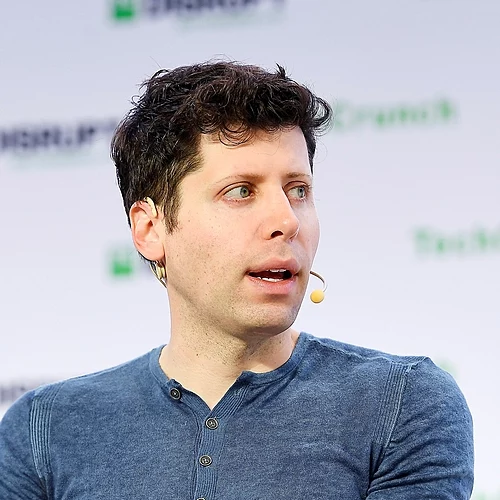
NextFin News - OpenAI chief executive Sam Altman spoke with Teraflow in a short-format interview posted to the Teraflow channel. The video does not list a recording date or location; the following article presents Altman’s core statements as delivered in that conversation.
Economic threshold and practical utility
Altman opened by saying the industry has passed a critical inflection point in the usefulness of large models. In his words, "we really have crossed a threshold into major economic utility of these models."
He qualified that observation by noting there had been an earlier overhang — models were improving, but their practical adoption lagged until the community built the right tooling and workflows to make them easy to use.
From technical astonishment to real work
Altman described how models are already astounding people across different fields. He singled out coding as an area where the change is most noticeable, but made clear that the effects are broad: "it's also happening in science. It's happening in many fields of knowledge work sort of with disorienting speed"
. That astonishment, he said, has led people to shift from performing direct technical or legal tasks toward overseeing agents that perform those tasks.
Managing teams of agents
One of Altman’s central points was that the nature of work is shifting: instead of doing hands‑on technical work, managers and practitioners will increasingly supervise agents. He described that change as a movement from individual execution to management of autonomous systems: "my job shifted from doing you know direct technical work or legal work to managing a team of agents doing this work."
Short timeline: multi‑hour to multi‑week, then always‑on agents
Altman laid out a near‑term progression for agent capability. He argued that trust in agents will broaden rapidly: where today one might trust an AI software engineer to complete a multi‑hour assignment, "very soon it'll be a multi‑day task and then a multi‑week task."
He then projected a further paradigm shift in which agents become continuously integrated with a person’s life or a company’s systems: "not long after that I think the paradigm will shift again and it'll feel like these AI systems are just connected to your life to your company whatever proactively thinking working all the time and having full context on whatever they need to and just sort of doing stuff like you would trust a senior employee to"
.
Implications for trust and context
Throughout the conversation Altman emphasized the importance of context and continuous operation. The model of an agent that can be trusted over longer time horizons, he suggested, depends on agents having persistent access to the information and tooling they need to act autonomously. He repeatedly returned to the idea that the combination of smarter models and better "plumbing" is what turns technical breakthroughs into dependable economic tools.
Where the change is most visible
When asked for concrete examples, Altman pointed to software engineering as the clearest early use case but insisted the phenomenon is spreading. He said the shift is visible across domains and noted that the speed of progress can feel disorienting, because many capabilities people assumed were years away are arriving now.
Closing remarks from the interview
Altman closed the segment by reiterating the compression of timelines and the steady march toward agents that can be relied on for extended, complex work. The sequence he described — multi‑hour, multi‑day, multi‑week, then always‑on integration — was presented as an inevitable progression driven by model improvements and better integration tooling.
References and further reading
Teraflow (channel and company page): https://www.teraflow.ai/
Coverage of Sam Altman's statements on AI agents and the workforce: Axios – OpenAI CEO Sam Altman says AI agents will enter workforce (Jan 2025)
Reporting on Altman’s agent predictions in developer and tech press: India Today – AI agents will soon do everything software engineers with few years of experience do (Feb 10, 2025)
Analysis of Altman’s remarks at recent events and their implications: Snowflake Summit coverage and analysis (2025)
Video source: Teraflow channel video titled "Sam Altman: AI Agents Will Soon Handle Multi-Week Work" (publish date not specified in the video description).
Explore more exclusive insights at nextfin.ai.


