
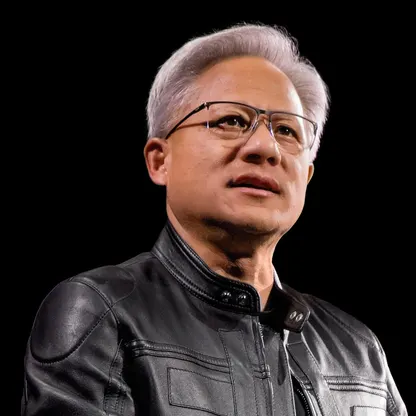
NextFin News - Jensen Huang, founder and CEO of NVIDIA, spoke briefly with John Furrier of theCUBE backstage at the Global Semiconductor Alliance (GSA) Awards Celebration. The interview took place following the awards ceremony held at the Santa Clara Convention Center on December 4, 2025, where NVIDIA was recognized as the Most Respected Public Semiconductor Company.
In a concise conversation captured by theCUBE, Huang discussed how artificial intelligence is changing the very definition of computing, the role of data centers, and the scale of opportunity unfolding for the semiconductor industry.
Reinventing computing
Huang opened by framing the moment as a foundational shift in how computers operate and how software is delivered. As he put it, "We're reinventing computing as we know it."
He contrasted the traditional model — "general purpose computing, software written by engineers, pre-computed, distributed as binaries"
— with the new reality in which intelligence is generated dynamically and in real time.
AI data centers as "intelligence factories"
Central to Huang's description was the concept of AI data centers as what he calls "intelligence factories"
. He explained that these facilities are not merely bigger or faster versions of existing data centers but are systems that "are generating intelligence in real time."
He said these computers will produce "tokens, but intelligence for all kinds of different applications, all kinds of different use cases for billions of people and for many industries."
"What's important now is that we're creating these what we call AI data centers, but essentially intelligence factories that are generating intelligence in real time."
Distributed computing: from centralized factories to the edge
Huang described a distributed future in which intelligence is produced across a spectrum of systems. He noted, "Sometimes they're centralized. We call them AI factories. Sometimes they'll be distributed — that would be at the edge."
He added that in some cases processing could happen entirely within devices themselves, offering the example of robotic systems where computation is completed in real time on the machine.
Modernizing the tech stack after 60 years
Emphasizing the depth of the change, Huang said the industry is modernizing "every single layer of the tech stack for the first time in literally 60 years."
He pointed to the historic integration of computers into society and industries and argued that the coming decade will bring comprehensive modernization across hardware and software.
Scale and opportunity for the semiconductor industry
On the scale of the business opportunity, Huang was emphatic: "The number of computers, the number of these factories that we have to build around the world is going to be extraordinary."
He characterized the current moment as an unprecedented market for chipmakers, calling it "the largest semiconductor opportunity in history."
He linked the technological shift directly to very large growth potential for semiconductor suppliers and ecosystem participants over the next decade.
Community and industry impact
Responding to remarks about the community at the awards, Huang affirmed his enthusiasm for the industry gathering, describing his state simply as "completely fired up."
He acknowledged the role of employees, customers and partners in the broader industry transformation and voiced appreciation for the recognition given to companies and individuals at the GSA event.
Below are references to the GSA event and theCUBE coverage where this backstage interview was recorded.
References: GSA Awards 2025 — Event page, GSA press release — 2025 award recipients (Dec. 4, 2025), SiliconANGLE / theCUBE coverage: Jensen Huang interview (GSA Awards).
Explore more exclusive insights at nextfin.ai.


